
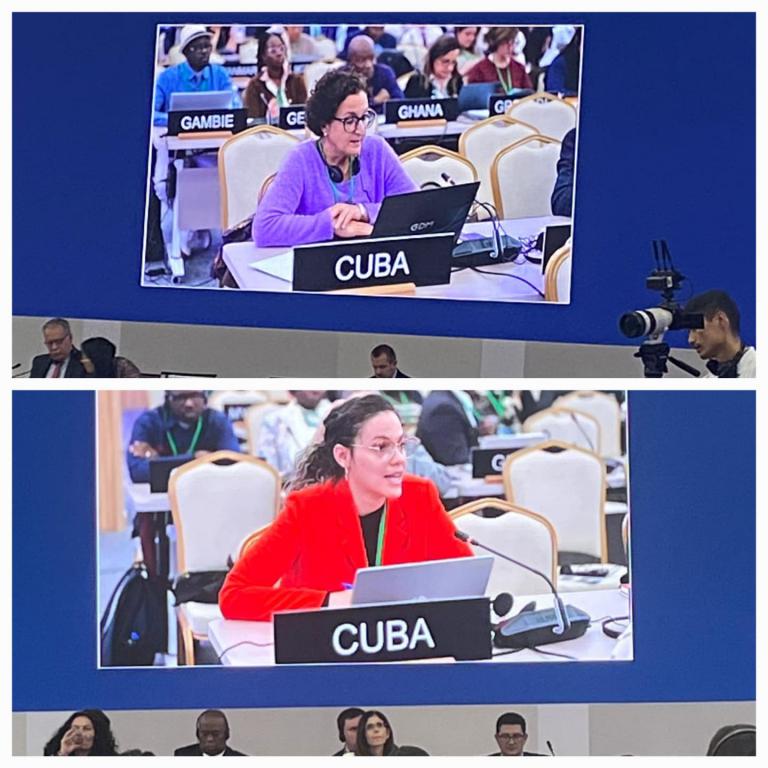
Paris, 15 November 2025.– The Cuban delegation participating in the 43rd UNESCO General Conference, held in Samarkand, Uzbekistan, systematically denounced, across the various Commissions and meetings convened during the Conference, the impact of the intensified economic, commercial and financial blockade imposed by the Government of the United States against Cuba, as well as the consequences of the country’s inclusion on the unilateral list of States allegedly sponsoring terrorism.
The delegation, composed of Dulce María Buergo Rodríguez, President of the Cuban National Commission for UNESCO, and Laura Álvarez Delgado, Third Secretary of the Permanent Delegation of Cuba to UNESCO, underscored that these unilateral, punitive and illegal measures constitute a structural obstacle to the country’s development and directly affect all areas falling within the Organization’s mandate.
Referring to the national situation, the Cuban delegation recalled that Cuba has faced a blockade for more than six decades, resulting in severe limitations on access to financial, technological and scientific resources. This scenario has been further aggravated by Cuba’s inclusion on the aforementioned unilateral list and by the recent impact of Hurricane Melissa in the eastern region of the country.
In the field of education, during debates held within the Education Commission and the High-Level Steering Committee for SDG 4 – Education 2030, the delegation denounced that between March 2024 and February 2025 the blockade caused estimated damages of USD 89.7 million to the Cuban education system. These impacts include the inability to produce millions of textbooks, shortages of specialized materials and equipment, and restrictions on access to virtual platforms and essential digital technologies for teaching, constituting a direct violation of the Cuban people’s right to education.
The delegation also warned of the limitations faced by Cuban scientists in accessing international databases, repositories and mechanisms for the exchange of scientific information and results, as well as the restrictions imposed on cooperation in areas such as open science, artificial intelligence and technological innovation.
In debates related to culture, sport and communication, the Cuban delegation highlighted the negative impact of the blockade on the development of cultural and creative industries, heritage protection, the implementation of cultural cooperation programmes — including the Transcultura Programme — as well as equitable access to digital platforms and communication tools. In the field of sport, it denounced how these measures hinder the acquisition of equipment, technical exchange and participation in international projects promoted under UNESCO’s auspices.
During the review of the internal services component, Cuba drew attention to the restrictions faced by some Member States in accessing digital platforms used by the Organization to complete questionnaires, application forms and periodic and evaluation reports, due to internal policies of service providers that de facto apply the provisions of the United States blockade. The delegation described this situation as unacceptable for a universal intergovernmental organization.
At the 12th Interregional Meeting of National Commissions for UNESCO, Cuba reiterated that, despite these adverse impacts, it continues to work actively in areas of interest such as UNESCO Associated Schools and Chairs networks, Global Geoparks and Biosphere Reserves, cultural and creative industries, science, education and communication, in close cooperation with the Organization and with countries of the Global South.
The Cuban delegation reaffirmed that the United States blockade and associated unilateral coercive measures not only undermine international cooperation, but also constitute a massive, flagrant and systematic violation of the human rights of the Cuban people. In this regard, it reiterated Cuba’s firm commitment to multilateralism, solidarity-based cooperation and to an inclusive UNESCO, free from political pressure and faithful to its founding principles.