
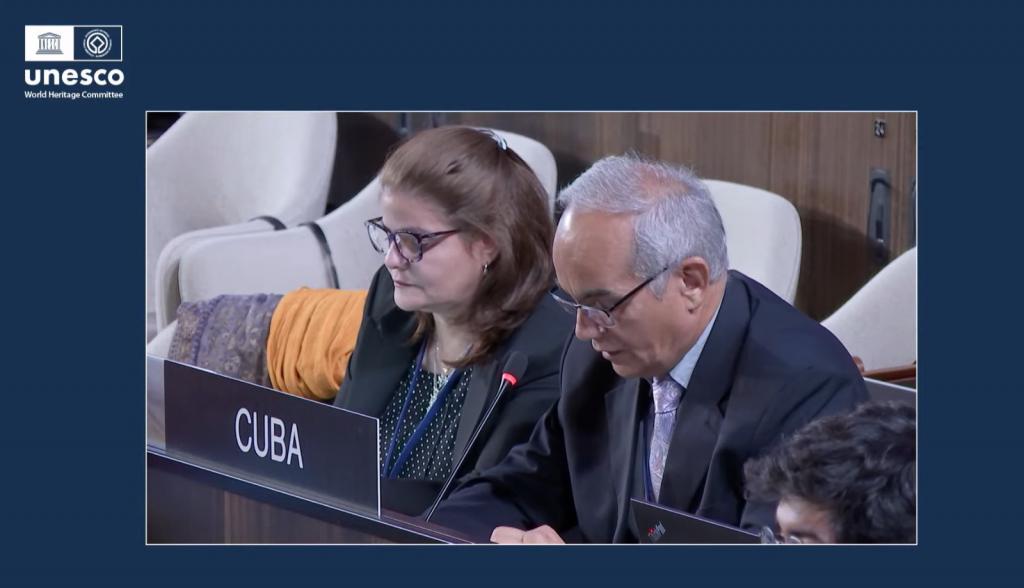
Paris, 8 July 2025. Within the framework of the 47th Session of the UNESCO World Heritage Committee, the Cuban delegation took the floor during the agenda item devoted to reviewing progress in support of Small Island Developing States (SIDS), highlighting the country’s efforts in climate change mitigation and adaptation, particularly in response to sea level rise.
The statement, delivered by Nilson Acosta Reyes, Vice President of the National Council of Cultural Heritage and Cultural Focal Point, emphasized that for the Caribbean region, “it is of particular importance to pay attention to the small island states in the field of cultural and natural heritage protection, and in this regard, we appreciate the priority of this issue on the session’s agenda.”
Cuba also reported on the preparation of the nomination dossier for the Cuban Caribbean Reef System, an initiative that will help increase the representation of island states on the World Heritage List, while promoting the conservation of highly biodiverse marine ecosystems threatened elsewhere by climate change and coral bleaching.
In his remarks, the Cuban representative highlighted the country’s experience in implementing the State Plan for Climate Change Adaptation “Tarea Vida”, through which Cuba has identified vulnerabilities and defined concrete mitigation and adaptation measures, integrated into the management plans of World Heritage properties.
He also acknowledged the Transcultura Programme, funded by the European Union and UNESCO, as an example of effective cooperation with tangible results in the region. Under this programme, Cuba completed the first phase of the restoration of the Convent of Santa Clara, which will host a training center for conservation and restoration professionals in the Caribbean.
During his intervention, Mr. Acosta also praised the Caribbean Biological Corridor, an initiative of five countries supported by the UN Environment Programme (UNEP) Regional Office for Latin America and the Caribbean and the European Union, which contributes to the conservation and management of terrestrial and marine biodiversity, ecological connectivity in key areas, and the promotion of sustainable development in a context of climate change.
Cuba reaffirmed its commitment to protecting the cultural and natural heritage of Small Island Developing States and its determination to continue strengthening international cooperation to address global challenges that threaten the preservation of humanity’s shared heritage.