
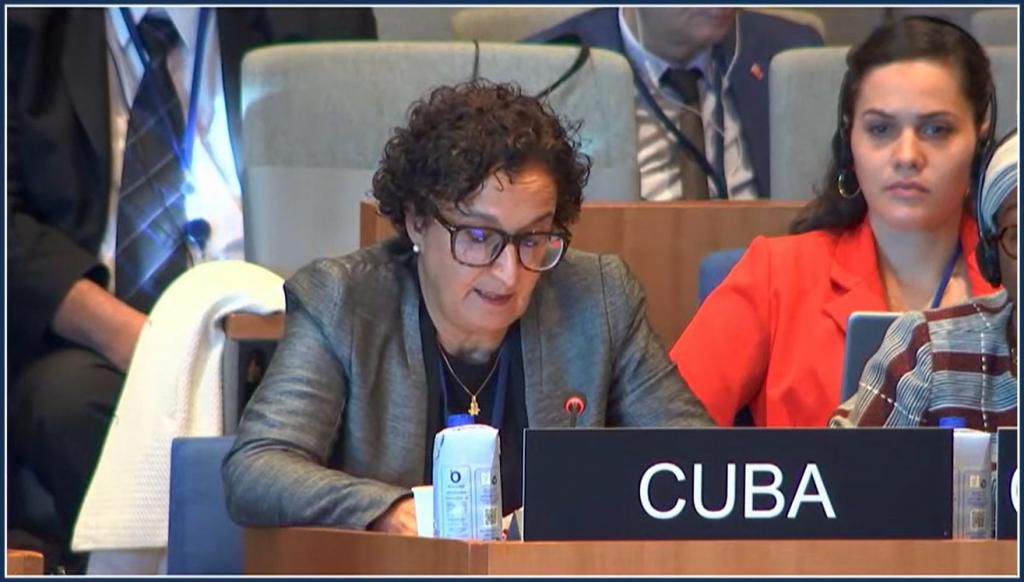
Paris, 7 October 2025. – Within the framework of the 222nd session of UNESCO’s Executive Board, the Representative of Cuba to this body, Ambassador Dulce María Buergo Rodríguez, President of the Cuban National Commission for UNESCO, intervened in the general debate to reaffirm Cuba’s firm commitment to peace, solidarity, international cooperation, and the strengthening of multilateralism, in line with the Organization’s mandate.
During her statement, the Cuban representative addressed the main challenges facing the multilateral system, denounced serious violations of International Law, underscored the urgency of a new, more just and inclusive international order, and highlighted the role that UNESCO can and must play in promoting sustainable development, a culture of peace, and international cooperation. She also referred to the impact of the economic, commercial, and financial blockade imposed by the United States against Cuba within the scope of UNESCO’s mandate, as well as to the country’s priorities and cooperation experiences promoted in coordination with UNESCO’s Regional Office in Havana.
The full text of the intervention of the Representative of Cuba to UNESCO’s Executive Board is reproduced below:
STATEMENT BY THE REPRESENTATIVE OF CUBA TO THE EXECUTIVE BOARD,
AMBASSADOR DULCE MARÍA BUERGO RODRÍGUEZ,
PRESIDENT OF THE CUBAN NATIONAL COMMISSION FOR UNESCO
222nd SESSION OF THE EXECUTIVE BOARD – 7 OCTOBER 2025
Madam Chair of the Executive Board,
Madam President of the 42nd General Conference,
Madam Director-General,
Distinguished delegates and colleagues of the Secretariat,
There is no salvation for the world if it does not follow a path of peace, solidarity, and international cooperation; if multilateralism is not defended, and if the Charter of the United Nations and International Law are not respected.
We strongly denounce Israel’s genocide against the Palestinian people and reaffirm the urgency of a comprehensive, just, and lasting solution to the conflict, based on the creation of two States, allowing the Palestinian people to fully exercise their right to self-determination.
We denounce the hostile actions of the United States in the Caribbean Sea and strongly reject threats of aggression against Venezuela. We defend the Proclamation of Latin America and the Caribbean as a Zone of Peace, in the face of any attempt at imperial domination in the region.
Madam Chair,
There is an urgent need for a new international order that guarantees the right to development, sovereign equality, and the participation and representation of developing countries in global policy decision-making, and that ensures the full enjoyment of all human rights for all people. A new order without blockades or unilateral coercive measures. A new order that guarantees peace and adequate mechanisms for development financing.
UNESCO can and must contribute to this, within its noble and indispensable mandate. In our view, the out-of-Headquarters field network will have a fundamental role to play and must be strengthened to support national development efforts, enhancing the Organization’s comparative advantages.
We encourage making use of the review of the UN Secretary-General’s UN80 initiative, taking place at this Headquarters, to reinforce the intergovernmental nature of the Organization and system-wide coherence, by identifying areas of our mandate that are duplicated and/or overlap with other United Nations bodies, with a view to making more efficient use of scarce financial resources.
We welcome the increase in extrabudgetary resources to finance programme activities, while warning of the need to ensure that these funds are not conditioned to specific mandates, as this distorts the complex intergovernmental exercise of priority-setting and must be corrected.
Madam Chair,
For more than 60 years, Cuba has faced a cruel economic, commercial, and financial blockade imposed and intensified by the United States, which constitutes the main obstacle to the country’s development. This is compounded by Cuba’s inclusion on the spurious and immoral list of countries allegedly sponsoring terrorism, resulting in additional challenges in addressing the country’s complex economic situation.
This has an impact on areas within UNESCO’s mandate, such as access to and use of online platforms to complete statutory reporting, obstacles to the implementation of cooperation projects, and financial transfers to the Organization, both to cover our annual contributions and to finance Cuba’s two UNESCO Prizes, José Martí and Carlos J. Finlay. I take this opportunity to reaffirm our commitment and political will to maintain these prizes, despite the complexities described.
Madam Chair,
Allow me to briefly mention some programmes and activities promoted by Cuba in recent years, in coordination with the Regional Office in Havana:
- The Transcultura Programme, an honour for Cuba as both beneficiary and implementing country, which demonstrated the potential of international cooperation and triangular partnerships, highlighting the commitment of national academic and cultural institutions that are members of the Caribbean Cultural Training Hub to contribute to its sustainability.
- The application of the RAM methodology for assessing the level of artificial intelligence development, highlighting the approval of the National AI Strategy as part of the digital transformation governance pillar.
- Actions in the field of education and follow-up of SDG 4, with a transformative and intersectoral vision, impacting programmes such as the General History of Africa, the Slave Route, and Education for Sustainable Development.
- Actions in the field of culture and heritage, particularly projects with local impact linked to sustainable tourism.
We welcome the positive outcomes of MONDIACULT, which reaffirmed the central role of culture in sustainable development, as well as in preserving historical memory and cultural identities in the face of attempts at recolonization.
We also welcome UNESCO’s work in advancing strategies for Small Island Developing States in the field of heritage, and for the inclusion of persons with disabilities across the Organization’s sectors and programmes, a historic step toward greater inclusion.
We support the Organization’s priorities regarding gender, youth, and Africa.
Madam Chair,
We wish to congratulate you on your leadership at the helm of the Executive Board, contributing to strengthening the intergovernmental nature of the Organization and the role of Member States in decision-making processes.
We also congratulate the President of the General Conference and the Director-General for their commitment to the Organization and the momentum given to its broad mandate.
In conclusion, allow me to reiterate that, in the pursuit of peace, the strengthening of multilateralism, and the promotion of sustainable and solidarity-based development, Cuba can always be counted on.
We align ourselves with the statement delivered by Haiti on behalf of GRULAC, and with the one to be delivered by Colombia on behalf of the Group of 77 and China.
Thank you very much.