
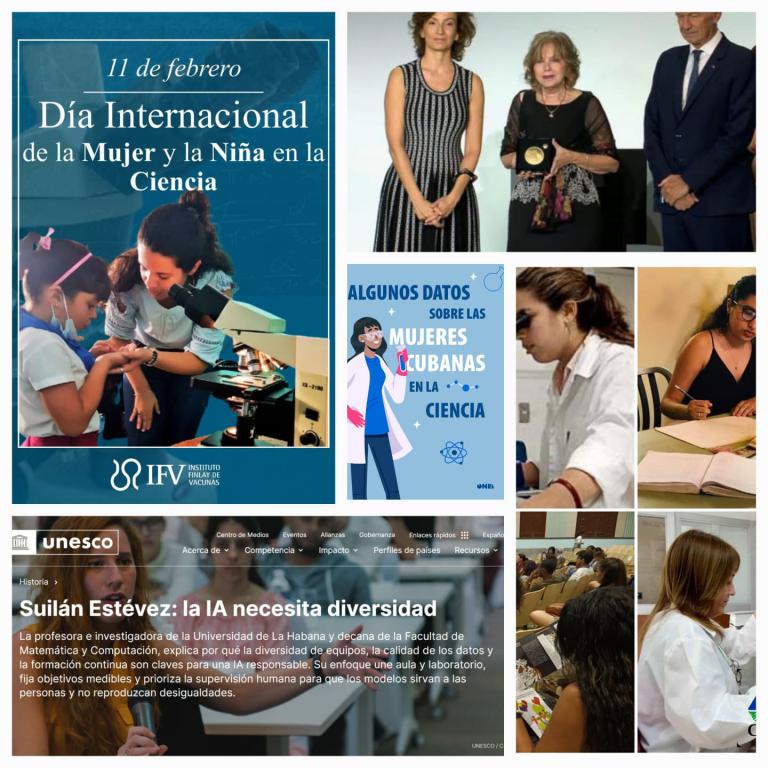
Paris, 11 February 2026. — The Permanent Delegation of Cuba to UNESCO joined today the celebration of the International Day of Women and Girls in Science and participated in the hybrid event organized at UNESCO Headquarters under the theme “From Vision to Impact: Redefining STEM by Closing the Gender Gap,” aimed at highlighting solutions and good practices to reduce the gender gap in science, technology, engineering and mathematics.
The event brought together Member States, renowned scientists, scientific networks, private sector representatives, journalists and students, with particular emphasis on the role of emerging technologies and their impact on gender equality. Organized in collaboration with Femmes@Numérique, the meeting addressed successful experiences in four strategic areas: health research, cybersecurity, artificial intelligence and scientific entrepreneurship. It featured the participation of Latin American and Caribbean panelists, including Professor-Researcher Augusto Rojas-Martínez from Tecnológico de Monterrey, and Luisa F. Echeverría-King, President of OWSD and Director of Science Diplomacy and International Scientific Cooperation at Universidad Simón Bolívar.
At the global level, only 35% of graduates in scientific and technological disciplines are women, and they represent less than one third of researchers worldwide. Persistent stereotypes, lack of role models, and workplace environments continue to hinder their retention and leadership in these sectors.
Recent studies coordinated by UNESCO IESALC also show that although women account for more than 53% of university students in Latin America, their participation drops significantly in scientific and technological disciplines, particularly in technology and engineering, where it barely reaches around 27%. Leadership gaps and inequalities in working conditions also persist, with women underrepresented in decision-making positions and facing wage disparities.
Cuba stands as an international reference in women’s participation in science. Data from the Cuban Gender Equality Observatory and the National Statistical Yearbook show that women now represent more than half of the country's research personnel. In 2023, women accounted for 57.3% of categorized researchers, while in 2024 the figure stood at 56%. Likewise, women are involved in more than 50% of national patent applications, with recent years showing that over 70% of applications included at least one woman.
Within the Cuban Academy of Sciences, female membership has steadily increased, rising from 25.9% in the early 2000s to 34% during 2018–2023, and is projected to reach 39% in the 2024–2029 period. However, challenges remain, as reflected in the reduction in the number of women employed in science and technology activities in 2024 compared to the previous year, when 46,404 women were registered among the sector’s 90,327 workers.
On this special date, we also recall the international recognition granted to Cuban scientist María Guadalupe Guzmán, awarded the L’Oréal-UNESCO International Award “For Women in Science” in 2022 for her pioneering research on dengue and her contribution to public health at the Pedro Kourí Institute of Tropical Medicine, becoming the first Caribbean woman to receive this distinction.
Despite being a country subjected to economic and financial blockade and pressure by the world’s leading power, Cuba has demonstrated that sustained investment in education, equitable access to science and recognition of women’s leadership are key tools to advance towards more just and resilient societies, building scientific ecosystems that are more inclusive, ethical and capable of addressing contemporary social challenges.
The International Day of Women and Girls in Science is celebrated every 11 February since its proclamation in 2015 by the United Nations General Assembly, aiming to promote full and equal access and participation of women and girls in science and technology as an essential condition to address global sustainable development challenges.