
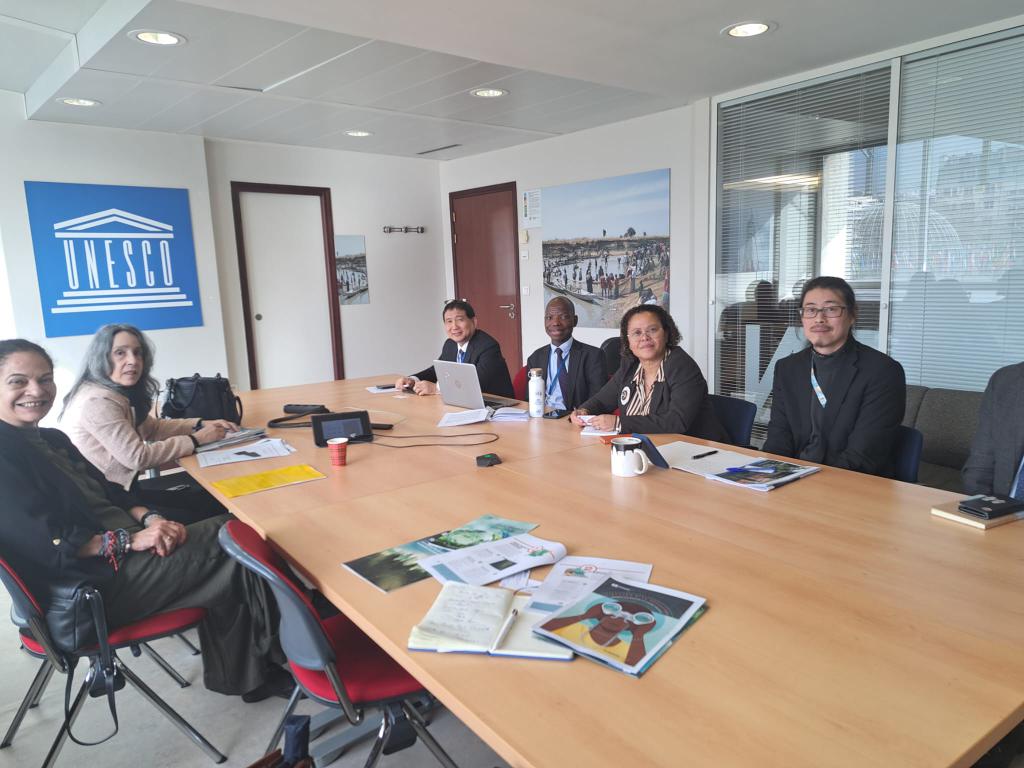
Paris, 27 February 2026. — The Permanent Delegation of Cuba to UNESCO held a working exchange with senior officials of the Organization’s Natural Sciences Sector, in a context marked by the beginning of Cuba’s coordination of the GRULAC Working Group for this programme and at a key moment of institutional transformations.
The meeting brought together, on UNESCO’s side, high-level officials of the Sector, headed by Assistant Director-General for Natural Sciences, Lidia Brito, along with heads of its main divisions, including Ecological and Earth Sciences, Water Sciences, Basic Sciences and Engineering, Science Policy, Small Island Developing States (SIDS), and Disaster Risk Reduction. On the Cuban side, the meeting was attended by Ambassador María del Carmen Herrera Caseiro, Permanent Representative of Cuba to UNESCO, and Third Secretary Laura Álvarez Delgado.
During the exchange, participants addressed the Sector’s programmatic priorities for the current year, with particular emphasis on Latin America and the Caribbean, as well as on strengthening regional scientific cooperation. The discussions made it possible to identify concrete opportunities for collaboration in strategic areas, in line with the objectives of the International Decade of Sciences for Sustainable Development.
The Cuban side underscored the importance of science as a pillar for sustainable development and reiterated its commitment to science diplomacy, highlighting the country’s contributions in areas such as biotechnology and health, as well as the implementation of its updated legal framework on science, technology and innovation.
The meeting provided an opportunity to further strengthen ties with the Organization at a time when structural adjustments are envisaged to reinforce UNESCO’s science mandate, and demonstrated Cuba’s commitment to multilateralism, regional cooperation and the promotion of sustainable development based on knowledge.
UNESCO’s Natural Sciences Sector leads international programmes such as the Intergovernmental Hydrological Programme (IHP), the Man and the Biosphere Programme (MAB), and initiatives to promote basic sciences, with the aim of strengthening Member States’ scientific capacities and contributing to addressing global challenges.