
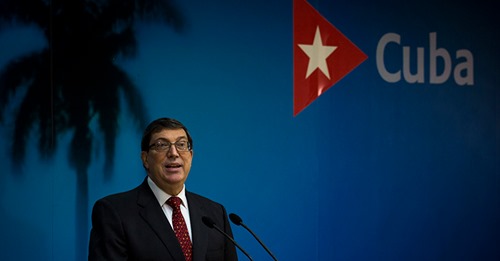
The Cuban Foreign Minister, Bruno Rodríguez, denied today that the prohibitions against travel and remittances from the United States to this country are the result of health symptoms reported by North American diplomats.
Through his official account on Twitter, the Foreign Minister rejected the statements in this regard by senior officials of that nation and said that such restrictions respond to "a deliberate situation promoted by anti-Cuban politicians."
"It is not true that the prohibitions against travel and remittances between Cuba and the US are the result of health symptoms reported by US diplomats, as senior officials in that country have been claiming," he wrote.
Also on this day, the director general for the United States of the Cuban Foreign Ministry, Carlos Fernández de Cossío, made reference to the northern senator Robert Menéndez, and assured that the closure of consular services in Havana was the first step of the Donald Trump government against the bilateral approach.
In February 2017, the State Department and the United States embassy on the island informed the Ministry of Foreign Affairs (Minrex) about the occurrence of alleged acoustic attacks between November 2016 and that year, a pretext used for the reduction of diplomatic personnel of Washington in this capital.
The White House "refused to cooperate and act with transparency in the search for answers" to the event, Fernández de Cossío emphasized in a tweet.
In this context, the deputy director general for the United States of the Minrex, Johana Tablada, assured on the platform that Menéndez is "responsible, like few others, for harmful policies against Cuba."
On the basis of injustices and falsehoods, including the alleged sonic attacks, opportunism and blackmail to his own party, people like that senator also affect the American people and Cuban emigration, she remarked.
Menéndez demanded that President Joe Biden condition an eventual negotiation with Cuba to "improvements in the situation of human rights and political freedoms", and was one of the main critics, within the Democratic Party, of the rapprochement between the two nations promoted by the administration of Barack Obama.
As Fernández de Cossío recalled, the White House 'has not officially clarified whether it recognizes Cuba's right to sovereignty and self-determination, whether its intention is to determine the fate of Cubans from Washington, whether it believes it has the right to interfere in the processes. politicians from a country that is not theirs. '
A report from the US State Department considered the provisions of the Trump government inadmissible against the so-called Havana Syndrome, and described the events as a mystery, because, months after they occurred (in 2016 and 2017), it was not known what happened. , why, or who did it.
According to the president of Cuba, Miguel Díaz-Canel, the report confirms what his country said based on scientific research: the 'acoustic attacks' served as a pretext for that administration to accuse without evidence and damage bilateral relations.
(With information from Prensa Latina)