
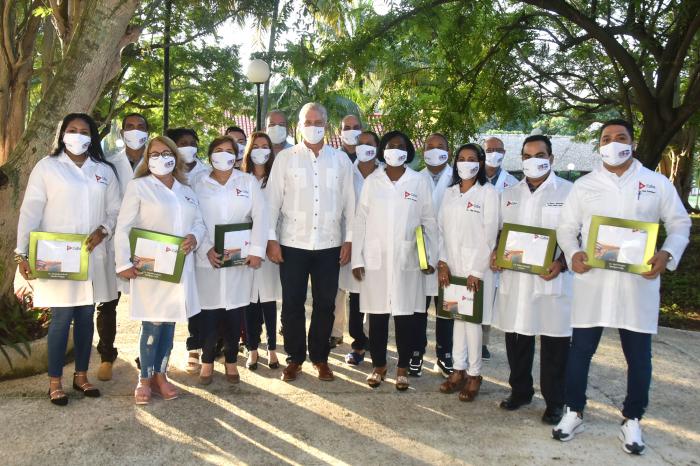
Díaz-Canel and Marrero Cruz chaired the meeting with managers and specialists from the Ministry of Public Health (Minsap), to discuss priorities and actions of the body for 2021, and review what was done in 2020, as part of the work cycle that undertakes, by these days, country address
Author: René Tamayo León | internet@granma.cu
February 19, 2021
Because "technically" it prefers to show itself in numbers, the economy refuses to express itself factually explicit about the most essential human services, "those vital for life", such as those related to health.
Cuban Prime Minister Manuel Marrero Cruz skipped the "technical" detail and made a resounding statement this Friday, February 19: public health was the most dynamic sector on the Island in 2020.
The situation triggered by the COVID-19 pandemic made it the center of the nation's life last year. And he continues to be so so far this year.
Health, individual and collective, determines everything. The pandemic has conclusively failed what has been touted and sold for more than half a century as the holy grail of "modern" and "postmodern" economics: neoliberalism.
It is always said about Fidel that he is capable of traveling to the future, coming back to tell us about it and work accordingly. The robustness of the Cuban Public Health system is part of his work. COVID-19 has corroborated the accuracy of his vision.
Few countries in the world have achieved such effective management of the SARS-COV-2 virus. It is an irrefutable reality highlighted by the President of the Republic, Miguel Díaz-Canel Bermúdez: neoliberalism has not been able to respond to the pandemic, starting with the highly developed capitalist countries, he said.
Díaz-Canel and Marrero Cruz chaired the meeting with managers and specialists from the Ministry of Public Health (Minsap), to discuss priorities and actions of the body for 2021, and review what was done in 2020, as part of the work cycle that undertakes, by these days, the country address.
It was a very critical meeting. The guideline was set by Vice Prime Minister Roberto Morales Ojeda: "How are we going to solve the problems we have today in the health system?" He asked.
The vast majority of the people recognize the consecration and commitment of health workers, said the member of the Party's Political Bureau; but we have not been able to improve a group of indicators, such as infant and maternal mortality, care for the infertile couple, and work in primary care.
Improving health indicators, increasing the quality of services and the satisfaction of the population, and making an efficient and more rational use of resources, are public health guidelines in which there are still many reservations, and this has a considerable influence the work of the paintings, reflected Morales Ojeda, also a doctor and who assumed the criticism made as himself.
When intervening, after a debate where managers in charge of various branches of the sector presented the performance during 2020 and the prospects that open this year, Prime Minister Manuel Marrero Cruz underlined the sacrifice and consecration of the Minsap workers in the confrontation to COVID-19, before which - he said - they have had to redouble their efforts.
In the first minutes of the meeting, Marrero had recognized the complexity of the current regrowth of SARS-COV-2, "where we remain on a plateau from which we cannot get down."
The pandemic has put our country and our health system to the test, and we have to get the experience of everything we did well and what we have not done now, despite having, from the beginning, a robust protocol that has gone getting stronger and stronger.
Despite the great limitations of resources that we have, the problem is not in the lack of these, but in the performance, in the violations and in the complete non-compliance with the established protocols, analyzed Marrero Cruz.
The admiration and respect of the country for our health personnel are infinite; honor to whom honor is due, he said. Cuba's indicators against COVID-19 are very favorable if measured with a large part of the world, and this has been possible thanks to health workers, but today some weaknesses are emerging, and we have to solve that We have to change it, he reflected.
The biggest challenge we have today is to get out of COVID-19, said the Prime Minister, who also analyzed the behavior of several prioritized programs, such as maternal and child care, care for the infertile couple, the doctor and the nurse of the family and international collaboration.
He also analyzed the need to increase discipline, good construction, and cleanliness and neatness in hospitals, a task that also corresponds to the municipal and provincial governments. The key to success - concluded the Prime Minister - is to permanently improve and update the Cuban health system, starting with primary care.
PROUD, BUT UNSATISFIED
We have shown, in the face of COVID-19, what the socialist system can do, including the strength of our protocols to prevent and control the disease, but here the comparison is between us, said the President of the Republic in the conclusions of the working meeting with the directors of the Public Health system.
This is - he said - a very sacrificed sector, but we cannot only contemplate what we are proud of, but also touch the weak points that we still have.
Díaz-Canel shared a meticulous analysis of today's challenges and priorities, such as the control of the pandemic, Task Order and the accentuated campaign of political and ideological subversion of the enemies of the nation, who seek to promote a social outbreak to serve as a pretext for foreign intervention.
Faced with these challenges, thought, ideas and ideology were the keys developed by the Head of State. Everything we do to mitigate this complex landscape, he said, is necessary, including work on COVID-19.
The president also called for increasing the quality of primary and hospital care, improving patient care, warding off bungling and indolence, and responding with agility to complaints from the population.
He called us to always put ourselves on the side of the other, to go for perfection, where everything goes well, and that is achieved - he said - with the culture of detail, but also with demand. «The road to ease leads us nowhere. The path of rigor keeps us alert, it is the one that enhances the work, "he said.
Through videoconference, members of the territorial directorates of Public Health, university rectors and student leaders of the Faculties of Medical Sciences participated in the meeting.
Also attending were Vice Prime Ministers Ricardo Cabrisas Ruiz and Alejandro Gil Fernández, the Minister of Science, Technology and the Environment, Elba Rosa Pérez Montoya, and the head of the Ministry of Health, José Angel Portal Miranda, who was in charge of the presentation.
In context
Minimum summary of good work
In the midst of the complex scenario caused by COVID-19, which has strained all the human and material resources of the Cuban Public Health, the sector shows many successes. Here is a minimal preliminary summary:
• The mortality rate from congenital malformations fell from 0.8 to 0.7, the lowest in history.
• The one to four year mortality rate decreased from 3.6 to 2.8 deaths per 10,000 population (40 fewer deaths).
• The mortality rate from 5 to 14 years fell from 1.9 to 1.6 deaths per 10,000 inhabitants (36 fewer deaths).
• The mortality rate for children under five years of age decreased from 6.6 to 6.3 per thousand live births (67 fewer deaths).
• 6,600 pregnancies were obtained in the infertile couple care network (707 more than in 2019).
• 41.2% of the elderly are incorporated into grandparents' circles. The number of grandparents' houses has grown by six, now totaling 300, with a total of 10,263 places of staffing, in addition to the 3,516 places of this type in nursing homes. Two homes for the elderly were opened; there are already 157 in the whole country, and 12,561 beds.
• 321,603 patients were admitted to the rehabilitation services; 84.1% were rehabilitated.
• 97 014 836 units of natural products were produced (102% of the plan, the highest in history).
• The basic table of natural products was increased by 172 lines.
• 171 high-performance pulmonary ventilators were delivered for intensive care units. There is one for every 10,000 inhabitants.
• In July 2020, 13,748 health professionals graduated from the universities of Medical Sciences: 10,726 doctors, 1,523 stomatologists, 578 graduates in Nursing and 921 graduates in Health technologies.
• Life expectancy at birth in the Cuban population, for both sexes, increases to 78.45 years on average, even higher for women, which is 80.45 years.
• Vaccination coverage is maintained above 98%. In 2020 2 156 773 doses were applied.
Polio, diphtheria, newborn tetanus, pertussis, measles, rubella and mumps remain eliminated. No cases of tetanus have been reported.