
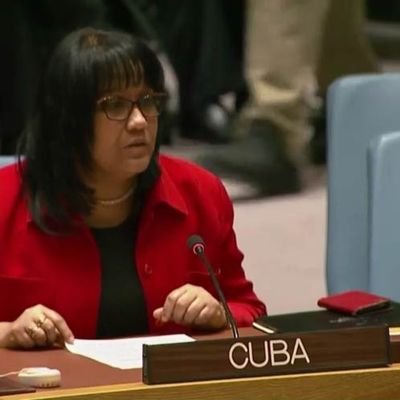
In an exclusive interview with Anadolu, Cuba’s Deputy Minister of Foreign Affairs Anayansi Rodriguez Camejo says the country is open to talks with the US but will not negotiate over its leadership
INTERVIEW – Cuba open to US talks but won’t negotiate on leadership: Deputy minister
As Donald Trump escalates threats, Cuban deputy minister signals openness to dialogue but rules out negotiations over leadership
‘I can categorically confirm that the Cuban political system is not up for negotiation … Neither the president nor the position of any official is subject to negotiation,’ Anayansi Rodriguez Camejo tells Anadolu
Camejo says there are ‘a great number of issues of mutual interest’ for talks with the US, including law enforcement, drug trafficking, organized crime
As tensions deepen amid a renewed US oil blockade and sanctions, a senior Cuban official has ruled out any negotiations over the country’s political system or leadership, while signaling openness to dialogue with Washington on areas of mutual interest.
In an exclusive interview with Anadolu, Cuba's Deputy Minister of Foreign Affairs Anayansi Rodriguez Camejo drew a red line on internal affairs.
"I can categorically confirm that the Cuban political system is not up for negotiation," she said. "It's not part of the negotiating table, if we can have this negotiating table. And, of course, neither the president nor the position of any official is subject to negotiation."
Her remarks come amid escalating tensions between the two countries, including a blockade on fuel supplies and threats by US President Donald Trump of a "friendly takeover" of the island.
On Monday, Trump said that the US "may stop by Cuba" after he is done with his war on Iran, the latest such remarks indicating that the adversarial island nation is high on his list of priorities.
"Cuba is a failing nation, and we're going to do this, and we may stop by Cuba after we're finished with this," Trump told reporters at the White House, referring to US military engagements against Iran.
Despite the standoff, Camejo pointed to potential cooperation in areas such as law enforcement and security.
"In negotiations with the United States, there are a great number of issues of mutual interest,” she said, pointing to law enforcement, drug trafficking, organized crime and terrorism.
“These are issues that we can deal with in a cooperative way.”
While both sides have acknowledged that high-level talks are ongoing, she said such discussions involve sensitive issues and are handled with discretion.
Havana, she added, has consistently been willing to engage in dialogue with Washington in a respectful and responsible manner without "preconditions."
‘Cuba posed no threat’
On Jan. 29, Trump signed an executive order imposing a fuel blockade on Cuba and threatening sanctions on countries supplying the island with oil, describing Havana as an “unusual and extraordinary threat” to the United States.
Camejo rejected that characterization.
"Cuba definitely posed no threat whatsoever to any country, including the United States of America,” she said.
She described the measure as part of a long-standing effort to pressure the island, aimed at strangling the country’s economy to force political change.
But rhetoric has escalated. On March 27, Trump said Cuba is "next" following military operations against Iran, adding that the island would soon fail.
Camejo warned that any external pressure would be met with resistance.
"Any external aggressor I can certainly say will run up against an impregnable resistance by our people,” she said.
Despite differences, she said the US and Cuba could maintain a "civilized relationship" based on reciprocity and respect for sovereignty.
Relations with allies
Addressing US accusations that Cuba supports "hostile countries," Camejo said Havana maintains "positive and excellent cooperation" with partners including China and Russia.
She said Cuba, as a sovereign state, has the right to develop economic and trade relations with any country.
"It must depend on trade, on its own economy, and that is the type of relationship we see with the rest of the world,” she said. “These are the kind of relations that we have with countries like China and Russia.”
She said international solidarity and aid are welcome, but stressed the importance of countries exercising their sovereign right to trade with Cuba without US interference.
"As a sovereign country, Cuba is willing and has the capacity to develop economic and commercial relations with any nation, including China, Russia, Türkiye, Mexico, and any other country in the world."
Camejo urged the international community to resist external pressure.
"This is how international trade should be conducted – without the government of a powerful nation having the prerogative or the capacity to dictate how and with which nations any other state can develop its foreign trade."
She emphasized that Cuba has support from international movements and governments.
"The overwhelming majority of the international community rejects the US blockade against Cuba,” she said, referring to repeated UN resolutions.
Last October, for the 33rd consecutive year, the UN General Assembly overwhelmingly adopted a resolution calling for an end to the US blockade on Cuba, with 165 nations in favor, seven against and 12 abstentions.
"Cuba is not isolated at all, as the United States pretends to show to the world," Camejo said.
"On the contrary, we count on the support of the international community, which has been shown not only at the General Assembly, but also by the Non-Aligned Movement, the Community of Latin American and Caribbean States (CELAC), the G77, and China."
Energy blockade
Since January, the Trump administration has sharply limited oil shipments to Cuba, triggering fuel shortages, price increases and prolonged power outages.
Camejo said the blockade has been intensified in recent years and further strengthened under the current administration.
She said it costs Cuba’s economy around $7 billion annually and has a "devastating impact" on daily life.
Since the Jan. 29 executive order, Cuba has not received a single fuel shipment for almost four months, apart from one from Russia, she said.
“The country is deteriorating due to the energy infrastructure, leading to blackouts and prolonged power outages that our people are suffering every minute," she said.
She said the crisis has strained public services, including healthcare.
"There are nearly 100,000 patients waiting on a surgical operation, including almost 2,000 children,” she said, adding that up to 40,000 pregnant women are also waiting for ultrasounds.
She said more than 30,000 children are missing timely vaccinations due to fuel shortages affecting refrigerated transport.
Despite the strain, she said the system is "not collapsing."
Cuba is expanding renewable energy use to address shortages, she added.
"In the energy sector, we are improving a lot the use of renewable energy, which is something that has helped a lot to overcome the difficulties that we have in the sector caused by the US."