
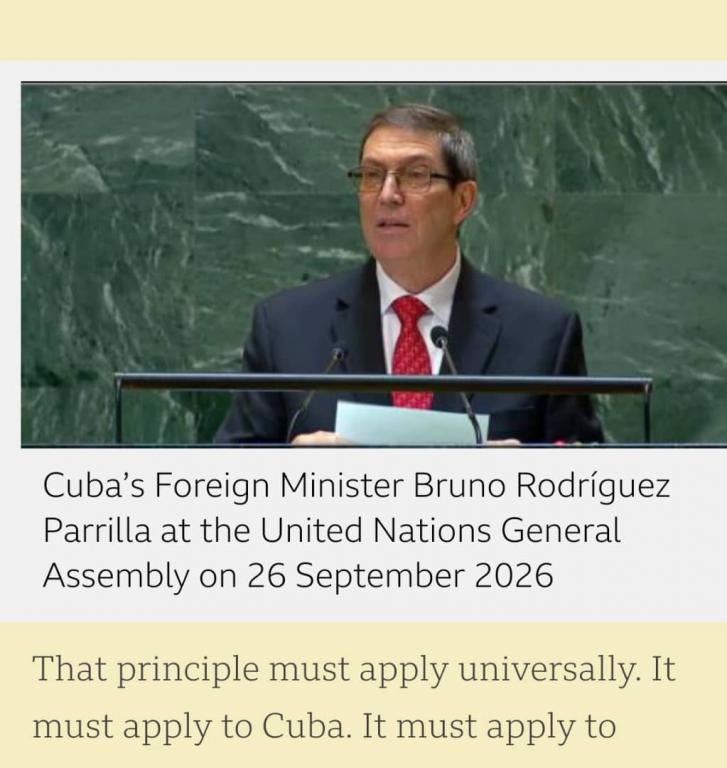
Harare, September 28, 2026 – The law of the jungle cannot be humanity's future, stated Mafa Kwanisai, Coordinator of the Fidel Castro Chair in Zimbabwe, while commenting on the speech delivered by Cuban Foreign Minister Bruno Rodríguez at the 81st session of the UN General Assembly.
The core message was unequivocal: the world cannot build peace as long as powerful states continue to use military pressure, economic coercion, and political intimidation against weaker nations, Mafa noted in his analysis, published in regional media outlets such as *The Panafrikanist* and *The Southern Africa Eye News*.
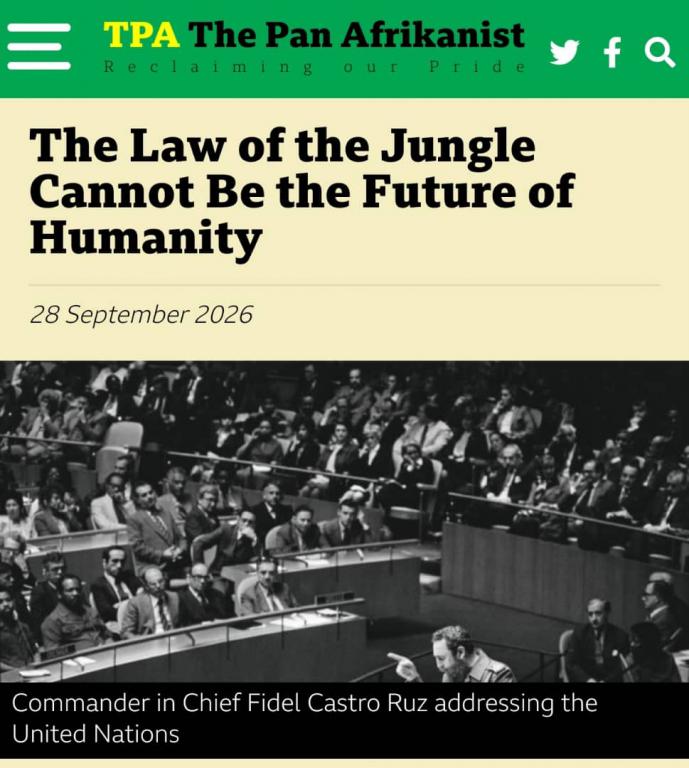
Sixty-six years after Fidel Castro took the same United Nations podium to demand an end to the philosophies of plunder and war, Cuba revisited that historic argument with renewed urgency.
He highlighted the Cuban government's assertion that expansionism, military aggression, economic coercion, and attacks on national sovereignty are once again threatening the foundations of international law.
The United States has intensified what Havana describes as a multidimensional campaign against Cuba, involving severe restrictions on fuel supplies, trade, financing, technology, and international business.
Mafa recalled that over seven thousand shipping containers were stranded at ports—affecting food, medicines, and medical equipment—as part of an economic war ultimately directed against the population.
If economic coercion becomes an accepted instrument of international policy, all developing countries become vulnerable.
Africa knows this story well, he noted, asserting that the continent bears the scars of colonial conquest, economic exploitation, and political interference.
Cuba’s stance continues to resonate across much of the Global South. Cuba’s history has made sovereignty a fundamental pillar of its political identity.
The Caribbean island’s Foreign Minister also argued that attempts to force political change through economic strangulation amount to an attack on the sovereignty for which generations of Cubans have fought.
He rejected the characterization of Cuba as a threat to the United States, highlighting instead its track record of international cooperation and its long-standing commitment to other developing countries.
Cuba’s statement offers another lesson, the professor maintained, noting Rodríguez’s acknowledgment of the Cuban economy’s serious challenges and the ongoing efforts to transform the country’s economic and social model while upholding its independence, sovereignty, and social achievements.
The answer cannot be the destruction of multilateralism, but rather its democratization. The United Nations must become more representative, more effective, and better able to defend the principle that all states—large or small—possess equal sovereign dignity.
According to Mafa, writing in *The Panafrikanist* and *The Southern Africa Eye News*, Cuba explicitly advocated for strengthening the UN and bringing it closer to the peoples of the world.
It also reaffirms its solidarity with countries and peoples facing colonial legacies, sanctions, interventions, and struggles for self-determination, including African and Caribbean nations.
The most powerful phrase in the speech—in his view—was also the simplest: "The law of the jungle cannot be humanity's future." That warning should not be dismissed as mere rhetoric.
A world where military force becomes law, economic power becomes justice, and the sovereignty of smaller nations becomes negotiable.
The world does not need another century of domination disguised as diplomacy. It requires sovereign nations—equal under international law—that cooperate rather than coerce, trade rather than stifle, negotiate rather than threaten, and build peace rather than prepare for war.
As Cuba’s Foreign Minister concluded, this alternative is not inevitable. A better world remains possible if peoples and nations strive with determination to build it, emphasized the Coordinator of the Fidel Castro Chair at Midlands State University in Zimbabwe.