
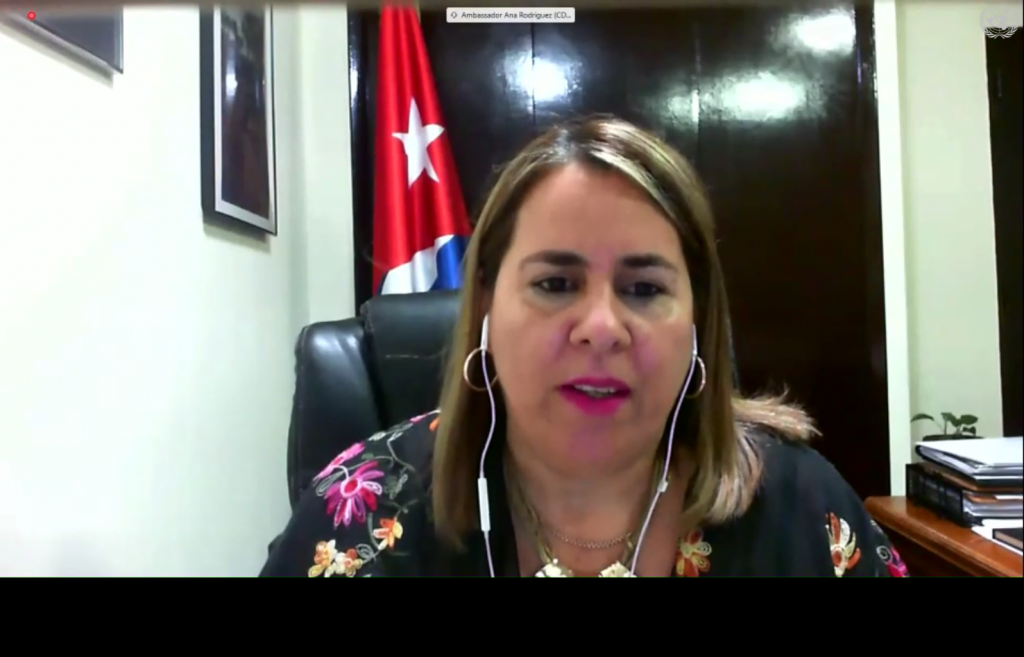
New York, 23 July 2020. Cuban Ambassador Ana Silvia Rodríguez Abascal, Deputy Permanent Representative and Charge d’ Affairs of the Permanent Mission of Cuba to the United Nations, participated today as a panelist in the Side Event organized by the Permanent Mission of Nigeria, entitled Building back better: risk-informed COVID-19 recovery and rehabilitation and strengthening resilience to climate change-related disasters in Africa and the Caribbean.
The island representative explained how the present crisis has demonstrated the fragility of institutions at all levels, exacerbated the multiple vulnerabilities and inequalities among and within countries, and galvanized the urgent need for international solidarity. As a consequence, she added, countries across both African and Caribbean regions are receiving a large damage to their economies and are experiencing the conjunction of the present health and economic crisis with their intrinsic structural vulnerabilities.
Realities as climate change – especially for Caribbean and Pacific islands-- and the promised unpaid support to developing countries also have a negative impact on the current international scene, she recognized.
The Cuban diplomat also gave details about how her country has incorporated the adaptation to climate change and disaster risk reduction perspectives in the national development plan, articulated by the State Plan to Address Climate Change, the National Economic and Social Development Plan and the institutions of the Civil Defense.
Likewise, she referred to the cooperation carry out by Cuba with Caribbean countries in addressing climate change and disaster risk reduction, such as the signing of a memorandum of agreement between the Caribbean Community Climate Change Centre and the Cuban Institute of Meteorology to reinforce and increase efforts to address climate change through a long-term association, the support of the realization of Studies of Hazards, Vulnerability and Risks of Natural Origin in Haiti, Dominica and Saint Lucia.
She added that Cuban experts have also worked closely with their partners from the Dominican Republic, Dominica, Saint Vincent and the Grenadines and Saint Lucia providing methodologies and experiences to develop Early Warning Systems, Studies of Hazards, Vulnerability and Risk, human settlements resilience and adaptation to climate change. For these purposes, a toolbox was developed and shared with these country partners, the envoy expounded.
Rodríguez Abascal pointed out that the countries of both African and Caribbean regions are not part of the cause of the world´s ecological problem but are more severely impacted instead. Actions as putting an end to the imposition of unilateral and coercive measures, that jeopardize around 2 billion people in the world living under the burdens that these illegal policies represent, and a call for the ecological debt to be paid in favor of the right of their peoples to achieve sustainable development, must be put in place.
Permanent Mission of Cuba to the United Nations