
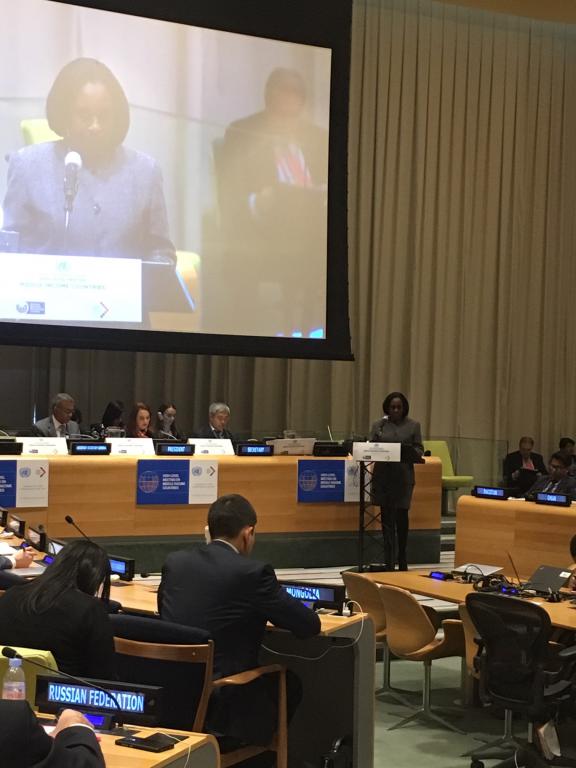
New York, 4 December 2018. Cuba participated today in the plenary segment of the United Nations High-Level Meeting on Middle-Income Countries, represented by Ms. Ileana Núñez Mordoche, Deputy Minister of Foreign Trade and Investment of the Republic of Cuba.
She argued that the income level, as a criterion to classify countries in order to access development cooperation flows, is a limited and insufficient approach. She therefore advocated a more comprehensive, multidimensional and complete methodology, including special challenges, vulnerabilities, structural gaps and particularities of the countries.
In the case of Cuba, the Cuban Deputy Minister explained that a National Economic and Social Development Plan until 2030 is being developed, whose strategic pillars are intertwined with the Sustainable Development Goals. This has been possible, she added, despite the fierce economic, commercial and financial blockade imposed by the U.S. Government for nearly six decades, which constitutes the main obstacle to the island's economic development.
Núñez Mordoche also referred to South-South cooperation as a valuable instrument in the search for solutions to the problems of middle-income countries, as a complement to, rather than as a substitute for North-South cooperation.
She illustrated with the example of Cuba, a middle-income country with limited economic resources, which has nevertheless implemented cooperation programs in 157 countries, where hundreds of thousands of health, education, sports and other Cuban specialists and technicians have worked in a spirit of solidarity. Currently, more than 65,000 Cuban health workers are providing their services in 65 nations. Likewise, more than 70,000 foreign young people in middle and higher level education from more than 100 countries, mainly from Africa, Asia and Latin America and the Caribbean, have graduated from various specialties in the Caribbean nation.
Permanent Mission of Cuba to the United Nations.