
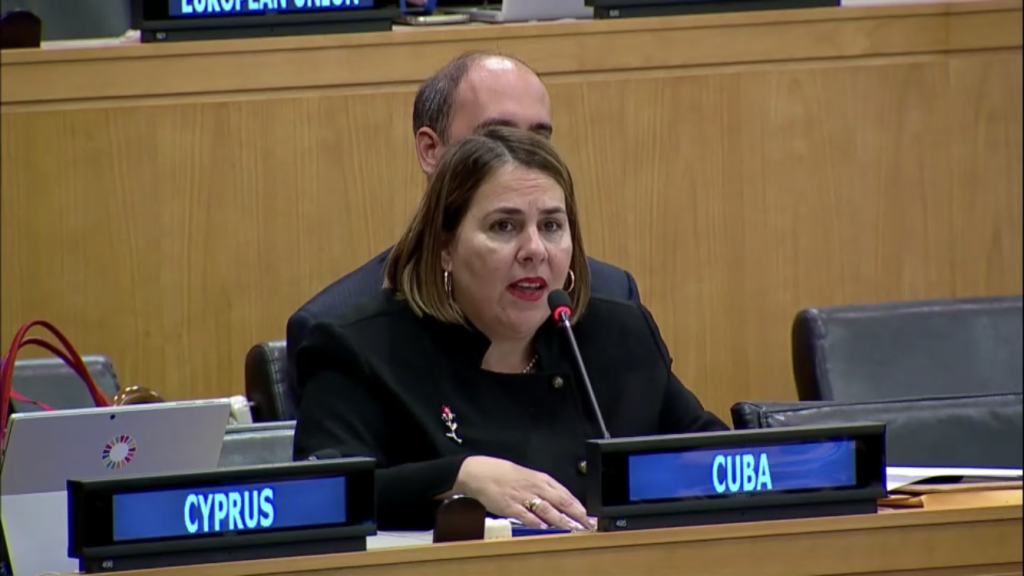
New York, 16 October 2019. Cuba participated today in the debate on Agenda Item 22: "Eradication of poverty and other development-related questions", of the Second Committee of the United Nations, at its 74th session.
Ambassador Ana Silvia Rodríguez Abascal, Deputy Permanent Representative, Chargé d'Affaires a.i., highlighted that despite 60 years of unjust, illegal, immoral and criminal economic, commercial and financial blockade imposed by the United States, tightened this year with the activation of the extraterritorial Title III of the Helms Burton Act, the island shows remarkable social achievements and has already fulfill several of the goals set in the Sustainable Development Goals, showing with figures these achievements.
Cuba, a small island developing state, also subject to the adverse effects of powerful hurricanes, droughts and climate change, is currently the second country in the world with the lowest value in the Multidimensional Poverty Index, being the only country in Latin America and the Caribbean that has eliminated severe child malnutrition according to the UNICEF Annual Report 2018 and the fifth country among the first 14 that have managed to reduce the hunger and undernourishment rate in a sustained manner for several years, according to the 2018 Global Food Policy Report, stressed the Cuban diplomat.
Rodriguez Abascal, reaffirmed Havana's commitment to South-South cooperation and international solidarity, based on the concept of sharing the island's modest resources with other nations in need through international cooperation. She noted that currently more than 60,000 Cuban health cooperators are working in 65 countries, while the Cuban Literacy Program "Yo si puedo", recognized by UNESCO, has taught millions of adults in 28 countries to read and write.
In her statement, the diplomat questioned how to achieve the commitment to eradicate poverty definitively in all its forms and dimensions, as the 2030 Agenda seeks; if countries such as the United States earmark multimillion-dollar resources to military expenditures that could be allocated to the development of our peoples; protectionist and unilateral practices in trade increase; the current multilateral framework is undermined; unilateral coercive economic measures are increasingly implemented in violation of the Charter of the United Nations and international law; Official Development Assistance is contracted in real terms and the foreign debt, which has been paid several times, continues to grow.
Permanent Mission of Cuba to the United Nations