
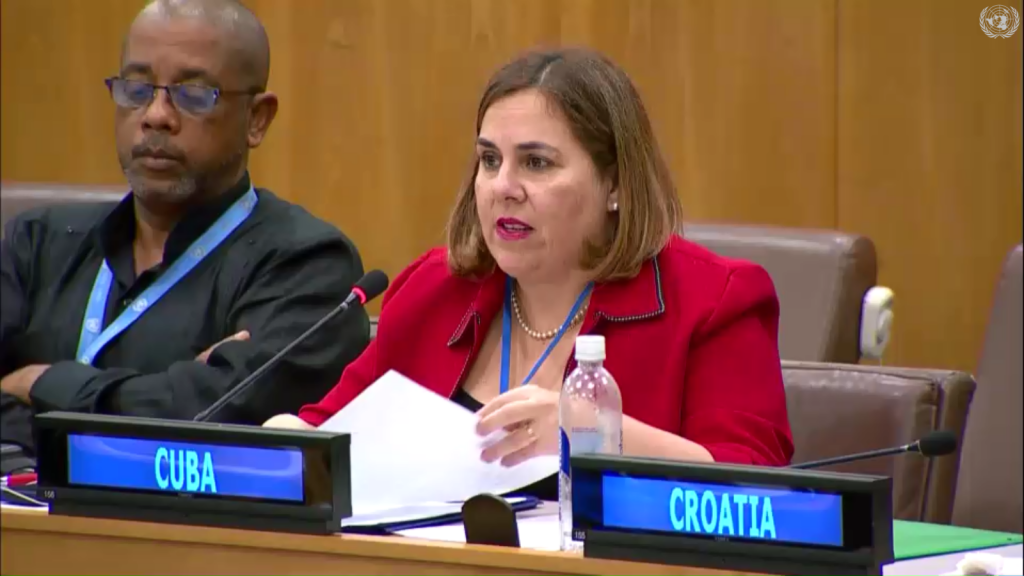
New York, October 2nd, 2018. Cuba participated today in the debate on Item 28: Social development; a) Implementation of the outcome of the World Summit for Social Development and of the twenty-fourth special session of the General Assembly; and b) Social development, including questions relating to the world social situation and to youth, ageing, disabled persons and the family, from the agenda of the United Nations. In the debate, the Deputy Permanent Representative of Cuba to the international organization, Ambassador Ana Silvia Rodríguez Abascal, listed Cuba's achievements on the agenda items, despite the strong economic, commercial and financial blockade that the island has suffered for almost six decades, which has a direct impact on its social development.
In her statement, the diplomat highlighted Cuba's support for the World Program of Action for Disabled Persons and referred to the government development strategy carried out by the Cuban State to provide care for this sector of the population.
She also referred to the Cuban policy towards youth, which has a marked vocation of social benefit, prioritizing the professional training of young people, their labor insertion, their participation in the processes of discussion and making of decisions at all levels and their representation in the main structures of the Government, the Parliament and other decision-making scenarios.
Rodríguez Abascal stressed that by 2030, in Cuba there will be 3.3 million people aged 60 or older, due to which the island has turned attention to the elderly as a priority, in order to guarantee the quality of life of this sector of the population.
Regarding the family, the Cuban representative pointed out that the island's public policies always seek to have a positive impact on this area, through the implementation of multisectoral programs from the national to the community level.
The Ambassador also referred to the broad, transparent and democratic process of popular consultation of the new draft Constitution of the Republic of Cuba, which proposes a series of modifications that, in a singular way, highlight the reinforcement or development of a wide range of rights, including social rights, treated in a novel way and with great impact on issues related to youth, the elderly, disabled persons and the family, in line with the international instruments to which, in these matters, Cuba is a party.
Permanent Mission of Cuba to the United Nations