
April 19, 2021
ACN
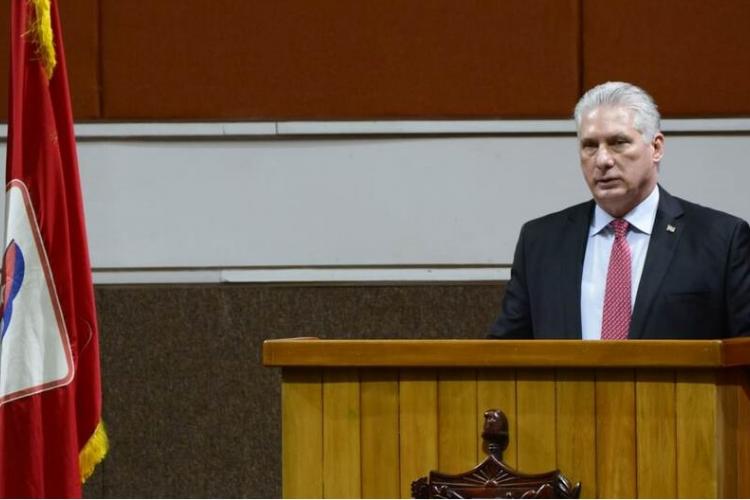
The most revolutionary thing within the Revolution is and must always be the Party, which is the force that revolutionizes the Revolution, said today in this capital Miguel Díaz-Canel, First Secretary of the Central Committee of the Communist Party of Cuba (PCC) and President of the Republic, at the closing of the 8th Congress of the political organization.
Díaz-Canel described the meeting as a historical moment in which the gradual transfer to new generations of the main tasks of the country took place, which he considered an important milestone in Cuban political history and defines Congress as that of the continuity.
RAÚL: REFERENCE FOR COMMUNISTS AND REVOLUTIONARIES
The Cuban president pointed out that the main standard-bearer for this process has been Army General Raúl Castro, who has prepared, conducted and led the continuity process with tenacity, without attachment to positions and responsibilities, serenity, maturity, trust, altruism and modesty. .
He will be consulted on the most important strategic decisions for the destiny of the nation, assured the First Secretary of the Central Committee of the PCC, adding that he will continue to be present because he is a reference for any communist and revolutionary.
Raúl is the best disciple of Fidel (Castro), but he has also contributed values to the revolutionary ethics and the exercise of government, said the Cuban President, adding that his legacy of resistance in the face of threats and the search for the improvement of the society.
When reviewing the work of the Army General at the head of the country's leadership, Díaz-Canel highlighted the impetus for important conceptual and structural changes, including the improvement of the economic model, the renegotiation of the debt, the new immigration law and the expansion of the management of non-state forms.
He also considered the development of new regulations for the agricultural sector, the creation of the Mariel Special Development Zone, the elimination of obstacles for the Cuban state company, the computerization of society and the maintenance and improvement of social achievements.
Díaz-Canel recognized the achievement of the liberation of the Five Heroes (Cuban antiterrorist fighters), and the development of a broad and dynamic activity of foreign relations, among whose facts the talks to reestablish diplomatic relations with the United States and the work of Cuba as president pro tempore of the Community of Latin American and Caribbean States.
The commitment to the Revolution overcame human pain, he led the country tirelessly, with success and impetus, said the Cuban President, who also highlighted in the work of the Army General the promotion of the improvement of the Party's work, demanding contact with the people, the results of the Revolutionary Armed Forces and the Water Transfer and Tarea Vida programs.
THE BLOCKADE, AN AFRINT AGAINST HUMAN RIGHTS
Díaz-Canel considered that the brutal blockade (economic, commercial and financial) of the United States against Cuba in the last four years has escalated to more aggressive levels.
No one can ignore that this siege constitutes the main obstacle to the country's development, and ratifying this truth does not try to hide the deficiencies of our reality, said the First Secretary of the PCC, who maintained that this policy is the longest affront against human rights of a people.
He warned that Cuba's demand is to end it, for which they have the support of the international community and a large part of Cubans living abroad.
The President recalled that the 240 measures dictated by the US administration of Donald Trump remain, to which are added those derived from the recent inclusion of the Antillean nation in the list of States sponsors of terrorism.
In the same way - he pointed out - the campaigns of subversion and ideological intoxication continue, promoted by the agencies of that northern country to discredit Cuba and try to confuse the people by exacerbating internal contradictions.
Díaz-Canel said that despite the declaration that Cuba is not a priority for the United States, there are laws such as Helms-Burton and Torrricelli, hundreds of millions of dollars are dedicated to trying to subvert the constitutional order and resources are used to undermine the national conscience.
He wondered how to justify the economic war against the Antillean nation and the willingness to pay the price of international isolation by maintaining a legally unsustainable policy.
The president said that the aspiration of the Cubans is to live in peace and maintain a relationship with the United States as with the rest of the international community.
He stressed that priorities of the current US administration such as the fight against the COVID-19 pandemic, climate change, migration issues and human rights are issues that would allow exploring bilateral cooperation.
THE PARTY: THE FORCE THAT REVOLUTIONIZES THE REVOLUTION
In his words, the First Secretary valued the tasks and challenges that the Communist Party of Cuba has in the current context, in which it is challenged to constantly innovate, changing everything that must be changed, without departing from its principles.
He pointed out as purposes the fight for prosperity that ranges from food to recreation, demonstrating that it is worth defending socialism as a response to the need for a more just, equitable, balanced and inclusive world.
Díaz-Canel indicated unity as the main force, which will defend itself without discriminating or giving space to prejudices, dogmas or pigeonholes that unfairly divide people.
He considered as important elements the exemplary nature of the militancy, so that it arouses admiration and respect in the people, the assurance of generational continuity with the distinction of young people as managers of the transformations underway and the improvement of the dynamics of the Party's operation, that has the challenge of being more democratic, attractive and close to the people.
The president called for periodic meetings with representatives of the different sectors of society and for adopting more agile, brief and innovative dynamics to communicate the messages to the militancy.
He urged making the growth of the ranks a process that generates genuine interest, with social repercussion, and to generate more attractive working methods.
It is the obligation of the militants to be championed in the fight against corruption, and to incorporate computerization, social communication and innovation and science as a pillar of partisan work, he said.
Díaz-Canel explained that the country has many tasks ahead of it, including food sovereignty and security, energy and industrial development, and first of all, defense and institutional strengthening as the rule of law.
Success depends on the ability to dialogue with the population, enthuse citizens and rebuild values, aware that democracy is more socialist to the extent that it is more participatory, he said.
At another point, the President warned that from the subversion they want to build a matrix of opinion that Cuba is a rigid nation, and they try to steal topics, words and phrases to destroy feelings and paradigms.
We are not a closed society and this is not a weak revolutionary process, he said and stressed that in the ideological battle we must go to Fidel, who taught that culture is the first thing to save.
He recalled that the Revolution does not fear creative thinking, but encourages and cultivates it, and feeds on its contributions, and warned that it cannot be ignored that the enemies of the Revolution apply unconventional war concepts and try to sneak in on the flank of the sensitivity, culture and thinking.
The Cuban Revolution will not be betrayed or given away to those who intend to live playing with the luck of the Homeland. We will not allow the activists of chaos and contempt to smear the flag and insult the authorities. We warn the mercenary lumpen that the patience of this people has limits, he said.
He added that Cuba is a structured and organized country that works hard to get out of a hostile and suffocating reality, a truth that must be told every day without arrogance or bragging, offering content from the truth.
Díaz-Canel applauded the advances in the emancipation of women, the fight against racism and discrimination, the protection of animals, and urged to recognize how much progress still has to be made, to give a more just response to popular concerns.
ECONOMIC BATTLE: RESIST CREATIVELY
When assessing the situation of the economic battle, Díaz-Canel pointed out that the five-year period under analysis does not show good results, which is influenced by the inefficiency and inefficiency of the business system and the budgeted sector, excess spending, lack of control over resources and structural problems.
However - he clarified - the Cuban economy has shown resistance capacity to preserve social conquests and has given a lesson to the world of how the political will and the humanist vocation of the Revolution together with public policies that have the human being as the center, the Dialogue with scientists and popular participation can successfully tackle problems as complex as the COVID-19 pandemic.
The First Secretary pointed out that Cuba aspires to continue resisting without renouncing its development, and pointed out as challenges to respond in a short time the production of food, the use of renewable energy sources, the efficiency of the investment process, the production capacity national to satisfy the internal demands and the elevation of the quality of the services of the population.
He added that it is necessary to enthrone concepts such as savings and the circular economy and to stimulate the process of economic updating of the country and the strategy of the National Economic and Social Development Plan, flexibly combining the relationship between the necessary planning, decentralization and local autonomy.
When assessing the Ordering Task, monetary and exchange rate, the First Secretary said that it is not always well understood, which requires a lot of political work.
He explained that this transformation aimed at stimulating development could not continue to be postponed, although he presented instrumentation problems due to insufficient preparation and inadequate interpretation of the regulations; But it is also a mistake to associate it with problems that were present before, he remarked.
In this regard, Díaz-Canel specified that the first response has been the immediate follow-up and solution, whenever possible, to the proposals of the population, promoting an exercise of citizen participation, and quoted as an example the changes in rates and prices and recent measures to encourage the production and marketing of food.
FRAME POLICY
In his intervention, the First Secretary referred to the strategy approved by the 8th. Congress of the PCC for the Policy of Pictures, which allows its scientific approach and the implementation of its transit model.
Our cadres must stand out for their dedication to the task, desire to excel, modesty and sensitivity to put themselves in the place of others, responsibility to sincerely dialogue and incorporate those opinions into decision-making.
THE CONTINUITY CONGRESS
Díaz-Canel transmitted a message of respect to Commanders Ramiro Valdés and Guillermo García, who completed several years of work and continue to give lessons of consecration and dedication to the revolutionary work every day.
To the commander of the Rebel Army José Ramón Machado Ventura, who for decades carried out the difficult tasks of organizing the Party, our permanent gratitude for his consecration, example, discipline and loyalty, he said.
In a special way, the Cuban president transmitted on behalf of his comrades a message of gratitude to Army General Raúl Castro: Thank you for the example, the push, thank you for being there and helping us to believe in ourselves.
At the end of his speech, the First Secretary of the PCC Central Committee evoked the victory of the Cuban people in the sands of Playa Girón, on April 19, 1961, and reaffirmed his willingness to give his life for the worthy cause of the revolution.