
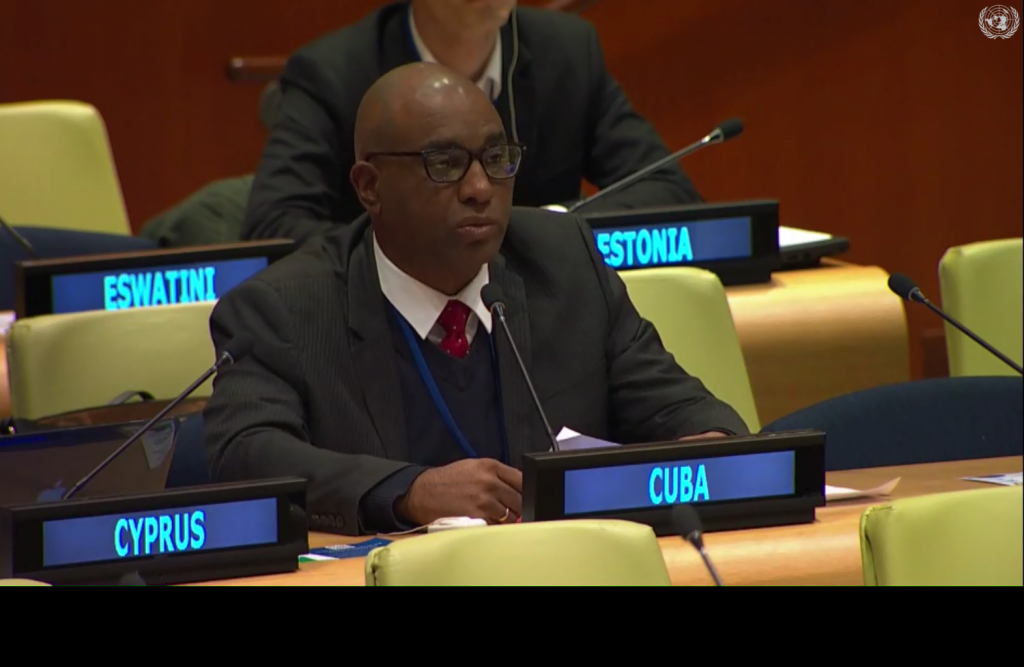
New York, January 24th, 2020. The realization of the right to quality education for all is a moral imperative. It is also a necessity in order to promote a culture of peace, understanding and non-discrimination of any kind; stated Cuban Ambassador Oscar León González, Chargé d' Affaires a.i. of Cuba to the United Nations, during the High-Level Interactive Dialogue on the occasion of the International Day of Education, Session II under the theme "Matching the Imperative of Inclusiveness with the Quest for Quality Education: Policy Choices and Action Priorities.
The Caribbean representative called on States to take concrete actions to provide this right with material guarantees that would facilitate universal access to education, at all levels and throughout life, especially when official figures reveal that 260 million children in the world do not attend primary or secondary school; while 758 million people do not know how to read or write, two thirds out of them are women.
León González underlined that the Cuban state turned education into one of its priorities since the very triumph of the Cuban Revolution. In this regard, he recalled the massive Literacy Campaign of 1961 with which Cuba managed to become an Illiteracy-Free Territory.
The diplomat also underscored that despite the blockade imposed for 60 years by the Government of the United States of America, Cuba has a universal, accessible and free education system, at all levels, and open to all ages, without discrimination of any kind. More than two-thirds of the country's budget is earmarked for improving the levels of education, health, social security and welfare, culture, sports, as well as the scientific and technical research, he added.
He also illustrated how Cuba has helped more than 10 million people in 32 countries to become literate, through the "Yo, Sí Puedo" literacy method.
Permanent Mission of Cuba to the United Nations