
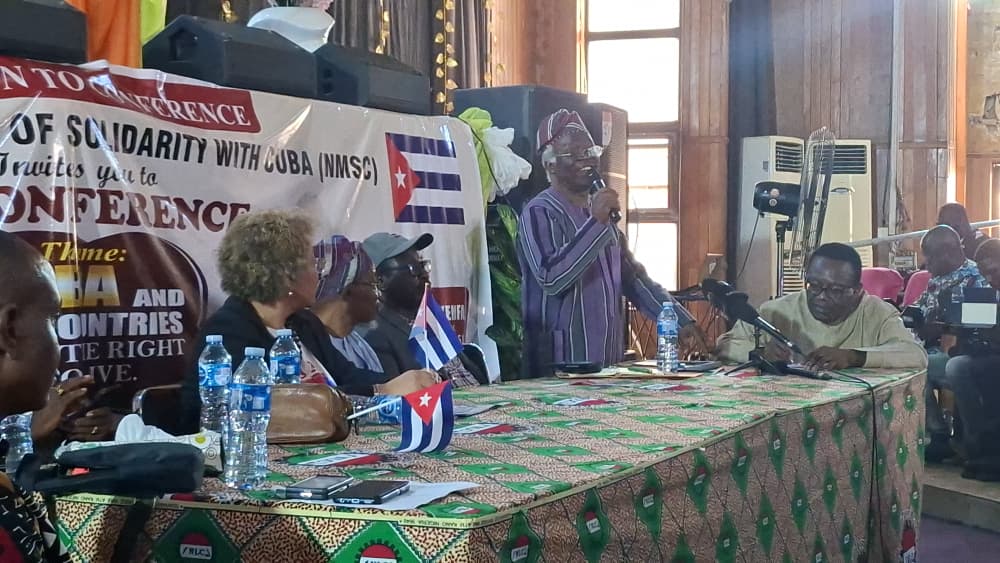
Abuja, February 24th, 2026.- Falana described these measures as economic strangulation that violates Cuba’s sovereignty and humanitarian norms.
Femi Falana, Senior Advocate of Nigeria (SAN), has called on African nations to support Cuba in the wake of intensified U.S. economic sanctions, warning that the measures risk creating a humanitarian crisis on the island.
In a statement on Tuesday, Falana noted that following the U.S. capture of Venezuelan President Nicolás Maduro and his wife, President Donald Trump threatened to remove Cuba’s socialist government.
Fearing a military intervention worse than the 1962 Bay of Pigs invasion, the U.S. opted to impose new sanctions, including restrictions on oil imports, which have driven up prices for food, medicine, and transportation, while causing widespread fuel shortages and blackouts.
The sanctions were reportedly enforced under the International Emergency Economic Powers Act (IEEPA), and the U.S. threatened tariffs on any country exporting oil to Cuba.
Falana described these measures as economic strangulation that violates Cuba’s sovereignty and humanitarian norms.
“In addition to the blockade of over 60 years, President Trump moved to block oil from reaching Cuba, pushing up prices for food, medicine, transportation and prompting severe fuel shortages and hours of blackouts,” Falana said.
“The harsh economic sanctions were said to have been based on the International Emergency Economic Powers Act (IEEPA). As if that was not enough, the US government threatened to impose tariffs on any country that exports oil to Cuba.”
Highlighting Cuba’s historical contributions to African independence movements, Falana urged African countries to assist Havana in defending its sovereignty.
He also called for donations of funds and relief materials to support Cuban communities hit by Hurricane Melissa in October 2025.
“The African Union has recently called on the United States to end the sanctions imposed on Cuba. Apart from ignoring the call of the African Union, the US government has exposed the Cuban people to economic strangulation,” he said.
“Having regard to the unqualified contribution of Cuba to the independence struggle of the African people, all African countries owe it a duty to assist Cuba to defend its sovereignty under international law.”
The senior lawyer said, “In view of the Hurricane Melissa that swept across the eastern provinces of Cuba last October, all African and Latin American countries should donate funds and relief materials to Cuba.
“It is pertinent to state that notwithstanding the economic suffocation of Cuba by President Trump, the United States government provided $6 million in food and supplies in early 2026, and $3 million in disaster relief following Hurricane Melissa. The relief is distributed through non-governmental channels like the Catholic Church.”
Falana further referenced the 2026 U.S. Supreme Court ruling in Learning Resources Inc. v. Trump, which found that tariffs imposed under IEEPA are unconstitutional.
“The judges emphatically stated that the statute does not authorize the use of tariffs and that the President does not have authority to tax. The court specifically stated the power to tax, including the imposition of tariffs, lies exclusively with the US Congress, in accordance with the US Constitution,” he said.
He argued that the ruling renders Trump’s Executive Order on tariffs null and void, and encouraged friendly nations such as Nigeria, Algeria, Angola, and South Africa to sell oil to Cuba.
Noting that the U.S. has still provided limited humanitarian aid, $6 million in early 2026 and $3 million following Hurricane Melissa, Falana argued that Africa must act in solidarity with Cuba to defend its people and economy.
“The implication of the historic judgment is that President Trump's recent Executive Order imposing tariffs on countries selling oil to Cuba under the International Emergency Economic Powers Act is illegal, null and void having exceeded the President’s constitutional authority,” Falana said.
“To that extent, friendly countries like Nigeria, Algeria, Angola and South Africa ought to sell oil to Cuba.”