
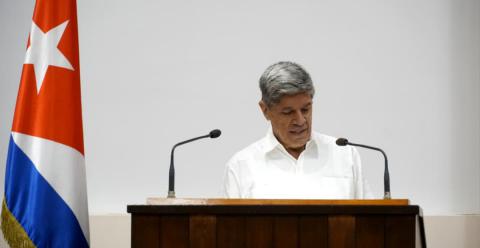
Remarks by Deputy Minister of Foreign Affairs Carlos Fernandez de Cossio at the Forum “Fidel And The Foreign Policy of the Cuban Revolution”
Fidel, as we learned to call Commander-in-Chief Fidel Castro Ruz from birth, did not write any textbooks or educational materials on foreign policy.
His teachings, as in almost all the countless activities in which he was involved, developed in the heat of the daily struggle leading a country in revolution, a people who, with the revolutionary triumph, achieved true independence for the first time.
This presentation does not attempt to advance a thesis on Fidel’s thinking regarding international relations. This will be an attempt, through the examination of certain pivotal episodes or issues in Cuba's foreign policy, to demonstrate key lessons in his thinking that have guided and continue to guide our country's actions on the international stage with crystal clarity.
In his memorable farewell letter to Fidel, Che Guevara wrote:
“…I felt by your side the pride of belonging to our people during the bright and sad days of the Cuban Missile Crisis.
“Rarely has a statesman shone brighter than in those days…”
One might wonder what the Heroic Guerrilla Fighter was specifically referring to when he singled out that particular moment to highlight Fidel’s undeniable qualities as a revolutionary, leader, and statesman—someone under whose guidance Che himself had been fighting since they met in Mexico City and alongside whom he had experienced all kinds of dangers, challenges, setbacks and victories.
However, he emphasizes that specific episode.
The significance of that crisis, commonly known as the October Crisis, is logically understood: the danger of nuclear conflagration, the courageous and resolute firmness with which the leadership of the Revolution, together with the people, confronted that threat.
The outcome is also known, as is how it was reached without due and just consideration of the… Cuba, which was the country under threat and aggression even before the crisis erupted.
But following Che's logic, it is worth highlighting aspects of the political and diplomatic contradictions of the event that allow us to appreciate the revolutionary, patriotic, intellectual, and statesmanlike stature of the then very young leader of the Cuban Revolution, and could explain the special admiration expressed in the letter by Commander Guevara.
Without attempting to recount what happened, let us recall that, having reached the most dangerous moment during the crisis, an agreement was reached between the USSR and the US, in which Cuba did not participate and according to which Soviet missiles would be withdrawn from Cuba, along with other commitments.
That agreement also entailed the inspection of said withdrawal. Cuba, naturally, opposed any inspection on its territory.
For this reason, the then Secretary-General of the UN, U Thant, traveled to Cuba to assist in the implementation of the agreement between the two superpowers with the backing of the United Nations. United Nations.
The Secretary-General arrived on October 30, 1962, and that same afternoon held his first meeting with the Cuban government.
The essence of U Thant's proposal was that, by mandate of the Security Council and the recommendation of the Non-Aligned Movement that he take the initiative to contribute to finding a peaceful solution, he had come to explore the Cuban government's position.
He stated that the US wished to establish a mechanism with the UN that would ensure that no weapons would enter or remain in Cuba within a three-week period, that the Soviets agreed, and that this verification would be carried out through an inspection by the Red Cross, an agency that was willing to conduct inspections on the high seas and at Cuban ports of entry, if the Cuban government agreed. He added that if this UN inspection was accepted, the US would lift the naval blockade. The Secretary-General spoke with what might seem like elementary logic.
Fidel asked for clarification on the inspection procedures, to which the Secretary-General replied that there would be one on land and another on a plane that would fly over Cuba. He added that the US wanted to ensure that the missiles were being dismantled and would be returned to the USSR.
I am going to quote verbatim segments of the exchange that took place at that meeting so that the logic of the Commander-in-Chief can be understood, a logic that has become firmly established in the foreign policy of the Revolution and will be recognized by anyone who has interacted with Cuba over the years.
Fidel says: “What right does the US have to ask for this? I mean, is it based on a real right, or is it a demand by force, or is it a position of strength?”
U Thant responds: “This is my point of view; it is not a right. Something like this can only be done with the approval and acceptance of the Cuban government.”
Fidel then explains: “We simply do not understand why this is being asked of us, because we have not violated any rights, we have not carried out any aggression against anyone whatsoever; all our actions have been based on International Law. On the contrary, we have been victims, first of all, of a blockade, which is an illegal act; secondly, of the attempt by another country to determine what we have the right to do or not do within our borders… Cuba is a sovereign country, no more and no less than any other member state of the United Nations, with all the attributes inherent to any of those states.”
Later, the Commander says: “We can accept anything that is in accordance with the law, that does not diminish our status as a sovereign state.”
He continued: “I understand that this inspection is yet another attempt to humiliate our country…This demand for inspection is to validate their claim to violate our right to act within our borders with complete freedom, to decide what we can and cannot do…We can negotiate with complete sincerity and honesty. We would not be honest if we agreed to negotiate a sovereign right. For these rights, we are willing to pay whatever price is necessary.”
The conversation continued that day with arguments from both sides. Among the points emphasized by the Commander-in-Chief was the declaration that, as part of the agreement, the US would supposedly issue that it would not invade Cuba. Fidel clarified that the US had no right to attack Cuba and that the promise not to commit a crime could not be negotiated with the US.
The following day, there was another meeting.
In it, the Secretary-General referred to a letter from Soviet leader Khrushchev to Kennedy, in which Khrushchev stated his acceptance of verification of the dismantling by United Nations observers. U Thant wanted to know the Cuban government's opinion on this letter.
Fidel answered: “We understand that when the Soviet government decided to dismantle the facilities and spoke of verification, it was referring to some kind of inspection outside of Cuban national territory, since the Premier of the Soviet Union could not speak of verification on Cuban soil, as that is a prerogative belonging solely to the Cuban revolutionary government.”
These positions were defended with the profound conviction that Cuba was in the right, but also with the understanding and acceptance of the risk that the agreements between Kennedy and Khrushchev to end the crisis could be derailed.
This story is widely documented in various texts and perfectly illustrates that particular moment.
Here, very specific aspects are highlighted to underscore one of the pillars that, under Fidel's extraordinary leadership, became the cornerstone of Cuba's foreign policy: the defense of our sovereign rights without the slightest room for confusion or diminishment, even in the face of extraordinary dangers and even in the face of the will, at that time, of the two great nuclear powers of the era and the role of emissary of the United Nations.
That is the first aspect I wished to emphasize.
Another aspect, among the many that the Commander-in-Chief instilled in the compass of Cuba's foreign policy, was the principle of not negotiating with the adversary, or with any government, Cuba's solidarity and internationalist commitments to various causes and peoples. There are concrete examples that illustrate this position.
In the second half of the 1970s and even up to 1980, there were several instances of discreet talks between the governments of Cuba and the United States, with both Democratic and Republican administrations, under the mutually declared objective of trying to find solutions to bilateral differences.
It is noteworthy that the agenda of the US delegation at these meetings always included topics that had nothing to do with bilateral issues, but rather with Cuba's relations in other parts of the world. Specifically, these included Cuba's open solidarity with the Puerto Rican independence movement and Cuba's internationalist efforts in Africa.
These were highly sensitive political processes of great political priority for Cuba, in which various Cuban representatives participated, but which Fidel personally guided with extreme detail and precision, and which he closely monitored, even without physically participating.
There can be no doubt that the positions represented there by the Cuban representatives reflected almost verbatim Fidel's vision and direct arguments.
Several of these meetings occurred in New York, with representatives of the Republican government of Gerald Ford and the Democratic government of James Carter.
The verbatim minutes of several of these meetings have been published, which are gems of reference for anyone who wishes to study Cuba's foreign policy.
In them, Cuba made it clear that the cause of Puerto Rico's independence has accompanied our history since the 19th century, that we could not be asked to give up on it and that our country would continue to accompany it politically in the UN and any forum where our Puerto Rican brothers took it.
As a result of these conversations and as a demonstration of Cuba's solidarity and fraternal commitment, a bilateral agreement was even reached that remained confidential for many years.
In exchange for the release of four American prisoners who were serving sentences in Cuba for crimes committed and were of interest to the US government, our country did not ask for bilateral concessions from the United States, nor benefits for Cuba, but rather the release of Puerto Rican independence activists Lolita Lebron, Rafael Cancel Miranda, Ervin Flores and Andrés Figueroa.
The actions occurred independently of each other, as sovereign acts of each party, but it was clear that they were the result of an arrangement.
With respect to our internationalist commitments in Africa, I will quote the introductory words of the representative of Cuba at one of those meetings, which took place in November 1978.
I quote: "For you, Africa is the main problem that is causing difficulties for the United States to take steps towards full normalization [of relations with Cuba]. Some statements establish the total withdrawal of Cuban troops or a change in our attitude of support to African countries as a condition that we had to meet before any improvement was possible. Regarding this, our current position of principle is that in no way are we going to make our help to our African friends an element of negotiation. This is not negotiable. We are prepared to continue our constructive and positive policy in order to eliminate conflict and promote peace wherever it is threatened. But in no way are we going to make the agreements and commitments that we have established with friendly countries subject to negotiation. Our bilateral relations with these countries are not negotiable. End of quote.
On November 23, 1981, a discreet meeting took place in Mexico City between the Vice President of the Council of State of Cuba Carlos Rafael Rodríguez and Alexander Haig, then US Secretary of State. In it, the US representative conveyed the possibility of coexistence despite ideological conflicts and that President Reagan even considered the possibility of a commercial relationship with Cuba. But there was a price: Cuba had to end its solidarity support for political forces in Latin America, withdraw the teachers it had sent to Nicaragua and withdraw all its troops from Africa.
He added that a crossroads had been reached and introduced a threat, suggesting that President Reagan was also willing to go to the brink.
As can be assumed from what has been disclosed, the meeting was almost a dialogue of the deaf, but the representative of Cuba made several ideas clear, among them I quote: "We are giving and will continue to give Nicaragua our solidarity and support. We consider it our obligation and our right." Comrade Carlos Rafael also said: "There is no obligation that we have assumed with any country, group or government that we have not been able to honor. This must be made clear to the United States." End of quote.
We are facing a new international scenario, but Cuba has not modified one iota those principles of solidarity, internationalism and loyalty that the Commander in Chief instilled in us in practice and with his leadership and that form a core part of the foreign policy of the Cuban Revolution.
A third issue to which Fidel dedicated much of his energy, talent and fighting spirit, and whose teaching far exceeded national borders, was the denunciation of the international economic order.
His memorable speeches, his participation and his interventions in academic events are essential study materials for those from the developing world and even the developed world who wish to understand the great problems, the immense contradictions, the seemingly meaningless war conflicts and the most pressing threats to the conservation of life on the planet, especially for human beings.
This is a topic on which Fidel did make contributions, which he documented in scholarly literature, such as the book he wrote and published in 1983 on the world's economic and social crisis and its impact on underdeveloped countries.
In his studies and analyses, he left no topic unaddressed and demonstrated a formidable capacity for integrating seemingly isolated yet uniquely complex issues in the world we live in. Comrades who accompanied him in these efforts of inquiry and analysis have testified to his intellectual discipline, his rigor in handling data, his thirst for information, and his ability to quickly arrive at his own conclusions.
It was not merely an intellectual endeavor. Like his life, it was yet another revolutionary struggle, in the pursuit of justice for all on the planet, and the identification and denunciation of the obstacles to achieving it.
His ideas rested on solid foundations. He clearly and repeatedly understood and denounced that the prevailing international economic order has led to underdevelopment for three-quarters of the world's population.
He clarified that the citizens of this part of the world and their ancestors did not conquer and plunder entire continents for centuries, nor did they establish colonialism, reimpose slavery, or create modern imperialism. They were its victims. The primary responsibility for financing their development, as Fidel understood it, lies with the states that today, for obvious historical reasons, enjoy the benefits of those atrocities.
He went so far as to outline, with solid arguments, proposals on where and how these resources could be obtained if the most powerful countries renounced or mitigated the arms race and diverted the immense financial and technological arsenal dedicated to and squandered in the death industry toward addressing the historical debt owed to the economic growth, development, and progress of Third World countries.
He exposed the stark paradox that humanity has never before possessed such formidable scientific and technological potential, such an extraordinary capacity for generating wealth and well-being, and yet the world has never been so unequal and inequality so profound.
His approach and method were Marxist-Leninist, without dogmatism, and he drew inspiration from the thinking of leading intellectuals of the so-called Third World, especially since the 1960s. He engaged in dialogue with experts from the developed world, World Bank officials, professors from various universities, and finance ministers from several countries, with an inexhaustible desire to find answers, explanations, and contrast viewpoints.
He spoke out about environmental risks as early as the 1970s, when such alarm was not yet internationally prevalent. He clearly identified the link between the progressive erosion of the ecosystem and the unsustainable production and consumption patterns of developed capitalist countries. He was an active spokesperson in warning about the dangers of accelerated climate change.
Under his leadership, Cuba's foreign policy has maintained a high profile and commitment to the struggle for a more just and equitable international order, and his teachings have guided and continue to guide our work in the United Nations, the Non-Aligned Movement, the Group of 77 and China, the regional organizations and mechanisms of Latin America and the Caribbean, and any forum where the fight for justice and the aspiration for a better world allows us to contribute.
Beyond these three paradigmatic examples, Fidel's work and teachings in foreign policy embraced, incorporated, and educated the Cuban people as a whole on some of the most complex issues on the international stage.
We cannot forget the massive popular assemblies held in Revolution Square, where hundreds of thousands of Cubans listened to and approved the First and Second Declarations of Havana; the massive solidarity with the people of Vietnam; the first medical brigades to Algeria; the blood donations for people in disaster situations; the creation of the Henry Reeve International Contingent and its decisive contribution to health in various parts of the world, including during epidemics such as Ebola in West Africa and the fight against COVID-19 in more than 40 countries and territories.
Thanks to the efforts of Cuban professors and teachers, tens of thousands of students from all over the world were educated in our schools and universities. Cuba's internationalist campaign in Africa was a massive and voluntary people's epic, involving more than 350,000 combatants.
These were all manifestations of Fidel's exceptional qualities as a leader and visionary. His legacy accompanies us today and will continue to do so.
Many Cuban comrades had the privilege of being at his side or under his direct leadership on sensitive tasks and issues of Cuban foreign policy and international relations as a whole. Likewise, many friends from other countries—politicians, activists, government officials, international officials and experts, revolutionary combatants, and people from diverse backgrounds—had formidable and unparalleled experiences exchanging ideas with Fidel on these or similar matters.
On his centennial, we must seize the opportunity to further disseminate, both in Cuba and around the world, the lessons on international affairs bequeathed to us by a revolutionary leader whose ambition was to defend his country's unquestionable right to enjoy full and absolute sovereignty, and, together with the brave Cuban people, to strive to bring justice or put an end to injustice in every corner of the planet.
Thank you very much.