
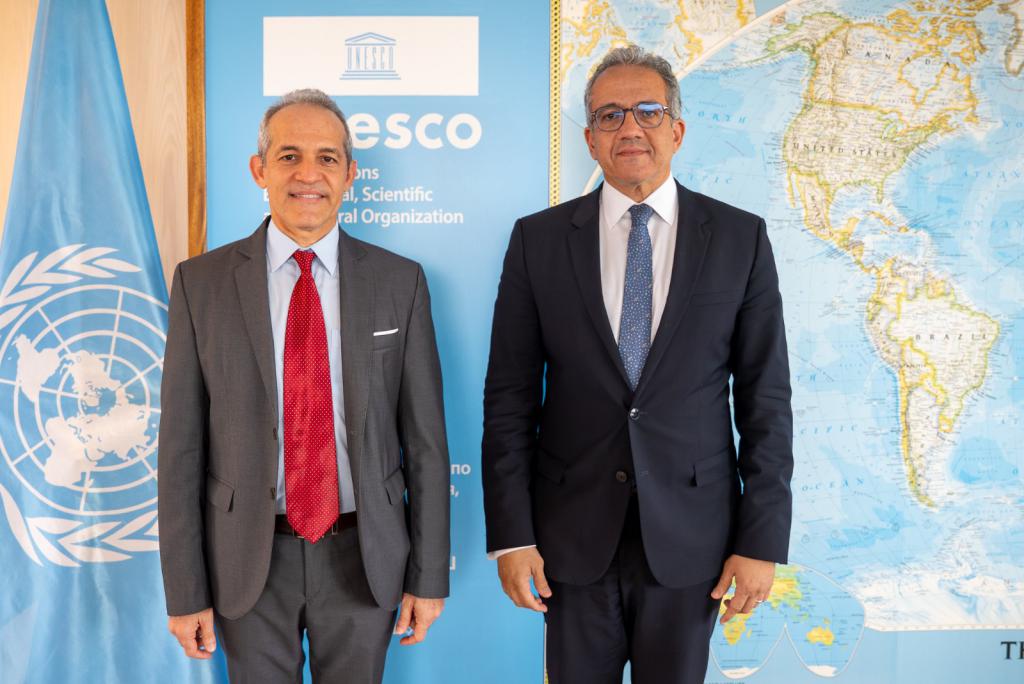
Paris, 16 July 2026. – UNESCO Director-General Khaled El-Enany received Cuba's Minister of Science, Technology and Environment, Armando Rodríguez Batista, this afternoon on the sidelines of the Global Conference of the International Decade of Sciences for Sustainable Development (2024–2033), currently taking place at UNESCO Headquarters.
The meeting also took place on the eve of the UNESCO-Cuba Carlos J. Finlay Prize for Microbiology Award Ceremony, a distinction established jointly by Cuba and UNESCO, which is approaching the 50th anniversary of its establishment.
During the cordial exchange, both sides discussed opportunities to further strengthen cooperation between Cuba and UNESCO in strategic areas such as science, water resources, biodiversity conservation, disaster risk reduction, and Science, Technology, Engineering and Mathematics (STEM) education, building upon Cuba's internationally recognized experience in biotechnology, medicine, science education, and the design and implementation of public policies for scientific and technological development.
They also exchanged views on the role that the International Decade of Sciences for Sustainable Development can play as a platform to strengthen South-South cooperation, support young scientists and innovators, and promote science-based solutions to address the challenges of sustainable development.
The meeting once again reaffirmed the historic ties of cooperation between Cuba and UNESCO, as well as the broad convergence between Cuba and the Organization's principles, values and programmes.
The Director-General acknowledged Cuba's international prestige in the training of scientific talent and highlighted the country's experience as a reference for other developing nations, whose good practices can be shared to promote international cooperation and strengthen scientific capacities.
For his part, Minister Armando Rodríguez Batista underscored UNESCO's leadership in promoting science worldwide and expressed appreciation for the Organization's continued support to Cuba, particularly the assistance provided in emergency situations, both following the impact of extreme weather events and in response to the country's current energy crisis, resulting from the United States Government's policy of blockade and economic suffocation against Cuba.
Both sides reaffirmed their commitment to further strengthening cooperation between Cuba and UNESCO, particularly within the framework of the International Decade of Sciences for Sustainable Development, with the aim of placing science, innovation and knowledge at the service of sustainable development and the well-being of all peoples.