
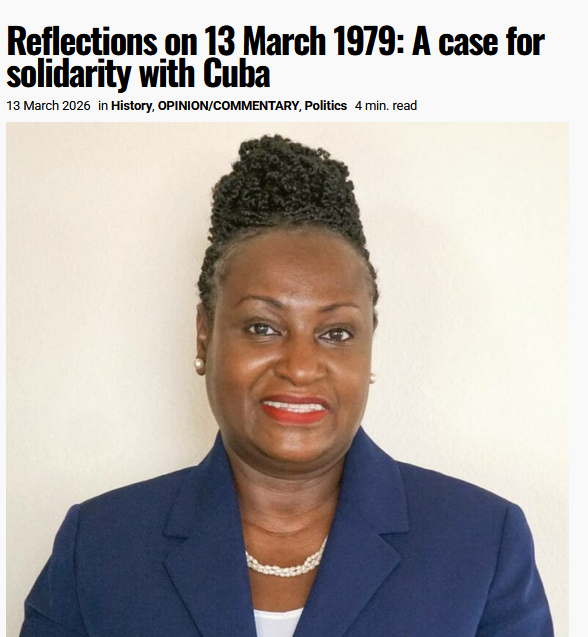
Grenadian professor Wendy C. Grenade recently published an article on the enduring legacy of the Grenada Revolution and Cuba’s role in the development of the Caribbean island, within the context of current geopolitical tensions.
In her analysis, the author underscores that Cuba has for decades been a global reference point for its internationalist vision, humanitarianism, and health diplomacy, highlighting the Cuban people’s capacity for sacrifice in service to others. She notes that, in Grenada’s case, many working-class families were able to overcome poverty thanks to scholarships granted by Cuba, which allowed their children to train in fields such as medicine, engineering, and veterinary science.
Grenade recalls that the Maurice Bishop International Airport stands as a lasting legacy of the Grenada Revolution, built through the efforts of the Cuban government and Grenadian workers. In this regard, she affirms: “The Cuban government and committed patriots worked tirelessly to build that international airport.”
The Saint George’s University academic emphasizes that Cuba has been one of Grenada’s most reliable development partners, with decisive contributions to health, sports, and culture. “Its contribution to the health system is irrefutable and, in the short term, perhaps irreplaceable,” she explains, reflecting the importance of maintaining and strengthening these ties in times of crisis.
Finally, Grenade warns that, in the face of geopolitical pressures and the humanitarian crisis confronting Cuba, this is not the time for Caribbean governments to distance themselves. She proposes that the region pursue collective diplomacy based on solidarity and resilience, reminding that the history of the Grenada Revolution offers valuable lessons for supporting Cuba’s struggle today.