
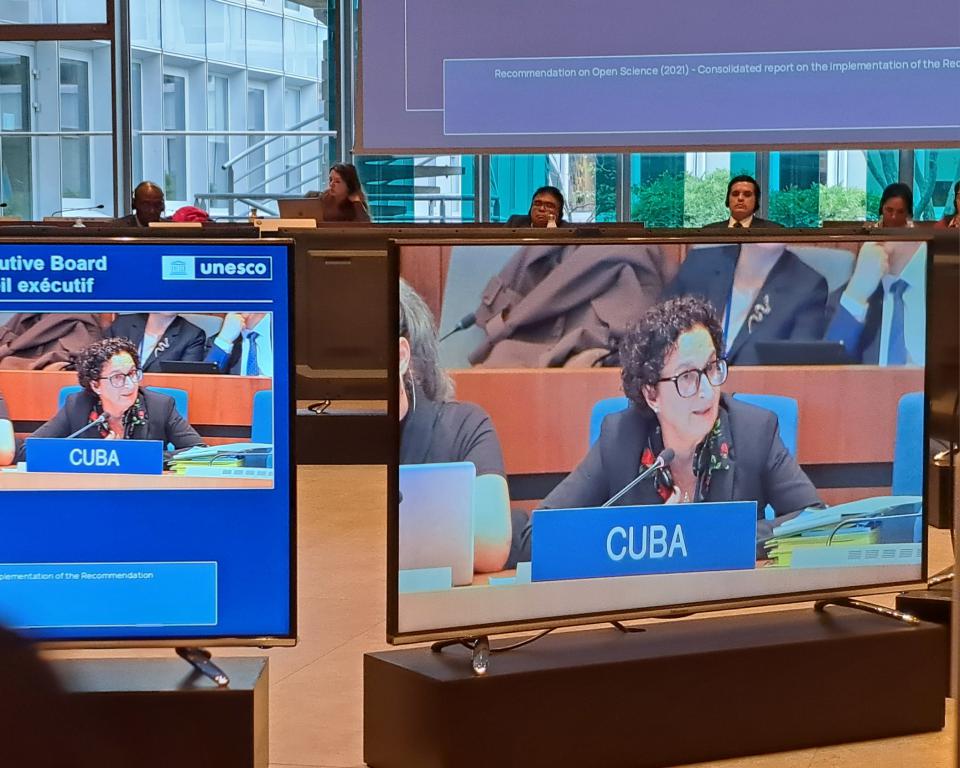
Paris, 4 October 2025. – Cuba’s representative to the UNESCO Executive Board, Ms. Dulce María Buergo, denounced during the working meetings of the Committee on Conventions and Recommendations the severe and multifaceted impact that the economic, commercial, and financial blockade imposed by the United States against Cuba continues to have on the Island’s development in all spheres of the Organization’s competence.
The intervention took place during the debates of the Committee on Conventions and Recommendations, which met from 1 to 3 October to examine, among other items, the implementation reports of key normative instruments such as the Recommendation on Open Science (2021) and the Recommendation on Science and Scientific Researchers (2017), the Recommendation on Adult Learning and Education (2015), and the Recommendation on the Ethics of Artificial Intelligence (2021), among other instruments.
The diplomat detailed how this unilateral policy hinders Cuba’s access to essential resources, funding, and international cooperation in all areas of the Organization’s competence. In the field of education, she pointed out that the blockade limits the acquisition of teaching materials, laboratory equipment, specialized software, and academic mobility, affecting professional training and the right to quality education.
In the area of science, she emphasized that the siege constitutes a fundamental barrier to Open Science, by impeding access to databases, specialized publications, reagents, high-tech equipment, and full participation in international research projects. She also highlighted the serious impairments in communication and information, due to restrictions on access to telecommunications infrastructure, hardware, software, and essential digital services.
Cuba thus reaffirmed its commitment to UNESCO’s ideals, while exposing the blockade as the main obstacle to the full application of its conventions and recommendations. The delegation reiterated its call to the international community to reject this policy and to work for its immediate cessation, as an indispensable condition for the country’s integral development.