
New York, 5 November 2019. For years, the U.S. blockade policy has lacked support within the international community.
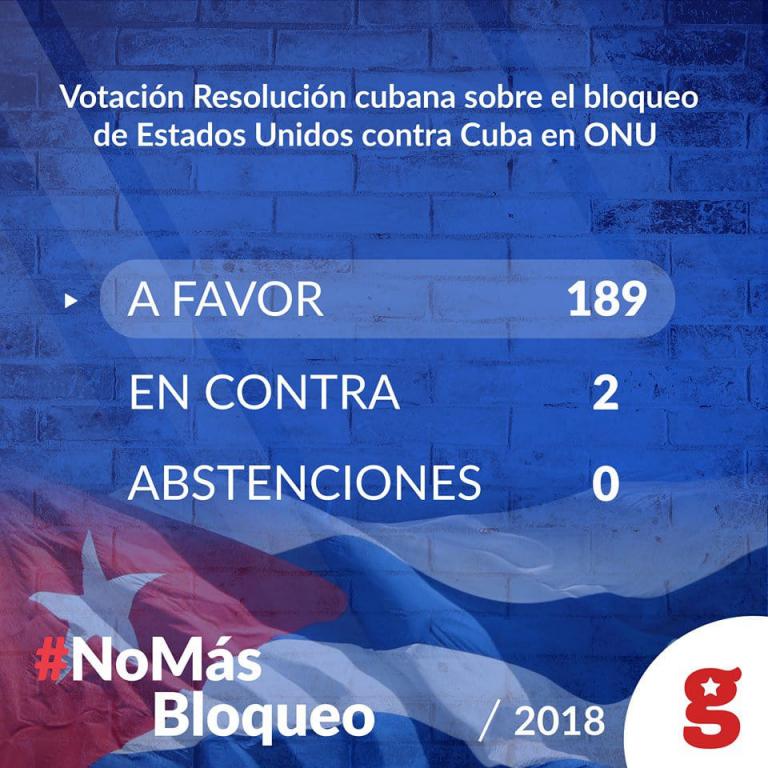
The fullest expression of this support was shown on 1 November 2018, when the United Nations General Assembly approved, for the twenty-seventh consecutive time, the resolution "Necessity of ending the economic, commercial and financial blockade imposed by the government of the United States of America against Cuba", with the yes vote of 189 member states. Likewise, the international community rejected by a large majority the 8 amendments presented by the U.S. delegation aiming at denaturing the text of the resolution with the introduction of contents that would serve as an excuse for the continuity of the criminal anti-Cuban policy.
During the debate and adoption of the Cuban resolution, 46 speakers expressed themselves in favor of the need that the U.S. eliminates the blockade it maintains against Cuba. The statements delivered by 7 representatives of groups of political coordination and regional and sub-regional organizations were remarkable, such as: the Group of 77 and China, the African Group, the Non-Aligned Movement, the Community of Latin American and Caribbean States, the Association of Southeast Asian Nations, the Community of Caribbean States and the Organization of Islamic Cooperation.
Previously, on 13 September 2018, during the 39th Ordinary Session of the Human Rights Council, the negative effects of the blockade were denounced and a call was made for its total elimination. On this occasion, 23 developing countries took part in the interactive dialogue with the Special Rapporteur about the negative impact of the unilateral coercive measures on the enjoyment of human rights.
On 27 September 2018, the Ministers of Foreign Affairs of the Group of 77 and China in their Ministerial Declaration once again rejected the implementation of the blockade against Cuba and the imposition of unilateral coercive measures against developing countries. The text was adopted at the 42nd Ministerial Meeting of the Group, held within the framework of the 73rd session of the United Nations General Assembly in New York.
Different kinds of groups have also expressed their opposition to this criminal policy: the Congress of South African Trade Unions (COSATU); the France-Caribbean Inter-parliamentary Friendship Group of the French Senate; the Sandinista Deputies to the National Assembly and the Central American Parliament; the National Assembly of Seychelles; the Brazilian Communist Party in the Brazilian Congress; the National Parliament of South Africa; the Latin American SELA Council; the Japan-Cuba Parliamentary Friendship League.
Scenarios such as the 32nd Session of the Assembly of the African Union; the Organization of Eastern Caribbean States; the 8th Summit of the Association of Caribbean States (ACS); the Fifth International Economic Forum of Yalta; have approved declarations against the blockade against Cuba.
After the announcement by the government of Donald Trump of the activation of Title III of the Helms-Burton Act, an unprecedented action that reinforces the economic, commercial and financial blockade against Cuba, numerous international actors have expressed their rejection, among them: the High Representative of the European Union (EU) for Foreign Affairs Federica Mogherini; Lu Kang, spokesperson for the Ministry of Foreign Affairs of China; the Human Rights Council Special Rapporteur on the negative repercussions of unilateral coercive measures on the enjoyment of human rights, Idriss Jazairy; the Reverend Jim Winkler, head of the National Council of the Churches of Christ in the United States of America, the CARICOM countries, gathered at the Twenty-second Meeting of the Council for Foreign and Community Relations (COFCOR); and the Sixth Meeting of Ministers of Foreign Affairs of CARICOM and Cuba.
Permanent Mission of Cuba to the United Nations