
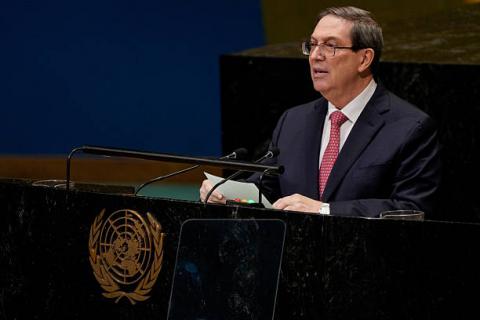
Mr. President of the General Assembly,
Madam Deputy Secretary-General,
In approximately three hours, it will be exactly 66 years since the Commander-in-Chief Fidel Castro Ruz, in a memorable speech at this very podium, declared: “Let the philosophy of plunder disappear, and the philosophy of war will have disappeared! Let colonies disappear, let the exploitation of countries by monopolies disappear, and then humanity will have reached a true stage of progress!”
Yet today, the advance of expansionism, acts of usurpation and conquest, military and economic aggression, is alarming. The United States government’s claim to impose peace by force is absurd and unattainable. Fundamental pillars of International Law and of the United Nations, such as the sovereign equality of States, are under permanent attack.
The genocidal crime of Zionism against the Palestinian people, pirate attacks against vessels and extrajudicial executions in the Caribbean and Pacific, the military aggression against the Bolivarian Republic of Venezuela, and the war against the Islamic Republic of Iran are new manifestations of this atrocity.
They also reflect the crisis of identity and relevance imposed upon the United Nations, even upon this General Assembly, the most universal, democratic, and representative organ of the international community.
We are convinced of the indispensable need to preserve and strengthen the UN, while making it more democratic, effective, and closer to the peoples.
In Cuba, as is well known, we face a multidimensional aggression from the United States government—permanent, abusive, and ruthless hostility lasting nearly seven decades. Since January 2026, it has intensified and become more cruel and dangerous with the establishment of an energy blockade which, through intimidation and coercion, prohibits all countries from exporting fuel to Cuba. This is equivalent to a naval blockade, typified under International Law as an act of war.
Through successive measures, the U.S. government has added prohibitions on all countries regarding products and services that cannot be exported or transported to Cuba. More than 7,000 containers have been detained in various ports, many of them carrying food, medicines, and medical devices, even contracted by private Cuban companies.
In an unprecedented act, a superpower unilaterally deprives all States of the right to export the product they wish to the country they wish, systematically violating freedom of trade and navigation.
This is compounded by intimidation of entrepreneurs from various countries to abandon, against their will, their investments and businesses in Cuba; obstacles to prevent the arrival of legitimate commercial shipments; pressures to block the flow of visitors and tourists; and efforts to limit Cuba’s legitimate access to financing, technology, and markets.
The U.S. government even pressures sovereign governments to renounce medical services requested for their populations, altruistically provided by Cuban professionals. Last Thursday, while this Assembly was in session, the U.S. State Department convened a humiliating meeting with recipient States to exert pressure and issue threats.
The official policy of the United States, as described by its Secretary of State, is to close every valve, every outlet, every formula of survival for Cuba.
The impact of such a ruthless siege has a human face. The economic war targets the people. It takes lives, causes pain, generates anguish. It is not “collateral damage.” It is a deliberate policy designed to wound Cuban families, prevent well-being, and harm the dignity of the people.
It is collective punishment, a crime proscribed by International Humanitarian Law. Its immediate goal is to induce a humanitarian crisis in Cuba—another crime.
The U.S. government has had to acknowledge the suffering inflicted, yet shamelessly insists on blaming Cuba. The executioner blames the victim.
This follows the formula defined in the infamous Mallory memorandum of 1960, which established as official policy the overthrow of the Cuban government through economic strangulation and extreme suffering of the people.
The U.S. President declared at this podium days ago that Cuba is a failed state. If that were so, why impose a fuel blockade, secondary sanctions, threats, and pressure on all States of the planet? He also admitted his government imposes on Cuba the greatest pressure ever exercised. Months earlier, he had said: “The only thing left is to go in and smash the place.”
The threat of military force against Cuba persists, a violation of International Law and a grave contravention of the Charter of San Francisco.
Were it to materialize, it would be a crime of great magnitude, causing Cuban and American deaths and enormous destruction. We hope it never occurs. Cuba would exercise, with full determination and energy, its legitimate right to self-defense.
This aggression is accompanied by a brutal media and cognitive war, aimed not only at the Cuban people but also at U.S. citizens and global public opinion. It is characterized by crude interference in Cuba’s internal affairs—another international crime.
The U.S. government openly declares its objective: to seize Cuba, control the country, dominate its economy, and annul its sovereignty—sovereignty for which generations of Cubans have fought since the 19th century, and defended tenaciously since 1959.
The claim that Cuba is an “unusual and extraordinary threat” to U.S. national security is a shameless falsehood. Any minimally informed observer understands the absurdity of presenting a small developing nation as a threat to the world’s greatest nuclear, military, technological, and economic power.
This Organization and its Member States have abundant evidence that Cuba is a country of peace, committed to international cooperation, understanding, and the peaceful settlement of disputes, and has always actively supported the United Nations.
Cuba is not a threat. The blockade is!
We remain willing to dialogue with the U.S. government to resolve bilateral differences on the basis of seriousness, respect, sovereign equality, and observance of international law, without interference or preconditions.
We are aware of the immense challenge facing our nation for its security, survival, and well-being. We do not face it passively, but with firmness and dignity.
On that basis, we advance in a process of profound transformation of our economic and social model, anchored in our historical experience.
President Miguel Díaz-Canel stated last July: “In the current complex scenario, how do we persist in building socialism, how do we find resources to maintain the social achievements of the Revolution? As in previous difficult stages, we undertake the transformations required by the moment, under the leadership of the Party, in consultation with the people, without compromising independence, sovereignty, or social achievements.”
The National Assembly approved a novel program with new practices, actors, and economic concepts, all within our Constitution and socialist rule of law.
As General of the Army Raúl Castro Ruz emphasized: “The most important thing will be proper and timely implementation, with well-defined priorities and conscious participation of the people.”
This process rests on the strength we have built, the potential of our human resources, and the determination to respond to the needs of the people with the greatest possible social justice, while defending sovereignty and self-determination.
We know we count on the support of the international community and the solidarity of millions, including increasing numbers of U.S. citizens.
Mr. President,
We reject the Monroe Doctrine and its corollaries, as we repudiate all attempts at militarization, intervention, or imperial domination in Latin America and the Caribbean, proclaimed a Zone of Peace in Havana in 2014.
We express solidarity with small island developing States, with victims of unilateral coercive measures, with Nicaragua, Puerto Rico, Africa, the Caribbean, the Sahrawi people, and reaffirm support for the principle of One China.
We are convinced that the current course of international relations—marked by disrespect for International Law, contempt for the United Nations, and imposition of unilateral will—is dangerous and unsustainable. The law of the jungle cannot be humanity’s future.
Let us recover the role of the United Nations before it becomes a frustrated dream of great promises.
On its centenary, let us trust, as Fidel Castro Ruz did, that if we fight with determination, a better world will be possible.
Homeland or Death! We shall overcome!