
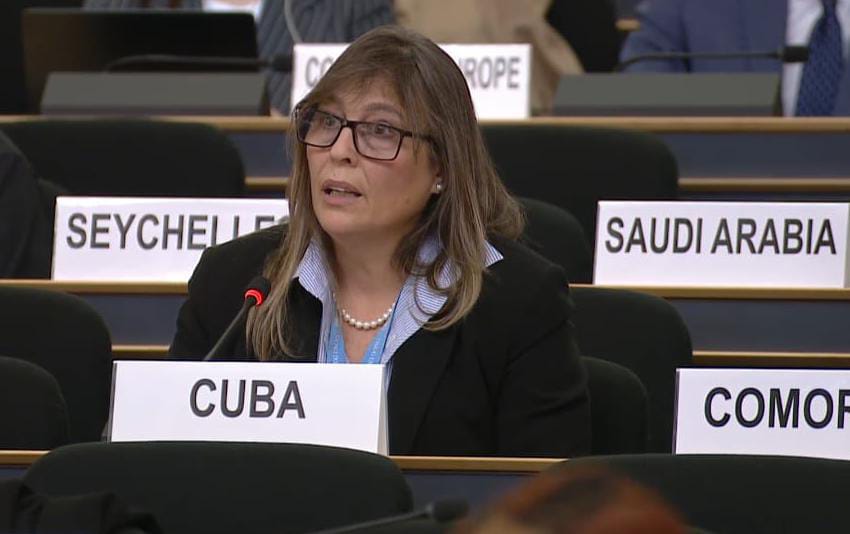
Mr. President,
This session takes place at a critical moment for multilateralism and international cooperation.
Lasting solutions are needed to address the current global crisis of refugees and displaced persons. This requires tackling its structural causes: poverty, inequality, conflict, interventionism, and the disregard for the sovereignty of nations.
Greater financial support and more active participation from developed countries in funding humanitarian responses are urgently needed. The main burden of hosting and caring for refugees and displaced persons cannot fall on low- and middle-income countries, which already face enormous challenges.
It is essential to eliminate, without delay, all unilateral coercive measures that affect countries of the Global South and generate cumulative effects that directly impact living conditions, development opportunities, and, consequently, decisions regarding mobility.
Cuba reaffirms its commitment to the principles of solidarity, inclusion, and respect that must guide the global response to this crisis.
Mr. President,
The Palestinian people have suffered forced displacement, illegal occupation, and the violation of their fundamental rights for decades.
The genocide being carried out by Israel against the Palestinian people has caused a humanitarian crisis of horrific proportions. The aggression and genocide must end immediately.
We reiterate our firm support for the right of Palestinians to live in peace, with dignity, and in a sovereign state.
Mr. President,
Cuba strongly rejects the political manipulation of the refugee category. We deeply regret that the recent Olympic Games became a stage for the unacceptable politicization of this important figure under International Law.
The arbitrary inclusion of two athletes of Cuban origin in the Olympic Refugee Team was a clear violation of the Convention Relating to the Status of Refugees and a complete distortion of the noble initiative behind the creation of that team.
The Office of the High Commissioner arbitrarily validated the refugee status of these athletes and included them in a team publicly presented as young athletes “uprooted by war or persecution.”
Cuba does not oppose athletes and coaches of Cuban origin pursuing their sports careers in other countries. What Cuba does not accept—and finds outrageous—is manipulation. UNHCR must not engage in selective and discriminatory practices that undermine its credibility.
We urge the Office of the High Commissioner to carry out its functions in strict adherence to its mandate and to review, in coordination with the International Olympic Committee, the procedures for granting scholarships and selecting members of the Olympic Refugee Team.
We also consider it imperative to ensure greater transparency regarding the operation of the Olympic Refuge Foundation, in which the High Commissioner serves as vice president.
Sport should be a space for integration, respect, and self-improvement—not a tool to validate narratives that stray from the humanitarian spirit that must guide UNHCR’s actions.
This position has been clearly conveyed by Cuba to UNHCR, respectfully but firmly.
What occurred does not reflect the relationship of mutual respect and cooperation that has always existed between Cuba and UNHCR, thanks to which thousands of refugees have benefited from Cuba’s solidarity over more than 30 years.
Cuba has historically been a host country, offering protection and opportunities to people displaced by conflict or natural disasters. We have done so without great resources, but with deep humanist conviction.
Refugees in our country are guaranteed free medical services, subsidized goods, and professional development while residing in our territory. We have granted government scholarships to more than 3,500 young refugees.
Cuba continues and will continue these efforts despite the terrible impact of the criminal blockade imposed by the United States against our country, which has intensified to extreme levels in recent years.
Finally, Cuba reaffirms its commitment to the Global Refugee Forum process and to the review of progress scheduled for December 2025. We urge all States and stakeholders to redouble their efforts toward a more just, equitable, and effective humanitarian response.
In times of crisis, international cooperation is not an option it is a moral obligation.
Thank you very much.