
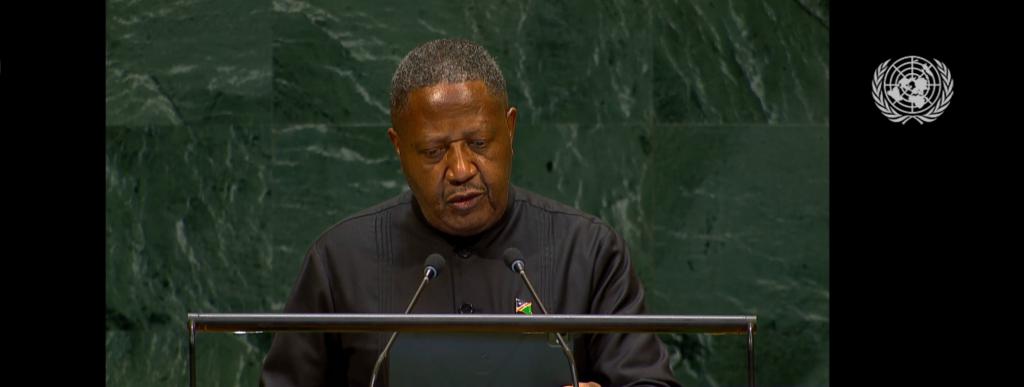
STATEMENT BY H.E. AMB. PENDA NAANDA PERMANENT REPRESENTATIVE IN UN, ON THE OCCASION OF THE GENERAL ASSEMBLY DEBATE ON THE “NECESSITY OF ENDING, ECONOMIC, COMMERCIAL, AND FINANCIAL UNITED STATES BLOCKADE ON CUBA”
TUESDAY, 27 OCTOBER 2026.
Mr. President,
1. Namibia welcomes the convening of this meeting and the opportunity to address an issue that has remained before this Assembly for far too long: the economic, commercial and financial blockade imposed on the people of Cuba.
2. Namibia aligns itself with the Statements delivered on behalf of the African Group and the Non-Aligned Movement, and the Group of 77 and China.
3. For decades, the Cuban people have endured the devastating consequences of a policy that restricts their access to essential goods, constrains development and imposes hardship on ordinary families. Namibia reaffirms its steadfast
solidarity with the Government and people of Cuba and calls for the immediate and unconditional lifting of the blockade and the termination of unilateral coercive measures against Cuba.
4. This issue is not merely a matter of economic policy; it is a matter of human rights and dignity. Restrictions affecting medicines, medical equipment, fuel and other essential supplies place an additional burden on the Cuban population. Namibia therefore calls for an end to the energy siege against Cuba, and urges its removal from the unilateral list of States designated as sponsors of terrorism.
Mr. President,
5. The effects of unilateral coercive measures extend beyond the countries targeted. They disrupt legitimate trade, restrict financial transactions, and adversely and unfairly affect third States, businesses and individuals. These extraterritorial effects undermine international cooperation and create further obstacles to achieving the SDGs.
6. More fundamentally, unilateral coercive measures are genocidal, they undermine multilateralism, disregard the sovereign equality of States and the principles of the UN Charter. By replacing dialogue with pressure and cooperation with punishment, we weaken confidence in international law and the multilateral system.
7. In this regard, Namibia welcomes the General Assembly’s decision in June 2025 to designate 4 December as the International Day against Unilateral Coercive Measures aimed to raise awareness of their humanitarian, economic and social consequences, and to reaffirm the need for international relations grounded in international law.
Mr. President,
8. Cuba’s painful experience demonstrates the human cost of prolonged economic isolation. Behind every disrupted shipment, delayed payment and blocked transaction, are people whose lives and livelihoods are affected. The consequences are felt by patients, families and communities struggling to access essential goods and services. The Cuban people deserve to live in dignity and to pursue their development aspirations free from the burden of this prolonged blockade.
9. Since 1992, the General Assembly has consistently called for an end to the blockade against Cuba. The continued disregard of these resolutions undermines the collective will of Member States, and erodes the credibility of the United Nations. Namibia calls for renewed international efforts to translate these Resolutions into concrete action.
10.Differences between States must be addressed through dialogue, diplomacy and good-faith engagement, not through measures that inflict hardship on ordinary people.
11.Respect for sovereignty, independence and non-interference must remain the foundation of international relations.
Mr. President,
12.This General Assembly cannot stand idle and watch the suffering of the people of Cuba indefinitely. For how long?
13.This institution was created to address such injustices, and it behoves on all of us to respond to such injustices perpetrated in the eyes of the world.
14.In conclusion, Mr. President, Namibia stands in solidarity with Cuba and calls upon the United States to lift the embargo and engage Cuba in meaningful bilateral dialogue based on mutual respect and respect for the sovereignty and independence of Cuba.
15.It is time to end this isolation and to choose cooperation over confrontation, and solidarity over silence.
Thank you.