
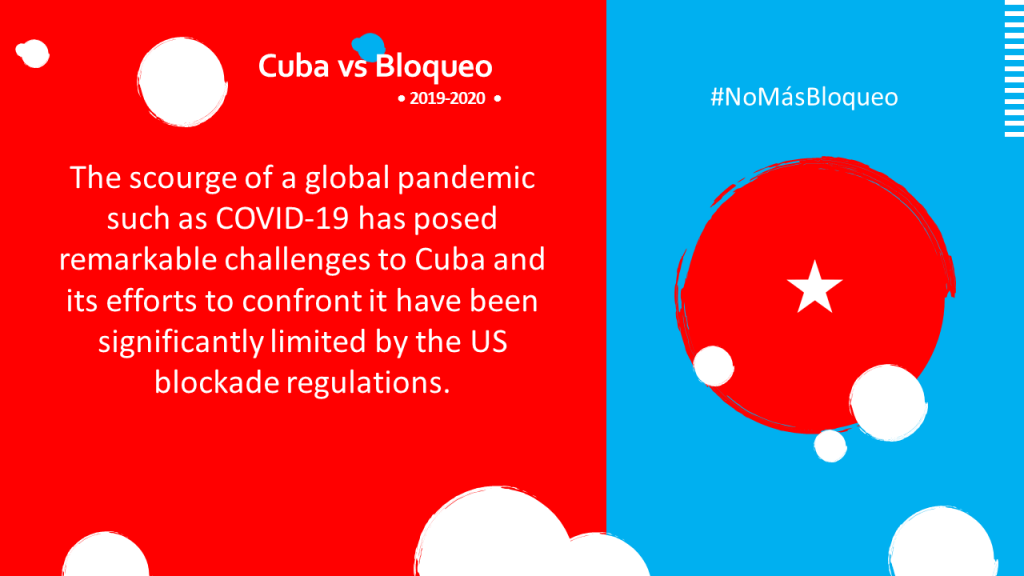
New York, 8 December 2020. The US blockade is the main hindrance to the implementation of the National Economic and Social Development Plan, the 2030 Agenda and its SDGs in the country. From April 2019 to March 2020, this policy has resulted in losses in the health sector on the order of 160 million 260 thousand 880 dollars; while the damage accumulated over nearly six decades amounts to over 3 billion dollars.
The health sector has invariably remained among the priorities of the Cuban government, which in 2019 earmarked 27.5% of the social expenditure budgeted for this area. Despite efforts made to ensure accessible, free and quality health care services as well as the protection and recovery for all citizens, the impact of the blockade on this sector is considerable.
The blockade denies access to medical technologies of US origin or which contain more than 10% of components coming from that country. In many instances, the new technologies that allow for greater accuracy in the diagnoses, treatments and speedy recovery of patients undergoing less invasive procedures, cannot be procured. This policy also disrupts the implementation of important National Healthcare Programs, such as the Mother and Child Care Program, the Care of the Critically-ill Patient Program, the Comprehensive Cancer Control Program, as well as several programs targeting the prevention and control of Non-communicable Diseases, among others.
The negative impact of the blockade is worsened and has proven to be more ruthless within the current context of tackling the COVID-19 pandemic. This policy entails an additional pressure for our public health system by hampering the procurement of materials, equipment and other supplies which are urgently needed to save lives.
A well-known case, disclosed in March 2020, dealt with a donation of mechanical ventilators, diagnostic kits, facemasks and other medical supplies needed to fight the COVID-19 that was sent by the Chinese company ALIBABA, which was unable to arrive in the Cuban territory. The transport company under contract refused to send the cargo to Cuba, claiming that its main shareholder was a U.S. company, so it was subject to the blockade regulations.
Another regrettable example was the case related to the Swiss companies IMT MEDICAL AG and ACUTRONIC MEDICAL SYSTEMS AG, which put forward the argument of the sanctions of the blockade to refuse to deliver high-tech mechanical ventilators to Cuba, essential for the treatment of patients infected with the novel coronavirus. These two companies, considered world leaders in the development and manufacture of the aforesaid medical equipment, have done business with Cuba in the past. Both were acquired by VYAIRE MEDICAL INC. a company based in Illinois, USA, and consequently have been forced to stop all commercial relations with our country.
Permanent Mission of Cuba to the United Nations.