
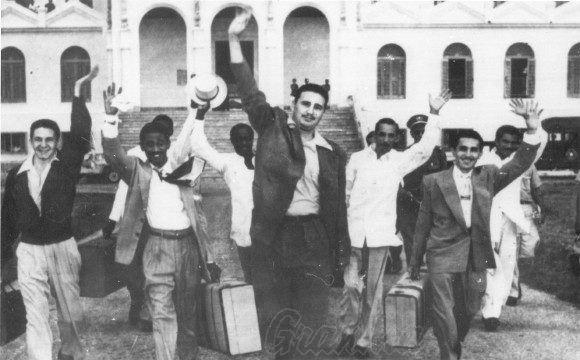
Release of Fidel Castro and his companions after the assault on the Moncada and Bayamo barracks.
Author: Marta Rojas | internet@granma.cu
May 15, 2021 12:05:43 AM
"It should not be forgotten that we Cubans love peace, but more freedom ... Amnesty is the first great victory of the Cuban people." This is what Fidel said in his statements to the press, in the port of Batabanó, when he disembarked with his companions, from the ship Pinero, coming from Isla de Pinos, where they were in prison for the assaults on the Moncada barracks and the Bayamo barracks, on 26 July 1953.
- How many were the participants in the actions of July 26? –A journalist asked him, and he answered:
–165 between Santiago and Bayamo.
"How many died?"
- About 80, about ten fighting.
There were many more questions answered by Dr. Fidel Castro: "Our freedom will be the fight without truce," he said.
Little more than 16 months had elapsed in captivity, in which he and the other moncadistas suffered, without wavering, all kinds of humiliations. For Fidel, jail turned out to be another exercise in patriotism. The letters to family and friends are eloquent: "What matters now is to save the principles: everything is saved if the principles are saved: from the depths of the rot the redemptive ideal will emerge more purified and clean," he wrote.
The Isla de Pinos prison served so that he could read a universe of political, historical, novels and other works of interest to him, and reconstruct his historical allegation History will absolve me, which the people of Cuba would know immediately . His companions Haydée and Melba contributed to this work, both of whom were already out of prison in the women's prison in Guanajay.
They responded to Fidel's call to them: to denounce the horrendous crimes, publicizing his allegation and the revolutionary program contained in the brochure. He asked them to have 100,000 copies printed with popular favor, an immense number, but one that encouraged his companions. They managed to get 10,000 brochures published. According to Fidel's instructions to his companions, the speech or allegation had to be distributed from one end of the island to the other, in four months at the most, in the midst of the greatest difficulties. And so it happened.
That was the engine that triggered the plan to demand amnesty by the people, already informed of the whole truth that the press censorship hid and misrepresented. Thus was unleashed, not without few sacrifices, a plan that culminated in the approval of the Amnesty Law for the Moncadistas, demanded from one end of the country to the other, based on a propaganda led, under great risks, by Marti Women and other colleagues.
Fidel, in a letter to a friend, wrote from prison: "(...) days before they took me to court: I had not seen open fields or horizons for a long time ... only eight and a half months, but how much I have had to suffer. It was the moment in which he was taken to the Isla de Pinos Court, where he ratified the accusations made by him, as a lawyer, accused and accuser, in the Moncada trial (Case 37), in which he requested several times that it be "deduced" testimony on the crimes perpetrated by the military. The events had been denounced at the Santiago de Cuba Hearing, on September 21, 1953.
When he went to the Isla de Pinos Court, Fidel and his companions had been locked up in the Modelo Prison for eight months. The ratification of his words in Case 37 was to have as a result that the accused soldiers were also tried. Then the eighth month of incarceration was passing. The fact that they took him to court went unnoticed ...
The campaign for amnesty became unstoppable, after a large part of the people learned of the atrocities committed with the prisoners on July 26 and on successive days, after the assault led by Fidel.
The Pro Amnesty movement for the Moncadistas coincided with an orchestrated plan for the general elections promoted by the de facto regime, a management in which representatives of the opposition parties were inserted, under the banner of peace. The revolutionary campaign of amnesty for the Moncadistas became general. The popular action for the Amnesty Law was impressive throughout the country.
The de facto government had to fold: the popular force was tremendous and thus it was forced to enact the Amnesty Law that the people requested in those circumstances. The then young lawyer did not speak for him, but declared from prison: "I neither ask nor will I ever ask for amnesty." Thus he said in the Isle of Pines.
But the Amnesty Law, incredibly for not a few people, was dictated by the Batista government. The Moncadistas were included in it.
Thus, on May 15, 1955, Fidel and the other Moncada assailants were released from prison. He would declare: «Our freedom will be one of fight without respite. I will know how to do what is necessary at all times and not what the enemy wants. The national conscience is reborn, trying to drown it would bring an unprecedented catastrophe.
At that time it was called the "percha law", some suspicious element that appeared in a legal document such as the Amnesty Law, issued by the government. This law favored all the defendants involved in the events of July 26. Obviously, it also benefited the military accused of crimes, according to that "legal" hanger that said law contained - the date that included July 26, 1953 - as a starting point. Thus, the military accused of crimes, according to the aforementioned date, would also be included in the benefit.
After six weeks on the streets, starting on May 15, 1955, Fidel Castro would say: "So there is no other solution than 68 and 95." And he marched to Mexico, where he prepared the Granma expedition. The vast majority of the people had already benefited him. He was the only opposition leader whom they believed in, and whom they followed. It would take until 1959, after the triumph of the Revolution, after the intense and victorious struggle in the Sierra Maestra and other revolutionary fronts, for many of those soldiers - some managed to escape - were sentenced in war crimes trials.