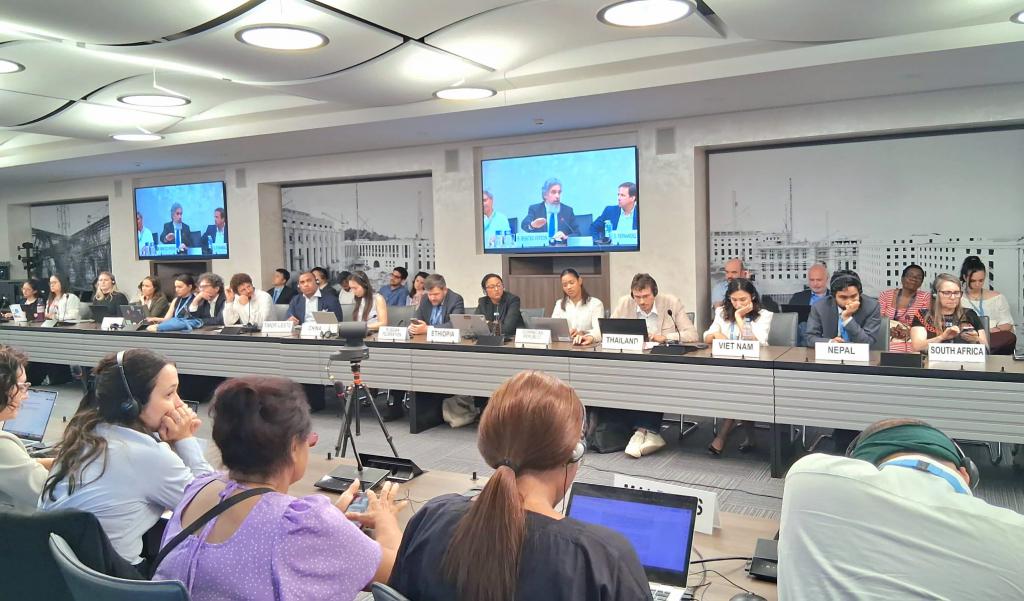
Title of the presentation: Preliminary proposal for short- and medium-term practical actions to formally recognize the right to peace as a human right. The case of Cuba.
1. Introduction
I will share with you our proposal for practical actions to be carried out in the short and medium term, as a follow-up to the 2016 Declaration on the Right to Peace.
This is a preliminary proposal, so some of the practical actions I will explain may be adjusted, depending on the evolution of the international situation and the outcome of our consultations with other countries.
2. Main Strengths and Weaknesses of the 2016 UN Declaration on the Right to Peace
Cuba was one of the strongest proponents of the Declaration on the Right to Peace, adopted 10 years ago by the Human Rights Council (HRC) and the United Nations General Assembly (UNGA).
We consider this Declaration a milestone. It represents a very important step forward in political and legal terms. It is a text with many merits. I will mention just two of them:
First: The 2016 Declaration defines peace for the first time in a broad and comprehensive dimension. Until then, the negative definition of peace, deeply rooted in Western culture, had prevailed within the multilateral system. That is, peace was traditionally defined as the absence of conflict, the absence of violence.
Cuba and many other countries have always advocated for a broad definition of peace. Of course, peace means the absence of violence. Where there is violence, there is no peace. Violence constitutes the negation of peace. There is no doubt that recognizing peace as a right is also an effective way to act against violence.
But peace is not only the absence of violence. Peace, from our perspective, is nonviolence plus justice and development. And essentially, this broad perspective is enshrined in the definition of peace that appears in the 2016 Declaration.
This is an important achievement, a significant step forward that we must nurture.
Second: Another great merit of the 2016 Declaration, and in my opinion the most relevant, is that, by virtue of this text, the UN General Assembly explicitly recognizes for the first time that everyone has the right to enjoy peace.
Thirty-two years earlier (1984), the UN General Assembly had already adopted, through its resolution 39/11, the Declaration on the Right of Peoples to Peace, which recognized the right of peoples to peace.
This means that, with the 2016 Declaration, both the collective and individual dimensions of the right to peace are now explicitly recognized by the UN General Assembly.
It has been established since 2016 that peace is a right of both states and individuals. And by recognizing the individual's entitlement to this right, the 2016 Declaration lays the necessary groundwork for peace to be recognized not only as a right, but also as a human right.
But here lies what, in our opinion, is the main shortcoming of the 2016 Declaration: It does not explicitly recognize peace as a human right.
This limitation was the result of concessions necessary to secure the Declaration's adoption.
This is why Cuba believes that the 2016 Declaration is not the end of the road regarding this issue within the multilateral system. The task of codifying the right to development is not yet complete.
The current international context demands further progress. We must begin the process to take the next major step: achieving formal recognition of peace as a human right and fully incorporating it within third-generation human rights.
From both a political and practical standpoint, it is necessary to take this step. In my opinion, it is technically feasible to achieve it within the next three years.
2. Factors Favoring the Formal Recognition of the Right to Peace as a Human Right
Several factors favor moving in this direction. I will mention some of them.
First: Peace meets all the requirements to be formally recognized as a human right. Human rights are those rights that are inherent to all human beings, without distinction.
Likewise, peace meets the requirement of being an interdependent, indivisible, and universal right. The connection between peace and other human rights is undeniable. Without peace, the rest of the human rights cannot be realized.
Second: The human right to peace has a solid legal and normative foundation, the result of sustained, progressive advancement toward its codification that has been taking place for decades within the multilateral system.
I will mention some key references within this progressive development:
First, the Charter of the United Nations, of 1945: This is a fundamental reference point, as it proclaims the maintenance of international peace as the UN's primary purpose.
This primary purpose of the UN is not found in any of the 111 Articles of the Charter, nor in any of the 19 Chapters of the document. It is reflected in Chapter 1, Article 1, paragraph 1. That is to say, peace appears in the very first sentence of the Charter's text, as its primary purpose.
Furthermore, in the Charter's Preamble, which is brief, with only 9 paragraphs, peace is mentioned twice, and the first sentence of the Preamble—that is, the first sentence of the Charter—is: “We the peoples of the United Nations, determined to save succeeding generations from the scourges of war.”
From 1976 onwards, resolutions began to be adopted, both in the former Commission on Human Rights and in the UN General Assembly, proclaiming the right to live in peace. Note that the expression "right to peace" was not yet used, but rather "right to live in peace," but progress was being made.
In 1984, with its resolution 39/11, the UN General Assembly referred for the first time explicitly to the right to peace, in this case as the right of peoples to peace.
And in 2016, the Declaration on the Right to Peace was adopted, representing the most significant progressive development of the issue to date.
Similar legal precedents exist with other third-generation human rights. This is the case with development, which underwent a similar progressive development to the right to peace and was already recognized in 1986 by the UN General Assembly as an inalienable human right.
The human right to development was also strongly opposed for years by a group of countries, and yet today it has monitoring mechanisms in the Human Rights Council (HRC): a Special Rapporteur, an Expert Mechanism, and an Intergovernmental Working Group. A draft legally binding international instrument for its codification is even being negotiated in the UN General Assembly.
The right to international solidarity is currently following a similar path, and it is highly likely that the Declaration on the Human Right to International Solidarity will be adopted next year by both the HRC and the UN General Assembly.
Cuba will present a resolution at this session of the HRC calling for the conclusion of consultations on the topic in April of next year, and we hope that in June 2027 we can adopt the HRC resolution recommending that the UN General Assembly adopt a Declaration recognizing the human right to international solidarity.
The human right to peace may follow a similar trajectory.
3. Practical Actions in the Short and Medium Term to Achieve Formal Recognition of the Right to Peace as a Human Right
Several practical steps must be taken in the Human Rights Council and the UN General Assembly to formally recognize the human right to peace and advance its progressive codification.
We propose the following five concrete actions in the short and medium term:
1. Hold consultations next year in the Human Rights Council to adopt a follow-up resolution to the 2016 Declaration on the Right to Peace, recommending that the UN General Assembly recognize the human right to peace.
2. After the Human Rights Council adopts the resolution, submit a draft resolution to the UN General Assembly for the formal recognition of the human right to peace.
3. Following recognition, establish a specialized mechanism within the Human Rights Council (HRC), such as a Special Rapporteur or a Working Group, tasked with implementing the human right to peace. This should begin with developing indicators and technical guidelines to allow for an objective and verifiable evaluation of the implementation of this right.
4. Promote a process of progressive codification of the human right to peace within the UN General Assembly (UNGA), creating an intergovernmental Working Group or a Group of Experts to draft a legally binding instrument on the human right to peace.
5. As a final step, work towards the UNGA adopting, as soon as possible, a Convention or Covenant for the implementation of the human right to peace.
4. The Case of Cuba
The case of Cuba illustrates the urgency and relevance of defending the human right to peace.
Our country faces a threat of military aggression from the United States. As a pretext, the US presents our small island as a supposed threat to the national security of the nuclear superpower.
The Executive Order on Cuba, signed by President Trump on January 29, declares a national emergency in the United States due to the unusual and extraordinary threat to the country's national security that Cuba supposedly poses.
Such a claim defies logic and common sense. Cuba is not, and cannot be, a threat to the United States. They are lying to justify a new, irrational war.
Our country is not an enemy of the United States, nor does it wish to be, despite significant differences with its government.
We do not want a conflict. Cuba is a nation of peace. We hope that dialogue will prevail over confrontation.
But if military aggression occurs, the Cuban people will fight, to the bitter end, to defend their sovereignty and independence.
At the same time, the United States has intensified its economic, commercial, and financial blockade against Cuba to unprecedented levels, the cumulative effects of which we have already suffered for almost 70 years.
Since January 29, the United States has imposed a total fuel embargo on Cuba. They prevent any country from selling oil to Cuba by threatening sanctions against anyone who dares to do so. In effect, this fuel blockade is a naval blockade, which is an act of war.
The consequences are devastating. Our people suffer daily from prolonged power outages, difficulties in water supply, transportation, community services, and the production and distribution of food, goods, and services. The health and education systems, among many other sectors, are severely affected.
This is a plan to provoke a humanitarian crisis in Cuba that will lead to social unrest. They are subjecting millions of people to scarcity, deprivation, and extreme hardship for political purposes.
These actions are clearly contrary to the spirit and letter of the 2016 Declaration on the Right to Peace.
We call on everyone to prevent aggression against Cuba and to prevent a humanitarian catastrophe from being imposed on our people, whether by force of arms or through the fuel blockade.
I conclude by thanking all those who have expressed their solidarity and support for Cuba in these difficult circumstances.
Thank you very much.