
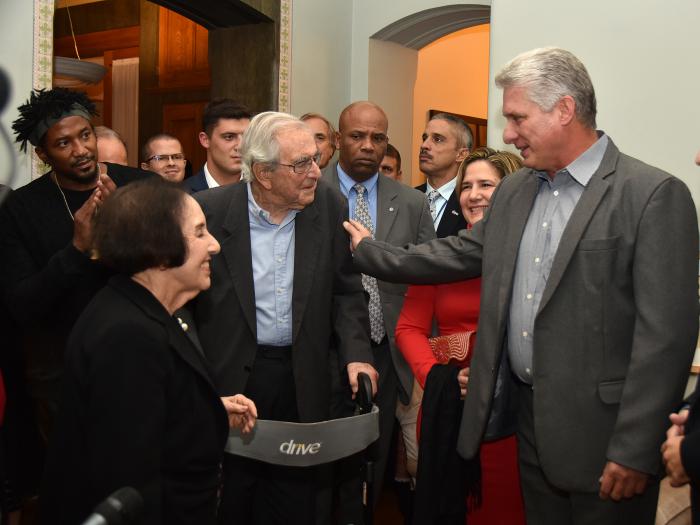
New York, September 29, 2018. The President of Cuba Miguel Mario Díaz-Canel Bermúdez arrived in New York City on September 23 to attend the General Debate of the 73rd session of the United Nations General Assembly. He developed a broad bilateral agenda with representatives of several sectors of the American society, interested not only in listening to the projects of the Cuban president - who has only six months in office - but also improving the relations between both nations, hindered by the hostile policy of the current North American leader Donald Trump.
Miguel Diaz-Canel began his bilateral agenda on September 24 at the Google headquarters in New York, where he met with executives from several companies of the technologies sector. Invited by Eric Shmidt, Vice-president of Alphabet, the Cuban President exchanged with the attendees on the development of high technologies, their role in the advancement of developing countries and the challenges for their use in an increasingly unequal world. He also stressed that the computerization of society is a priority of the Cuban government. Likewise, he emphasized that the economic blockade by the United States is the main obstacle to achieving the development of this area to its maximum capacity.
On the same day, he met with members of the United States Congress. In the presence of Senators and Representatives of the Chamber of both parties, the president ratified the will of Cuba to promote the progress of bilateral relations between Cuba and the United States, and to make the most of the potential of cooperation between both countries on the basis of equality and mutual respect. He affirmed that the setback of the US policy toward Cuba and in particular the blockade damage both peoples and hinder the progress of relations. Diaz-Canel thanked those present for their efforts to facilitate a climate of rapprochement between the two countries and invited them to continue working in favor of that process.
After a long morning and afternoon at the United Nations, on September 26, Miguel Diaz-Canel held a meeting with Bill de Blassio, Mayor of New York, at the headquarters of Cuba to the world organization.
The Cuban President expressed his satisfaction for the warm welcome received in the city of New York, a city inhabited by many friends of the island and in which strong feelings of solidarity have always been expressed. He thanked the mayor and the city for their efforts to achieve the unveiling in Havana of the replica of the José Martí equestrian statue, located in the Central Park of the city of New York.
On September 26, he participated in a friendship and solidarity ceremony with a large and diverse group of friends of Cuba in the United States. The event was held at the Riverside Church in the New York neighborhood of Harlem, where in 1960 Fidel Castro was welcomed, following the disdain of local authorities. The solidarity movement was represented by dozens of members of groups such as: IFCO / Pastors for Peace, Casa de las Americas in New York, the July 26th Coalition, the Socialist Workers Party of the USA, the NYC Jericho Movement, the Communist Workers League, the Venceremos Brigade, among others.
On the occasion, Díaz Canel recalled that in 1960, Fidel Castro found shelter in Harlem, ratifying the phrase: "I'm going to Harlem, because my best friends are there." He recalled that: "Cuba also owes a lot to international solidarity and to the solidarity of thousands of friends and activists here in the United States, among whom are many Cubans residing here."
On Thursday, September 27, the President of the Council of State of Cuba held a meeting with businessmen and leaders of different organizations of the agricultural sector of the United States, organized by the US Agriculture Coalition for Cuba (USACC) and by the National Association of State Departments of Agriculture (NASDA). Thanks to the pressures of this group on Washington, sales of agricultural products and food to Cuba began, which are carried out in a single direction since the prohibition of Cuban exports to the United States is maintained by the laws that support the blockade to the island.
This meeting demonstrated the interest that this North American economic group has in the trade of the island and in the lifting of the blockade, to which Diaz-Canel responded by assuring that is not Cuba the one that puts obstacles to commercial relations with the United States. In this meeting took part, among other executives, Barbara Glenn, executive director of NASDA; Paul Johnson, president of USACC; Thomas Sleight, executive director of the US Grains Council; and the commissioners of Agriculture of the states of Connecticut, Virginia, Minnesota and New Mexico.
Afterwards, Díaz Canel met with Cardinal Timothy Michael Dolan, Archbishop of New York City, meeting that took place at the legendary Saint Patrick’s Cathedral. The Archdiocese of New York has a long-standing relationship with Cuba and an attitude of respect and cooperation towards the Cuban nation.
During the meeting, the Cuban President highlighted the bonds of respect and stable and fluid communication between the Catholic Church and the Government of Cuba; and stated that the regression experienced with the current US government, affects Cuban families and ratified the will to move towards greater understanding with different sectors of the American society.
Before the end of that day, the president held a fraternal meeting with Jim Winkler, president of the National Council of Churches, and a group of its members.
In the meeting, the Cuban president acknowledged the long tradition of friendship between the peoples of Cuba and the United States and thanked the solidarity of the National Council of Churches shown in several moments and actions in favor of lifting the blockade, the effort to achieve the return of the child Elián González to his family and the fight for the liberation of the Five Heroes.
On Friday 28th he also had several activities and meetings aimed at guaranteeing a sovereign, independent future for Cuba, and also a socialist, developed and sustainable socialism.
In the morning, he met with a large group of senior executives from the US Chamber of Commerce and the US travel industry, with whom he discussed the opportunities for those entities dedicated to exchanges and travels between Cuba and the United States. He referred to the importance of contact between peoples and to the absurd prohibition of United States legislation that prevents its citizens from visiting Cuba freely.
Diaz Canel affirmed that, in spite of the restrictions, a large number of Americans travel to Cuba every day and enjoy the hospitality, culture, patrimonial wealth, security and happiness of the Cuban people.
In the afternoon, at the invitation of the renowned filmmakers Robert De Niro and Jane Rosenthal, Díaz-Canel enjoyed a private meeting with representatives of the arts and culture sector of the host country, in which he spoke about the historical links that unite the culture of both peoples, whose last expression was the successful Cuban Arts Festival held at the Kennedy Center in Washington last May. He invited the artists to bring the best of American creation to Cuba, to showcase their productions and help to strengthen the ties between the two peoples over political and ideological differences
That same evening took place the meeting of the President of the Council of State Miguel Díaz-Canel Bermúdez with members of the Cuban community residing in the United States.
During the event, the Cuban President recalled the so-called "Dialogue of the 78" as the beginning of the process of rapprochement between Cuba and its emigration. He acknowledged the important role played by Cubans living abroad in the efforts in favor of lifting the unjust economic blockade imposed by the United States against Cuba and thanked the contribution of Cuban patriotic emigration to the improvement of relations between both countries.
His last activity will be tonight, September 29, when he will friendly meet with the officials and workers of the Cuban Permanent Mission to the UN.
Permanent Mission of Cuba to the Unites Nations.