
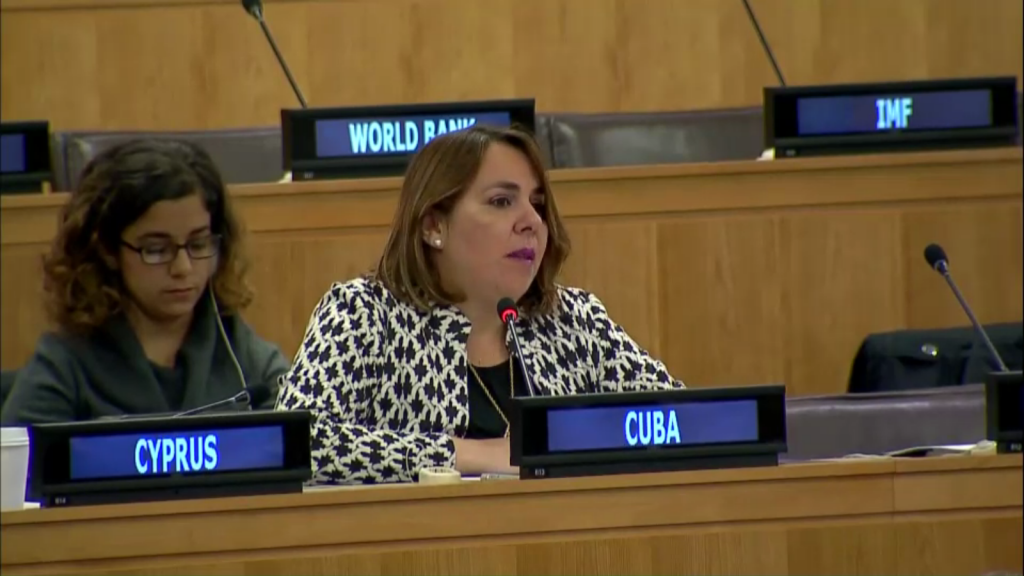
New York, November 22nd, 2017.At her statement on Item 136 "Proposed programme budget for the biennium 2018-2019, Estimates in respect of special political missions, good offices and other political initiatives authorized by the General Assembly and/or the Security Council, Thematic Cluster I: Special and personal envoys and special advisers of the Secretary General”, Deputy Permanent Representative of Cuba, Ambassador Ana Silvia Rodriguez Abascal, stated that the use of the principle of responsibility to protect continues to raise serious concerns in many countries, particularly small and developing countries, due to the lack of consensus and definitions on various elements of the same.
Rodriguez Abascal questioned the creation of the post of the Special Adviser on the Responsibility to Protect, especially when there is no agreement by the Member States on the scope of this concept; which leads to ambiguous interpretations of its content.
The Cuban diplomat also pointed out that the topic of responsibility to protect can be easily manipulated for political purposes, as has been the case of sad examples recorded throughout history and which show that, under the aegis of the responsibility to protect, international law, the sovereignty of the State and its primary responsibility for the welfare of its population have been undermined.
She added that the Cuban position should not be interpreted as a rejection to the work of the Special Adviser on the Prevention of Genocide, whose functions have the full and permanent support of the island, victim of an unjust economic, commercial and financial blockade, which due to its nature and scope, qualifies as an act of genocide, by virtue of Article II of the Geneva Convention of 1948 for the Prevention and Punishment of the Crime of Genocide.
Permanent Mission of Cuba to the United Nations