
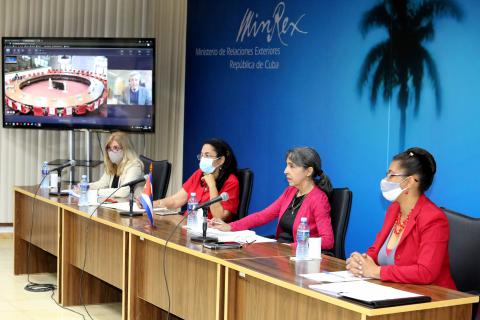
This Thursday, March 25, 2021, the Third Round of the Dialogue on Unilateral Coercive Measures between Cuba and the European Union (EU), held by virtue of the Agreement on Political Dialogue and Cooperation (ADPC) between Cuba and the European Union, held a virtual session. The event continued the meeting held in November 2019 in Havana.
The meeting, held in a respectful and constructive atmosphere, was conducive to discussing the damages caused by the economic, commercial and financial blockade imposed by the United States on Cuba, which affects both the Cuban people and economic and commercial interests. of the EU. In particular, the unprecedented recrudescence of this genocidal policy was highlighted in the context of the confrontation with COVID-19 and the obstacles it imposes for the prevention, treatment and development of vaccines against this disease.
The Cuban side thanked the EU for its position in support of the Cuban resolution in the United Nations General Assembly that calls for an end to the blockade, as well as the condemnation in multilateral forums of the application of Titles III and IV of the Law. Helms-Burton, and the denunciation of the inclusion of Cuba in the List of States Sponsoring Terrorism. An essential segment of the Dialogue was the exchange regarding the regulatory provisions existing in the EU and its Member States to counteract the extraterritorial dimension of the coercive measures applied by the United States to our country.
In this sense, the Parties discussed Regulation 2271/96 of the Council of the European Union, as well as other initiatives that could be developed to deal with the extraterritorial application of the Helms-Burton Law.
The willingness of both Parties to continue discussing unilateral coercive measures was ratified, on the basis of full respect for sovereign equality, independence, legality and non-interference in the internal affairs of the States.
The respective delegations were chaired by María del Carmen Herrera Caseiro, general director a.i. of Multilateral Affairs and International Law of the Ministry of Foreign Affairs of Cuba, and by Javier Niño, deputy director general for the Americas of the European Foreign Action Service.
Previously, on March 24, a meeting of representatives of Cuban and European civil society took place, in which points of view were exchanged on the damages caused by the application of the blockade, fundamentally, in the performance of civil society during the confrontation with the COVID-19 pandemic.
(CubaMinrex)