
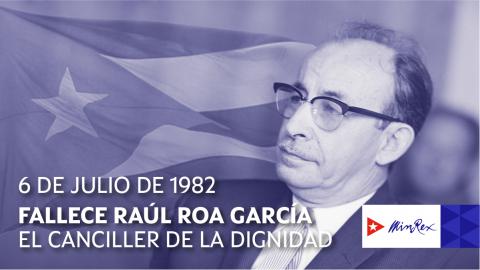
With his own style that he imposed on his historical allegations in different international forums, such as the difficult days of the attack on Playa Girón and the October Crisis, Raúl Roa García stood out in the trench of revolutionary diplomacy.
During the years when he fought important diplomatic battles against the representatives of US imperialism, he left in suspense those who tried to undermine the sovereignty of Cuba with his eloquent and scathing verb.
Impossible to forget his splendid and combative speeches in defense of the Revolution before the Organization of American States and the United Nations, actions that earned him the recognition, respect and admiration of his people and the world.
"The merit is not mine, it belongs to the Cuban Revolution, which I represent," so he used to say when someone congratulated him on the success obtained in one of those spaces to which he attended as Minister of Foreign Affairs. .
Faced with the challenges of the triumphant Revolution in January 1959, Raúl Roa became the best interpreter of the conceptions of revolutionary diplomacy, while pointing out that it was entitled to “duties and responsibilities consistent with its democratic nature, continental projection and universal transcendence ”.
Roa always knew how to fully interpret Fidel's line and positions. (…) It will not be possible to write the history of modern diplomacy in the world, without collecting the struggles and the work that the Chancellor of Dignity led in this field, ”said Cuban revolutionary Armando Hart Dávalos.
"The revolution that the people brought, under the arm of Fidel Castro, is as Cuban as the Sierra Maestra, as American as the Andes and as universal as the highest human values that it embodies", thus masterfully defined the Cuban Revolution at the VII Meeting of Consultation of the Ministers of Foreign Affairs of the OAS.
De Roa highlighted his ability to insert Cuba into a new international sphere in which the revolutionary, anti-colonialist principles of the struggle for the independence of Puerto Rico, to promote relations with the resurgent Africa and the Non-Aligned Movement were pronounced.
He contributed decisively to train a whole generation of diplomats, to consolidate MINREX as a body worthy of the then young triumphant Revolution and, above all, to form a whole school of foreign policy that not only lasts to this day, but also it is projected into the future.
39 years after his death, this July 6, we feel that the undeniable patriot, intellectual, politician and cadre of the Revolution dedicated to diplomacy, represents the principles of foreign policy that defend the mixture of generations of officials and workers of the Ministry of Foreign Relations of the Republic of Cuba.
(Cubaminrex)