
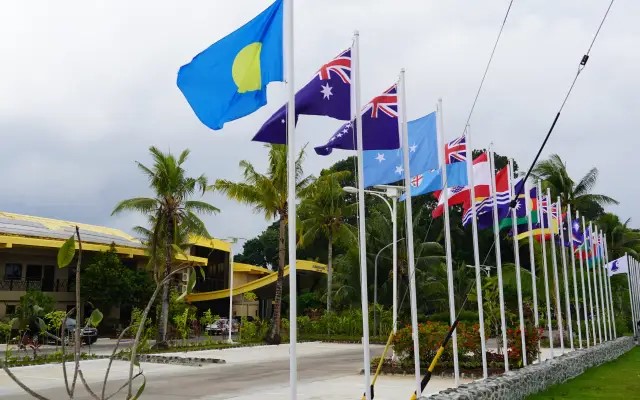
Palau, September 1, 2026.
Honorable President of the Republic of Palau, H.E. Mr. Surangel Whipps;
Distinguished Secretary General of the Forum, H.E. Mr. Baron Waqa;
Excellencies;
Ladies and gentlemen;
Allow me to express my government's deep gratitude for the invitation and for the warm hospitality extended to me since my arrival in Palau.
It is an honor for me to represent Cuba at this important meeting of Pacific Islands Forum leaders with the Organization's Dialogue Partners.
We deeply value the friendship, solidarity, and cooperation we have built with Pacific nations, despite the geographical distance and the limited financial resources available to our countries. The principal architect and inspiration behind Cuba's commitment to friendship with the region was the historic leader of the Revolution, Commander-in-Chief Fidel Castro Ruz. This year, as we commemorate with deep pride the centenary of his birth, we recall that Fidel was also the pioneer of Cuban health cooperation with small Pacific island states, initiating the deployment of medical brigades and scholarship programs for human resource training.
To date, a total of 245 young people from this region have successfully completed their studies in Cuba and reintegrated into their home communities—most as highly qualified health professionals driving social well-being. Complementing this, Cuba has deployed multiple medical brigades to the Pacific, ensuring comprehensive care—both primary and specialized—in the most vulnerable geographical areas.
Cuba reaffirms its full readiness to continue collaborating with Pacific nations through the deployment of medical brigades and the provision of health advisory services. Despite the complex economic difficulties our country is facing, we firmly maintain our annual offer of new medical scholarships for the region's youth. Furthermore, we are making our cutting-edge biotechnology available to the Pacific, including drugs such as Heberprot-P—a unique injectable that accelerates deep-tissue healing to cure severe diabetic foot ulcers and prevent amputations—while also fostering sports exchanges by providing high-performance Cuban coaches.
In this endeavor, we reaffirm our interest in coordinating triangular cooperation frameworks with New Zealand, Australia, and other international partners to generate a direct, positive impact on the development of the region's Small Island States.
Ladies and gentlemen,
The capacity of Small Island Developing States (SIDS) to coordinate—particularly within the Alliance of Small Island States (AOSIS)—and to act cohesively has strengthened significantly, a fact recognized by key development stakeholders.
This will be crucial in the lead-up to several important processes taking place in the final quarter of this year, particularly the COP31 Climate Change Conference to be held in Türkiye.
We consider it a priority for the Alliance that COP31 achieves an agreement on the operationalization of the Just Transition Mechanism agreed upon in Brazil last year. We welcome the coordinated efforts of all developing countries within the G77 plus China toward this goal. This practice must be preserved for the benefit of our common goals and interests. A united G77 plus China—now under Uruguay’s chairmanship—can achieve significant gains for developing countries. A recent example of this is the Loss and Damage Fund, an aspiration of SIDS that was launched at COP28 in Dubai.
We reiterate that the climate finance to be provided as part of the obligations of developed countries under the United Nations Framework Convention on Climate Change and its Paris Agreement does not constitute a favor done to us, but rather a historical responsibility that cannot be ignored—one consistent with fundamental principles such as equity, common but differentiated responsibilities, and respective capabilities.
For Cuba, the current context presents many challenges, including regarding the implementation of ABAS. The cumulative effect of the United States blockade—compounded by the tightening of sanctions, our continued presence on the infamous list of countries allegedly sponsoring terrorism, and the energy blockade imposed over six months ago—has a tremendous impact on the ability of our people and government to pursue any development objective.
We deeply appreciate the expressions of solidarity and support from many SIDS, as we recognize the power of the international community’s majority in speaking out against these measures.
Ladies and gentlemen,
I feel it is my duty to express my country’s support for the vision of the Pacific as a Zone of Peace—a commitment renewed through the historic Blue Pacific Continent Declaration. For Cuba, this stance aligns closely and consistently with the Proclamation of Latin America and the Caribbean as a Zone of Peace, adopted in Havana in 2014. We share with the Pacific an unequivocal commitment to banning nuclear weapons, rejecting external interference, and upholding our peoples' inalienable right to determine their own destiny within an environment of stability, cooperation, and mutual respect.
However, the peace we uphold in Latin America is currently threatened by the interventionist statements made by the current United States administration against Cuba. The economic, commercial, and financial blockade—in place for over six decades—has intensified to unprecedented levels. As President Miguel Díaz-Canel Bermúdez has denounced, we are witnessing the most extensive and profound expression of a "ruthless effort by the planet's greatest power to disconnect the economy of a small island state." The imposition of a criminal energy blockade that restricts fuel supplies—far from being a surgical strike—constitutes a "plan of collective suffocation" coldly designed to break our people and force a change in our political, economic, and social system.
For this reason, we reiterate our gratitude for the historic support of the Pacific islands that have joined the international call to end the blockade against Cuba and to foster a dialogue based on respect for sovereignty and the self-determination of peoples.
We hope to count on this valuable support once again during the 81st session of the United Nations General Assembly, where the presentation of a draft resolution demanding an end to the blockade against Cuba is under consideration.
Distinguished heads of delegation, distinguished guests:
Our country is consolidating and promoting its ties with the Pacific islands through a transparent dialogue among equals, driven by genuine intentions.
We come here fully prepared to share our experiences, while also expressing our sincere desire to learn from you—from the region's immense cultural richness and its exemplary harmonious coexistence with nature.
Cuba reaffirms its unwavering commitment to strengthening alliances with the peoples of the Pacific, proudly preserving the bonds of fraternity and mutual support that unite us.
Thank you very much.
(Embacuba Fiyi)