
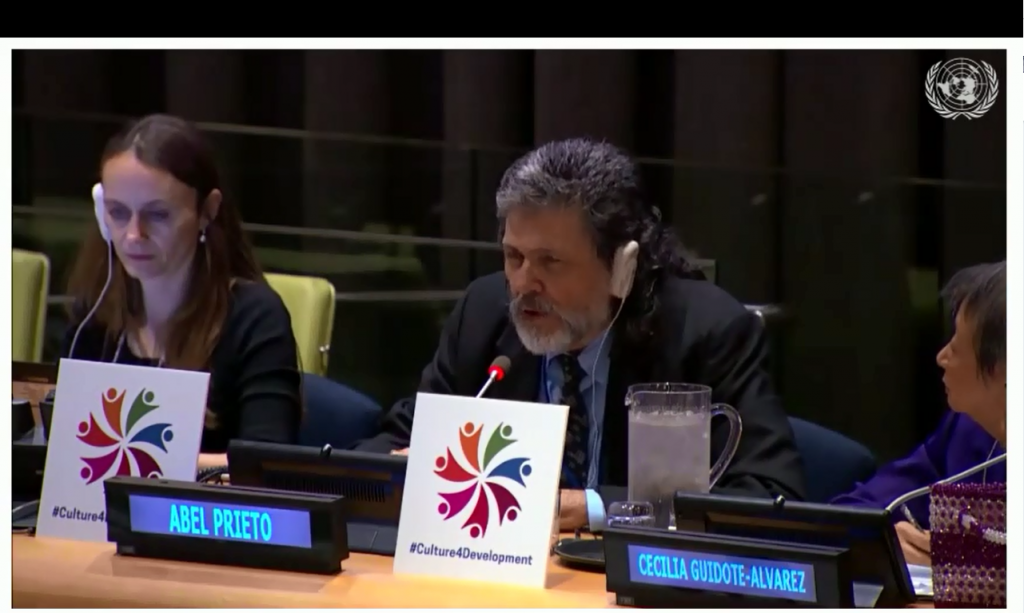
I thank the President of UN General Assembly, María Fernanda Espinosa, for inviting me to participate in an event that addresses such transcendental issues, especially given the particular historic juncture that humanity is experiencing, in the midst of an ethical, cultural and ecological crisis of incalculable proportions.
First, I will address how my country has worked on the 2030 Agenda and I will refer briefly to Cuba's Voluntary Report within the framework of the Third Forum of the Countries of Latin America and the Caribbean on Sustainable Development. (Chile, 22-26 April 2019).
I must reaffirm that Cuba attaches great importance to the 2030 Agenda for Sustainable Development. Accordingly, we have created a mechanism for its implementation, with the Ministry of Economy and Planning as the lead body. It is made up of 32 national bodies and entities, as well as research centers and representatives of civil society. The strategic focus of the National Plan for Cuba’s Economic and Social Development through 2030 is in line with the SDGs. Many of the SDGs are contained in our new Constitution, which was widely discussed with the people and approved by more than 86% of the voters last February 24, with a participation of over 90%.
-As the President Pro Tempore of ECLAC, Cuba submitted its Voluntary National Report on the implementation of the 2030 Agenda within the framework of the aforementioned Forum.
-The report presented by the Cuban delegation states the progress achieved by Cuba and denounces the main obstacle to our sustainable development: the economic, commercial and financial blockade imposed by the United States for nearly 60 years, which prevents us from accessing the leading international financial institutions and maintains a fierce persecution of our transactions.
-This policy of economic suffocation and harassment, condemned at the UN for 27 consecutive years by an overwhelming majority of countries, has been maintained for almost six decades and has intentionally caused the Cuban people ongoing suffering and deprivation.
-This genocidal policy is now being reinforced by the implementation postponed hitherto of Chapter III of the Helms-Burton Act. This chapter allows U.S. citizens to bring lawsuits in U.S. courts against companies from any country that enter into a trade agreement on properties legally nationalized by the Revolution in 1960.
The 2030 Agenda in paragraph 30 of its Declaration "strongly urges States to refrain from promulgating and applying any unilateral economic, financial or trade measures not in accordance with international law and the Charter of the United Nations that impede the full achievement of economic and social development, particularly in developing countries". Paragraph 38 reaffirms, "in accordance with the Charter of the United Nations, the need to respect the territorial integrity and political independence of States". Goal 17 ("Partnerships to achieve the targets") promotes, among other actions, "the provision of international support to developing countries" and "the adoption and implementation of investment promotion regimes for least developed countries". In addition, it stresses the need to "promote a universal, rules-based, open, non-discriminatory and equitable multilateral trading system under the WTO". It also speaks of "enhancing global macroeconomic stability" and "enhancing policy coherence for sustainable development". The blockade against Cuba clearly represents the opposite of the driving spirit of such postulates.
-Yet, as was said in Chile, U.S. policy not only affects the implementation of the 2030 Agenda in Cuba:
-"The region –the Cuban delegation said– faces serious threats to the peace and stability of its nations, militarization and the covert use of technologies to attack other states are on the rise, along with the manipulation of concepts of sovereignty and security.”
-ECLAC Executive Secretary Alicia Bárcena said at the Forum: "The third meeting is taking place amid a paradox centered on the weakening of international cooperation, at a time when the scale and complexity of global problems make it more necessary than ever... some governments are reacting politically to the effects of hyper-globalization with defensive policies that seek to create barriers and undermine international cooperation (especially the multilateral variety) while favoring unilateral responses, attributing responsibility for economic difficulties to trade with poorer countries...". It is also -she said- "the most unequal region on Earth”.
-At the event in Chile, an important pronouncement was made by the Civil Society of Latin America and the Caribbean, which states: "We reiterate the denunciation of the constant attacks to democracy and multilateralism in our region. We are experiencing deep setbacks from the conservative, fundamentalist, privatizing and neoliberal offensive that threatens peace and sustainable development and the recognition of all human rights...". It also denounced the dispossession of lands and the risk of extermination of indigenous peoples, the assassination of leaders and social actors, and the high rates of violence against women, girls, Afro-descendants, lesbians, gays, bisexual, transgender and intersex persons, migrants, journalists, etc.
Secondly, I will refer to the hegemonic entertainment industry as a parallel, non-formal "educational system" of children and youth in values contrary to the objectives of the 2030 AGENDA.
Today, the defense of culture and education (in a cohesive, integrated and inter-related manner, with a consistent impact on individuals and communities) as pathways for human emancipation is perhaps one of the most difficult, complex and quixotic missions that can be presently envisaged.
UNGA Resolution 72/229 "Culture and sustainable development" recognizes "the importance of respect and understanding for cultural diversity throughout the world and of working together and not against each other and of fostering intercultural understanding and dialogue, mutual listening and learning and an ethic of global citizenship and solidarity". Nowadays, unfortunately, we have gone backwards on intercultural dialogue; on the ability to listen to the "other", to learn from the "other", to respect the “other”; and, above all, dramatically, on the "ethics of global citizenship and solidarity". Today, the expressions of intolerance towards what is "different" have surged.
-Education and culture are the best antidote to the stereotypes and prejudices that fuel xenophobia, misogyny, homophobia, racism, fascist tendencies and "hate groups". Government policies must be promoted to facilitate the dual influence of a nurturing and releasing pedagogy and of a genuine, profound and equally emancipatory culture.
-However, even if States were to become aware of and to promote these priorities, there are powerful supranational forces that would hinder any such endeavor, and this must be acknowledged.
-If education and genuine culture could work for the training of children and young people under laboratory conditions, in an uncontaminated environment, we could ensure substantial contributions to preparing the citizens who would build that world where social equality and inclusion prevail, respecting cultural diversity, supportive, without exclusions, without discrimination, in peace, in harmony with nature, capable of fostering sustainable development. The great problem is that this is not the case.
-In addition to formal educational institutions and national policies in the fields of education and culture, there is an entire mechanism that plays a decisive role in the education of children and young people and at all times contradicts the most elementary pedagogical principles supported by teachers, professors, artists and art instructors. This is the so-called entertainment industry, for which culture has been reduced to a vulgar commodity, to a "product" to sell, to consume. This industry approaches multiculturalism only to sell it, mutilated, as exotic merchandise. Its most devastating effect has to do with homogenization, with standardization, with suppressing the diverse and imposing exclusive tastes and life models on a global scale.
-To be fully realized, human beings must be present in genuine cultural processes as creators and as participants. It is exactly the opposite of the kind of passive, hypnotized, addicted spectator nurtured by the entertainment industry. This industry views its communication with the public in an authoritarian and vertical design, regardless of the "democratic", "festive" and "free" appearance with which it is presented.
-One of the most repeated myths surrounding new technologies is that these allow individuals to "freely" choose their own cultural menu. Although these pathways may contribute to a richer and more diverse cultural climate, they actually do not. When we approach the sphere of the so-called "celebrities" (actors and actresses, musicians, television presenters, models, youtubers) and their followers in the various social networks, we will see nearly perfect matches with the hierarchies fabricated by the entertainment industry. When young people are to prepare their menus, they are inundated by messages from everywhere and push them towards the bids promoted by the industry.
-A survey could be organized among young people (I know there have been many) mixing such great names of literature, art and universal history as Lope de Vega, Goya, Eisenstein, Kurosawa, Gandhi, Bolivar, Gabriela Mistral, Mandela, Sor Juana, Verlaine, Martí, Juárez, Tolstoy, Frida, Robespierre (which are supposed to appear in history, literature and art textbooks) with names of "celebrities" fussed over by the media. Respondents would be asked who they know on that list and what they know about them. I'm afraid the results will overwhelmingly favor the "celebrities”. This is a very simple example of the advantages of the entertainment industry's "educational" power over formal education.
This educational apparatus unconnected with the school system is overwhelming and threatens cultural diversity, equality and the ideas of plenitude and spiritual growth of human beings. One of its pillars is uncontrolled commercial advertising, which coexists promiscuously with other cultural media and was studied in 2014 by the UN Special Rapporteur on Cultural Rights, Farida Shahee. A group of conclusions and recommendations were derived from that study, which remain in full force.
This industry exalts the paradigm of the "winner" as one who is capable of accumulating the more money regardless of any ethical limit, be it by means of drug trafficking, fraud, theft, or any other; promotes "fame" as something valuable and desirable in itself, regardless of what motivates it; encourages racism, the Law of the Strongest, the use of violence, the growth of "hate groups" and "hate crimes".
-The noblest objectives of educational and cultural institutions are openly distorted by the entertainment industry and specifically by the messages emanating from advertising.
-That industry renders a genuinely scandalous cult to arms, death and war. The most successful video games are those in which children and adolescents shoot at enemies represented with the greatest realism. The citizen of the future would thus be familiarized with a world driven by the most ruthless violence. Values such as solidarity, altruism and sensitivity towards the most vulnerable are ignored by an amoral industry. Empty, frivolous, hedonistic entertainment, only centered on competitiveness and individualism, is one of the essential pillars of such an effective parallel "educational" apparatus.
-Education and culture can foster environmental sensitivity in children and youth, and train them within a concept of human development in harmony with nature. However, this industry is aggressively placed at the antipodes of what we need to survive as a species. It sets as universal goals the lifestyles and paradigms of the upper classes in rich countries, based on the most irrational consumerism, waste and irresponsibility in the face of the imminent ecological collapse. In order to halt this suicidal race, it would be necessary to question an economic and social order aimed at continuously generating new needs (many of them false) and promoting consumption at all costs.
At the same time, the hegemonic entertainment and advertising industry "educates" children and young people within a philosophy of enjoying the moment and neglecting issues that may be distressing or difficult to understand. They create around them a "fun" space, oblivious to reflections on these and other issues. Social irresponsibility is induced.
On the other hand, these children, these teenagers, are always seen as potential "consumers". Machinery is not interested in forming citizens, but consumers. That is why the Rapporteur Farida Shahee is so right when she strongly recommends regulating advertising in public spaces, with a particular focus on advertising targeted at minors.
-The results of the link between education and culture should contribute to the well-being of the country and the communities. It is therefore necessary to create a relationship between universities and communities based on the key concepts of sustainable development. The predominant tendency envisages universities as suppliers of specialized labor to large companies. Cooperation and complementarity must be emphasized, not competitiveness.
-The picture becomes more serious given the fact that the entertainment industry has increasingly concentrated on a few –very few– monopolies, through a number of sales and mergers. These mega companies are more far-reaching in the area of information and advertising, both in traditional media and in ICTs. The imaginative universe of boys, girls and adolescents is overwhelmed by Disney. Family traditions and cultures are brutally displaced by symbols unrelated to their roots. Frei Betto uses a very revealing expression to refer to cultural globalization: he calls it "globo-colonization.
In order to curb this devastating entertainment industry in ethical and spiritual terms, the recommendations of Rapporteur Farida Shahee on commercial advertising should be implemented, further exercising the "sovereign right [of States] to implement their cultural policies and taking measures to protect and promote the diversity of cultural expressions in their territories" as outlined by the Convention on Cultural Diversity adopted by UNESCO in 2005.
Thirdly, I would like to talk about some examples based on Cuba’s experience and propose a reflection on the use of public policies in the area of education and culture, from the idea that the market and the quest for profit cannot dictate cultural models and paradigms.
-The influence of the hegemonic entertainment industry is present in Cuba, and certainly influences the formation of our children and our youth. Today, there are those who are addicted to violent video games and to films and series of extremely poor quality. However, we have taken significant steps in some of the topics addressed in this panel.
-In our case, local cultural institutions (museums, libraries, galleries, cultural centers throughout all the municipalities of the country) and the figure of the art instructor have been very useful.
-Grassroots institutions and art instructors are closely linked to schools and teachers. In fact, many instructors work directly with students in the classrooms. They have a dual purpose: to create choirs, theatre, puppet and dance groups and generally to promote what we call in Cuba the "amateur artists movement". They also organize workshops on artistic appreciation in all manifestations, including cinema and audiovisual materials.
-Instructors and teachers work to promote a critical and decolonizing distance between children, adolescents and young people and the hegemonic entertainment industry. We are debating films, cartoons and the most popular Hispanic television programs (which are also very popular in Cuba) that are often full of traps associated with the morbid reality show.
-The concept note for this panel includes a concept of great value: the idea that education will serve as "a catalyst for achieving most of the social development goals when curricula are adapted to local environments”. This should translate into government policies that recognize cultural and linguistic plurality in their own countries and the existence of regional and local cultural forms. Local culture and history should not be excluded from the curricula of schools in an area or region. These curricula should include knowledge of the tangible and intangible heritage of communities, visits to historical sites and direct contact with their own cultural expressions. Cultivating cultural memory, historical memory, is a common purpose for education and culture. Also, in "adapting curricula to local environments", educational programmes would include "the positive contribution of local and indigenous traditional knowledge in addressing environmental challenges in a sustainable manner", as proposed in UNGA Resolution 72/229 adopted on 12 December 2017.
We have seen examples in Cuba of the use of art as a healing element in individuals and communities with the participation of brigades of artists in areas affected by weather events. This contributes to the emotional and spiritual recovery.
In addition to the foregoing, we should mention the work with the most disadvantaged sectors, namely prisons, juvenile reeducation centers and slums. A valuable example has been the programme to create municipal bands, based on the accelerated training of young performers, many of them coming from behavioral schools. It is incredible to see how a typical marginalized youth experiences changes in behavior, appearance and way of relating to the group when incorporated into artistic groups.
We have developed a very original experience in the restoration of Old Havana and other urban centers, which consists in rescuing the immovable patrimony with the participation of the community, rather than creating dead and empty museum cities.
Another important intangible dimension of the heritage is protected against its artificial insertion in tourist spaces, with the subsequent folklorization. This topic is now being discussed by our major organization of artists and writers prior to its congress. This contradiction is not completely resolved, even though the concepts are clear and there is a political will to address these problems.
I read with interest the recommendations made by UCLG (United Cities and Local Governments). They produced a practical guide on culture and sustainable development for local action. I found points of contact with what we have been doing in Cuba, above all, with the use of public spaces, as common democratizing grounds. We have just concluded the Havana Art Biennial, where the main areas of the capital and other cities of the country became the scenario for interventions by avant-garde creators from more than 50 countries.
Cuban civil society has expressions in the cultural field that are very influential when it comes to elaborating public policies. Although we recognize the role of the art market as one of the formulas for the dissemination at the national and international level of cultural goods and services, the most important component of our artistic and literary life lies in a system of institutions where creators play a decisive role. The National Union of Writers and Artists of Cuba, the Hermanos Saíz Association of Young Writers and Artists, the José Martí Art Instructors Brigade, the Marti Youth Movement and the José Martí Cultural Society function as counterparts of institutional management, in a permanent fight against bureaucracy and other distortions.
Cuba’s cultural policy since 1959 has been characterized by democratizing access to culture for all sectors of the population. At the same time, in our case, massiveness has never been synonymous with deterioration of quality. Our cultural policy has promoted traditional popular expressions and the important legacy of the great creators; but at the same time, it has defended the right of the Cuban people to access the best of Latin American, Caribbean and universal creation.
One of the basic principles of José Marti’s ideology, which was later embraced by Fidel and the Cuban Revolution, has to do with the unbreakable link among education, culture and freedom. Ignorant people, incapable of understanding their environment and of understanding themselves, are easily manipulated by the machinery of the system, both to push them through commercial advertising to buy what they do not need and to vote for candidates who do not represent them. The "right-wing poor" is a painful fruit of manipulated ignorance.
Abel Prieto, born in Pinar del Río, Cuba, on 11 November 1950, is a writer, President of the José Martí Cultural Society and Director of the Office of the José Marti Program. He served as President of the Union of Writers and Artists of Cuba and later as Minister of Culture. He has published three short story books (Los bitongos y los guapos; No me falles, gallego; and Noche de sábado), two novels (El vuelo del gato and Viajes de Miguel Luna) and two essay books (El humor de Misha: la crisis del socialismo real a través del chiste político and Apuntes en torno a la guerra cultural).