
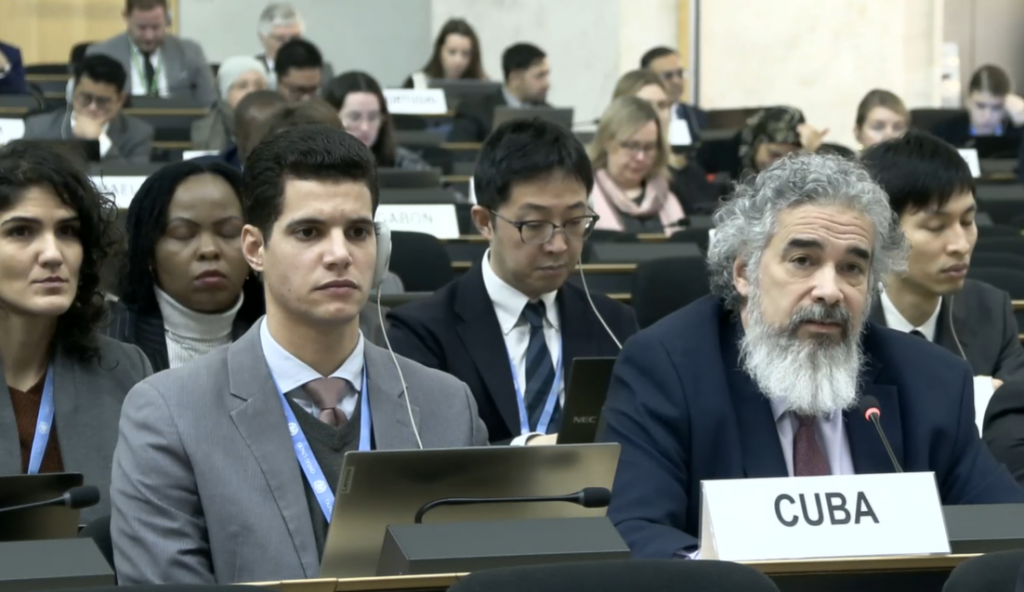
Mr. President,
Cuba considers that the Council has reached the limit of what can be rationalized in terms of conference management, including the reduction of time allocated to debates and interactive dialogues. It is also no longer possible to continue restricting the right of States to take the floor in their national capacity, nor to further shorten the duration of statements.
Such cuts are not, in themselves, indicators of efficiency. On the contrary, reducing the time for genuine dialogue undermines the effectiveness of this body. The rights of States are violated, and the quality and inclusiveness of debates are significantly affected.
In this context, we recall that the measures adopted to respond to the current financial crisis are exceptional and do not constitute a precedent for their institutionalization.
Efficiency does not mean doing less; it means making better use of resources. Decisions on rationalization must be based on clear, objective, and transparent criteria. The primary criterion must be the real impact on the ground.
It must not be overlooked that the Council’s main responsibility is to effectively reach people and support national progress in the field of human rights. Therefore, resources should be prioritized for the implementation of actions that have the greatest positive impact at the national level.
Costly intrusive mechanisms continue to be imposed against certain countries—always countries of the Global South—despite their absolute lack of effectiveness and their nature, which runs counter to the dialogue and cooperation that should prevail in this body.
Even worse, once these punitive mechanisms are established, they never end. They are extended indefinitely over time, despite the lack of results.
While exorbitant amounts are squandered in this manner, far fewer resources are allocated to improving people’s lives. The figures speak for themselves.
Currently, the Council has mandates in place concerning 23 specific countries, at an annual cost of nearly 70 million dollars. Fifteen of these mandates—representing 65 per cent, the vast majority—do not even have the consent of the States concerned and are also the most costly. Almost 40 million dollars are spent annually on them.
Paradoxically, only 17.5 million dollars—three times less—are allocated to cooperation activities with specific countries under agenda item 10.
The way in which the Council’s resources are being used is neither rational, nor effective, nor sustainable. Changes are required without delay.
As a first practical step, Cuba proposes reducing by at least 15 per cent the expenditures associated with mechanisms that do not have the consent of the States concerned and that have demonstrated their ineffectiveness for years.
This would make an additional 6 million dollars available, which we propose to use to increase assistance, cooperation, and capacity-building activities for States that so request, in order to implement the accepted recommendations of the UPR and the Treaty Bodies.
What is required is real support, not condemnations or interference, so that States can better fulfill their international human rights obligations.
Resources amounting to millions of dollars cannot continue to be spent on punitive activities that are incompatible with sovereignty and unproductive, while more and more treaty body sessions are being cancelled, field visits by Special Procedures requested by States are being reduced, and resources are being cut to address the legitimate concerns of countries of the Global South regarding economic, social, and cultural rights.
We thank the Office of the High Commissioner for the information provided on the status of implementation of decision 59/115. This information should be complemented with more disaggregated data on costs, available financial resources, and human resources associated with the implementation of the activities mandated by the Council.
It is urgent that States, together with the Office, develop an effective, transparent, and verifiable methodology so that Council members can take timely and well-informed decisions on mandated activities, including those that may be affected by the impact of the financial and liquidity crisis.
Thank you.