
Distinguished Special Rapporteur Alena Douhan,
Distinguished Professor Joy Gordon,
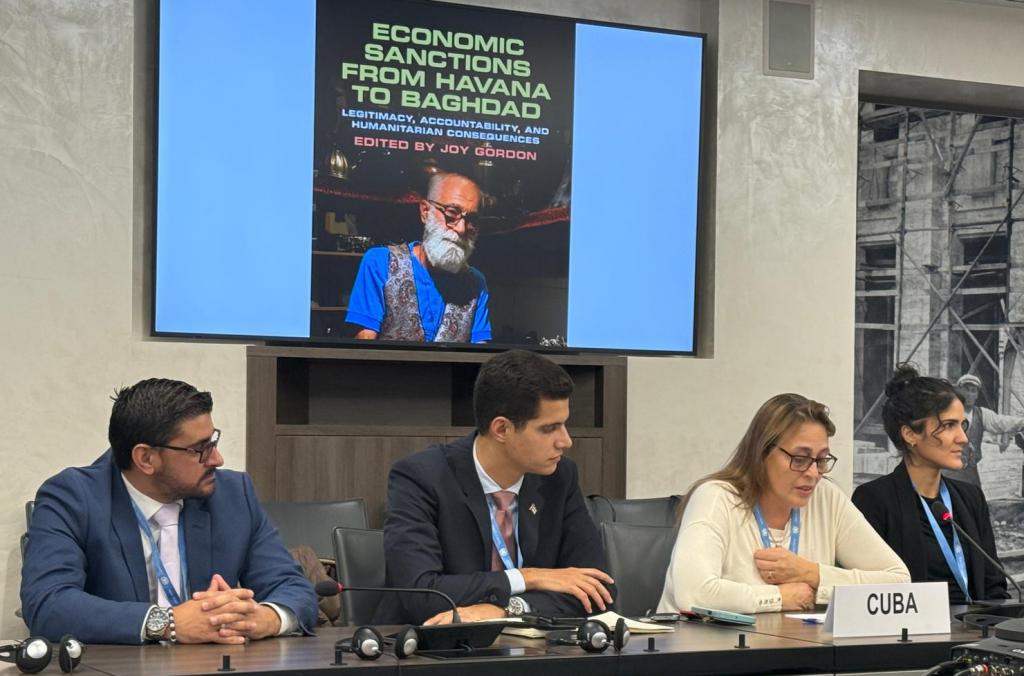
We thank you for the presentation of this volume, which carefully compiles case studies on the application of unilateral coercive measures in different countries. We also wish to highlight the participation of a diverse group of scholars from various nations, including from Cuba.
The reason that brings us together today is our shared conviction that unilateral coercive measures are, by their very nature, illegal under international law and contrary to the fundamental principles enshrined in the Charter of the United Nations, including the sovereign equality of States and non-interference in internal affairs.
Even more seriously, these measures directly and indiscriminately affect entire populations, becoming a structural obstacle to the full and effective enjoyment of human rights.
I would like to refer to the chapter entitled “The Impact of U.S. Sanctions on Cuba’s Economic Development”, authored by Cuban scholar Raúl Rodríguez.
Among the main arguments advanced by the author, I would highlight the following: the blockade against Cuba is not a simple bilateral dispute, but rather a system of unilateral coercive measures of an extraterritorial nature, unprecedented in its duration and scope, which has profoundly shaped Cuba’s development model for more than six decades.
Cuba has been subjected to aggression by the government of the Unite States for more than 67 years, base on interventionist, hegemonic, and colonial ambitions
It is the same ambition that has recently led to the military aggression against the Bolivarian Republic of Venezuela—an unacceptable and ilegal act that represents a serious threat to all countries, particularly those in our region.
No country in the world has had to endure a blockade as comprehensive and prolonged as that imposed on Cuba.
Moreover, the inclusion of Cuba on the United States Department of State’s list of alleged State Sponsors of Terrorism seeks to provoke near-total isolation from the international financial system.
This has led to severe restrictions on access to medical supplies, technologies, industrial equipment, and other goods and services, which directly affects the Cuban state's ability to guarantee the basic rights of its population.
Human rights cannot be defended through collective punishment, financial isolation, or economic suffocation.
Such unilateral coercive measures deserve not only strong political rejection in multilateral forums but also reasoned condemnation from the academic sector, particularly in those countries that impose these measures.
We urge academic experts to continue addressing this issue in their research and encourage continued cooperation with the mandate on unilateral coercive measures of the Human Rights Council.
I thank you .