
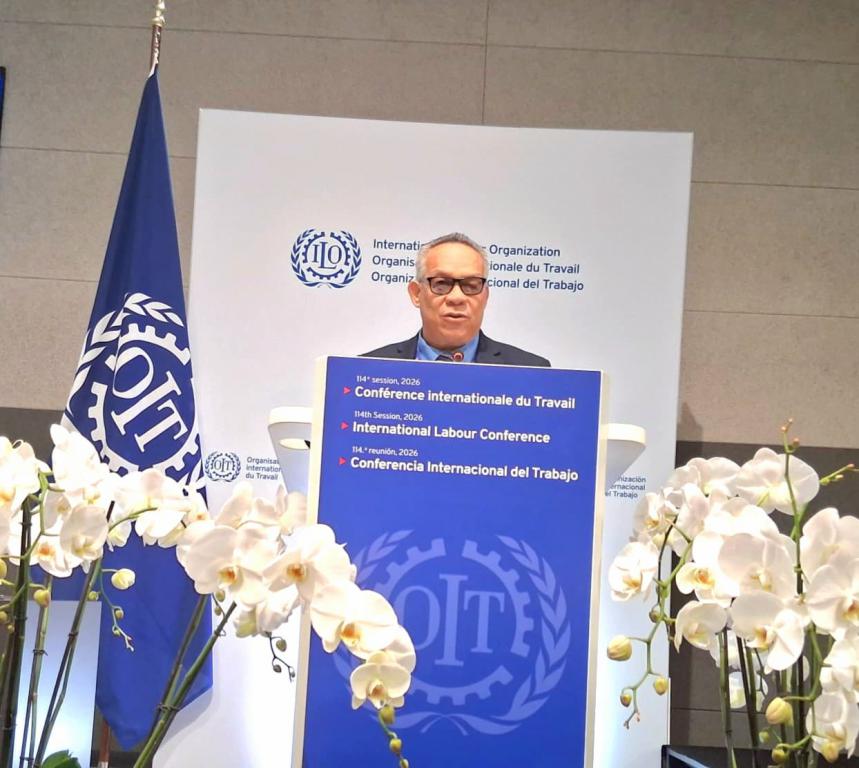
Mr. President:
Our fraternal and solidarity greetings to all delegations.
I bring before this Conference a denunciation of very serious events.
Cuban workers are suffering the consequences of the economic war imposed by the United States for more than six decades.
This blockade, the most comprehensive and prolonged that humanity has ever known, has escalated exponentially this year, with increasingly aggressive and ruthless measures.
For more than five months, the United States has imposed a total fuel blockade on Cuba, with devastating consequences. All Cuban workers are being severely affected. Without energy, no country can function normally.
Our people suffer prolonged power outages, disruptions to health services, the school system, transportation, food production and distribution, the supply of drinking water, and community services, among others.
Hospitals are operating under critical conditions. The lack of power halts the functioning of incubators, dialysis machines, and operating rooms. Urgent surgeries are delayed, and clinical conditions requiring immediate attention worsen.
The human cost is enormous. The effects are brutal.
The sinister plan of the United States is to create a humanitarian crisis. They intend to suffocate the Cuban people to provoke a social explosion. Provoking scarcity and extreme hardship for millions of people for political purposes is unacceptable under any circumstances.
Mr. President:
Implementing advanced labor policies in this scenario has become a Herculean task.
The computerization of society and the modernization of the Territorial Employment Management Service, cornerstones of decent, full, and accessible employment, are facing restrictions due to the lack of electricity.
Many non-essential work activities have had to be paused. We have activated emergency protocols to mitigate the impact. Whenever possible, alternatives such as teleworking, remote work, and adjustments to work schedules are being implemented.
We are exploring options to relocate those whose positions have become vacant and to guarantee their social protection. When there is no alternative but to suspend employment, 100% of salary is guaranteed for the first month of inactivity, and 60% from the second month onward.
We are strengthening the social welfare system to protect people in vulnerable situations. The number of social workers has doubled. The social assistance budget is increasing and protects more than 300,000 people nationwide.
The new labor legislation will soon be presented to our Parliament. As a result of a broad and democratic consultation process with workers, which generated more than 96,000 proposed amendments, Cuba will have a modern Labor Code that will expand rights and guarantees in all labor sectors.
Our highest priority has been, and always will be, protecting workers and their families. Never, not even in the greatest difficulties, will the Cuban worker be left alone. Even under siege, in our country, social justice and labor rights are an irrevocable achievement.
Mr. President:
The United States is threatening Cuba with military aggression. To justify this, it resorts to the pretext of portraying our country as a threat, which it is not, and as a failed state, which it has never been.
We do not want a conflict. Cuba is a nation of peace. We hope that dialogue will prevail over confrontation.
But if military aggression occurs, the Cuban people will fight, to the bitter end, to defend their sovereignty and independence.
The international community cannot passively stand by while an entire people are deprived of their livelihoods, while a whole population continues to be punished for reasons of domination, and while a country is militarily threatened without any justification.
We call upon the nations and workers of the world to prevent aggression against Cuba and to avoid imposing a humanitarian catastrophe on our people, whether through force of arms or a fuel blockade.
On behalf of the Cuban government and people, I conclude by expressing our deepest gratitude for the numerous expressions of solidarity and support received by Cuba at this Conference.
Thank you very much.