
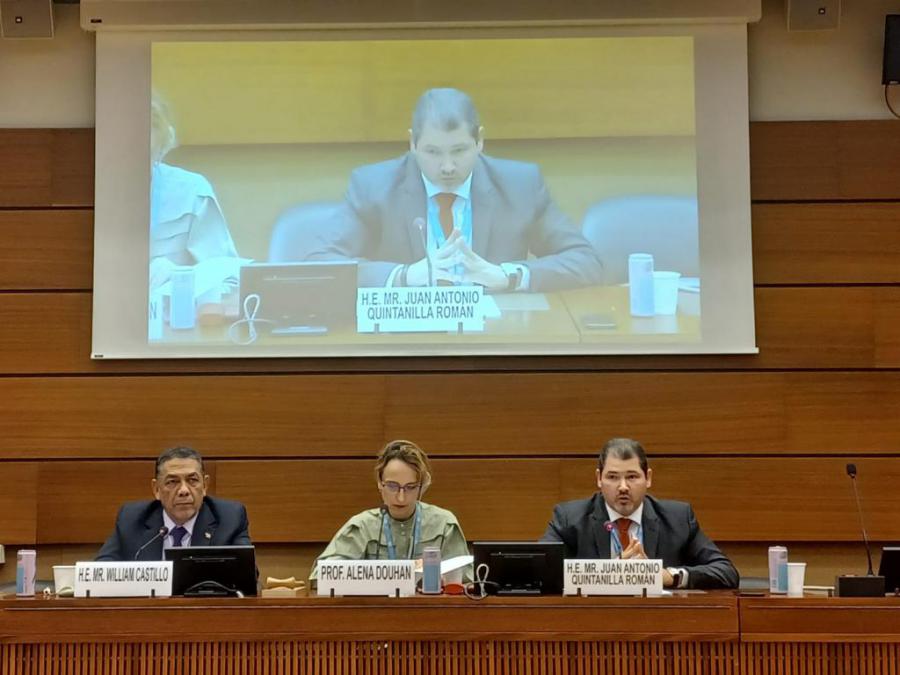
Esteemed Ms. Alena Douhan, Special Rapporteur on the negative impact of unilateral coercive measures on human rights,
Esteemed Mr. William Castillo, Vice-Minister of Anti-Blocking Policies of Venezuela,
Esteemed participants,
I thank Madam Rapporteur for the invitation to participate as a panelist and I wish to congratulate her for the professional work she has carried out over the last 4 years to make visible the impact of unilateral coercive measures, not only in the countries concerned, but also in third countries and, in many cases, in the countries that impose sanctions themselves.
For more than six decades, Cuba has been the victim of the most severe and prolonged system of unilateral coercive measures applied against any country. The economic, commercial and financial blockade imposed by the US government has caused damages amounting to 164 billion 141.1 million dollars. If we take into account the performance of the dollar against the value of gold on the international market, it has caused quantifiable damages of more than 1 trillion 499 billion 710 million dollars.
Between March 2023 and February 2024 alone, the blockade caused material damages to Cuba of 5 billion 56.8 million dollars. It is estimated that, if the blockade had not been in place, in 2023, Cuba's GDP at current prices could have grown by around 8%.
In order to calculate these effects, Cuba has Decree 290, issued by the Council of Ministers in 2012. The process is led by the Ministry of Economy and Planning, with the participation of the ministries and institutions concerned.
Every year, Cuba presents the world with a comprehensive report on the partial and cumulative damage caused to the economy and society by the blockade. This report is the response to the note issued by the Secretary General, based on the resolution that is adopted annually by the overwhelming majority of the members of the General Assembly to demand an end to the blockade.
In accordance with Article 5 of Decree 290, damages and losses caused by the blockade are considered to be those resulting from the application of measures of an extraterritorial nature, political pressure or any other type of pressure exerted by the US government to hinder or prevent Cuba from conducting commercial operations and economic transactions derived from cooperation projects and financial investments, prevent access to technology and knowledge, cause damage to production and services, or other damages.
The recording of information and the calculation of damages is carried out by 7 groups.
Group 1 reports damages caused by the impossibility of accessing the US market, transactions with subsidiaries of US companies based in third countries, with companies from third countries that have merged with US companies or interests, and those derived from the extraterritorial application of US laws or provisions that have an impact on exports.
Group 2 takes into account the rising prices of imported products and services vis-à-vis the price of similar products and services from U.S. companies and those located in third countries to which Cuban companies do not have access. In addition, the cost of insurance, freight and the increase in prices due to the need to use intermediaries for their acquisition are also taken into account.
Group 3 analyzes damages to production and services due to the impossibility of procuring spare parts, raw materials and products whose specifications cannot be replaced by another supplier, as well as delays in substitution or other causes that affect production and services, considering the value of goods and services that are no longer produced for this reason.
Group 4 supervises damages caused by the impossibility of using the US currency in financial transactions of all kinds, including exchange rate variations with regards to the currencies that the country is forced to use and the resulting bank charges.
Group 5 includes damages to the population due to various causes related to the blockade, including unpaid income from artistic performances, royalties, cash prizes, inheritances, financial transfers and others, as well as others that affect their interests or limit the exercise of their universally recognized rights.
Group 6 includes damages to production and services due to the impossibility of accessing technical information and technologies of US origin that are more efficient, less consuming of raw materials or energy, with higher yields or more competitive.
Group 7 assesses the consequences of the US government's policy of encouraging desertion and emigration in order to deprive the country of professionals and technicians, which hinders our development.
Generally speaking, this is a complex methodology, encompassing many economic variables, but it is carried out with full responsibility and adherence to the law by the national institutions involved.
Unfortunately, despite this methodology, the real impact of this criminal policy on the quality of life of the Cuban people and on the enjoyment of all human rights, including development, is incalculable.
More than 80% of the Cuban population only knows a blockaded and besieged Cuba, simply because they have chosen sovereignty, dignity, anti-imperialism, solidarity and social justice as their path.
Added to this is the arbitrary and unjustified inclusion of Cuba on the list of States that allegedly sponsor terrorism, drawn up unilaterally by the State Department.
I take this opportunity to thank Madam Rapporteur and other mandate holders for the communications sent to the US government in this regard and the public statements that have highlighted the lack of transparency in the drawing up of the list, its incompatibility with international law and its decisive impact on the enjoyment of fundamental human rights. I also thank the 122 countries that took part of the joint statement made by Cuba at the 56th session of the HRC to denounce the aforementioned list.
Thank you very much.