
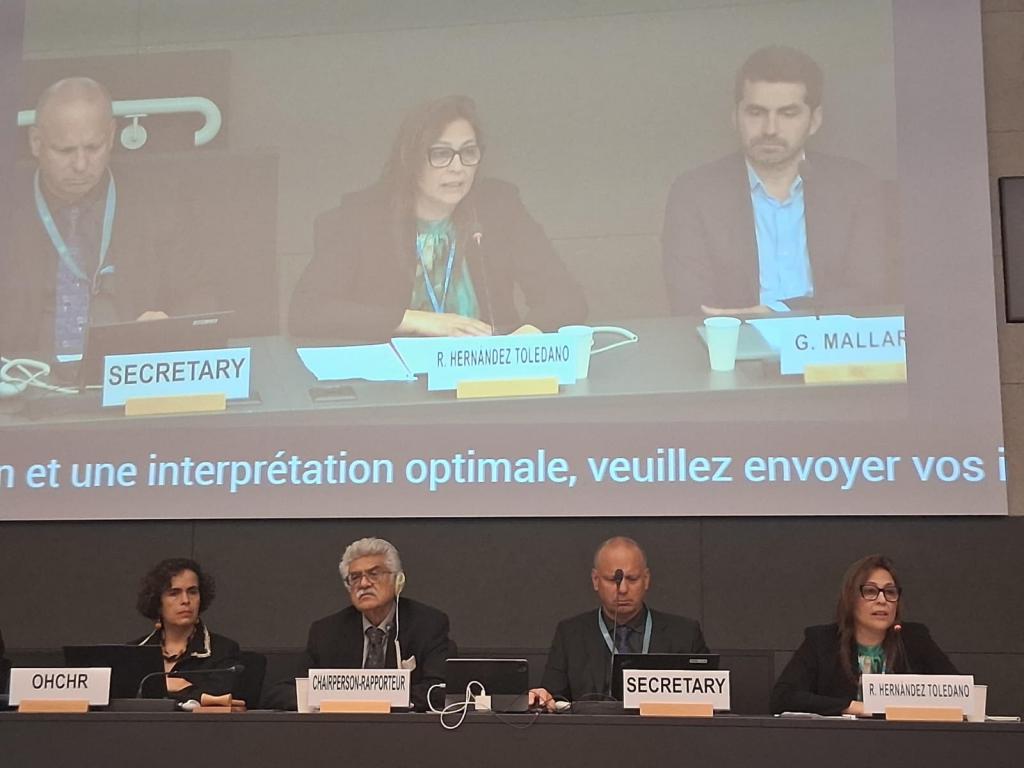
Mr. Chair, distinguished delegates,
We welcome the inclusion, among the thematic debates of this session of the Working Group, of a discussion on the impact of unilateral coercive measures (UCMs).
Ensuring the right to development requires the elimination of all practices that hinder its realization, including unilateral coercive measures.
Such measures constitute a serious obstacle to the implementation of the Declaration on the Right to Development and to the achievement of the goals of the 2030 Agenda.
Under International Law, unilateral coercive measures are illegal under all circumstances and are therefore unacceptable. Nothing can justify their imposition. They must be lifted immediately and unconditionally.
They constitute a flagrant violation of the Charter of the United Nations and of the principles underpinning multilateralism.
They not only affect the countries against which they are imposed. They also impact third countries, owing to their extraterritorial nature and their deterrent and intimidating effects.
Unilateral coercive measures run counter to the principles enshrined in the Declaration on the Right to Development, adopted by the General Assembly in 1986. For example:
Their purpose, as instrument of coercion aimed at imposing political and/or economic change, violates article 1 of the Declaration, which states that peoples have the right to self-determination and to full sovereignty over their natural wealth and resources.
With regard to article 3 of the Declaration, unilateral coercive measures violate the duty of States to cooperate with one another in eliminating obstacles to development, as well as their primary responsibility to create international conditions conducive to the realization of the right to development. They also run counter to the principles of International Law concerning friendly relations and cooperation among States reflected in article 3.
UCMs are likewise contrary to the provisions of article 4 of the Declaration on the Right to Development, which emphasizes the need for effective international cooperation to provide developing countries with appropriate means to foster their development.
UCMs also contravene article 6 of the Declaration, concerning the duty of States to take steps to eliminate obstacles to development.
UCMs hinder access to essential resources and services, including education, health care, food and housing, among others, which are fundamental to the full realization of the right to development, as set forth in article 8 of the Declaration.
Mr. Chair, distinguished delegations,
Cuba has been the victim of a criminal and illegal economic, commercial and financial blockade imposed by the government of the United States for almost 70 years, in flagrant violation of the right to development of our country and our citizens.
As a result of the current escalation of aggression, Cuba is presently under the threat of direct military aggression by the United States and is facing the effects of a brutal blockade on fuel supplies.
The Executive Orders issued by President Donald Trump on January 29 and May 1st further tighten the blockade against Cuba to unprecedented and extreme levels, including its extraterritorial effects.
The brutally reinforced blockade has a devastating and incalculable impact on the daily lives of the Cuban people. It constitutes an act of genocide and collective punishment, causing extraordinary human harm, suffering, severe deprivation and extreme hardship for Cuban families.
The energy siege has led to prolonged power outages and difficulties in water pumping, liquefied gas supplies, and the production and distribution of food, goods and services. Transportation and medical services have been affected, disrupting the lives of millions of people.
Allow me to cite just a few figures. Infant mortality, although it remains low, has doubled, and nearly 100,000 patients, including 12,000 children, are awaiting surgery.
More than 16,000 patients requiring radiotherapy and nearly 3,000 hemodialysis-dependent have been affected by the disruption of services requiring stable energy supplies.
More than 30,000 children have been unable to receive their vaccinations on time due to shortages of refrigerated transport caused by fuel shortages.
Schools and universities have had to readjust their curricula in order to ensure the continuity of the educational process.
The High Commissioner for Human Rights and numerous mandate holders of the Human Rights Council have stressed that the actions taken by the United States against Cuba are illegal and violate the human rights of the Cuban people.
Mr. Chair, distinguished delegates,
The multilateral system as a whole, including the Human Rights Council, can and must do much more to denounce and confront the unilateral coercive measures imposed against numerous developing countries, with a view to their elimination.
Allow me to present ten concrete proposals in this regard:
Emphasize annually, in Human Rights Council resolutions, the duty of all States to oppose unilateral coercive measures. This should include non-recognition and non-application of such measures, as well as the adoption of administrative or legislative measures, as appropriate, to counter their implementation and extraterritorial effects.
Reaffirm that essential goods, such as food, medicines, medical equipment and energy, must under no circumstances be used as instruments of political or economic coercion, and that in no situation should nations or peoples be deprived of their means of subsistence and development.
Maintain the issue of unilateral coercive measures as a standing item on the agenda of the sessions of the Working Group on the Right to Development.
Integrate into the monitoring and evaluation tool on sanctions developed by the Special Rapporteur on Unilateral Coercive Measures measurable indicators of the impact of UCMs on the Sustainable Development Goals (SDGs).
Request all organizations and agencies of the United Nations system to submit periodic reports on measures taken to address the impact of unilateral coercive measures on their respective objectives and programs related to the realization of the right to development.
Request the High Commissioner for Human Rights to include in his future annual reports to the General Assembly specific information on practical measures taken and envisaged to advance the elimination of unilateral coercive measures, within the framework of his mandate to promote and protect the right to development.
In cooperation with the Special Rapporteur on Unilateral Coercive Measures, organize a high-level conference on the impact of UCMs on the realization of the right to development, on the occasion of the 40th anniversary of the Declaration on the Right to Development.
Organize academic workshops and events on the impact of UCMs on the right to development.
Establish a Human Rights Council Working Group composed of five experts, with a mandate to comprehensively address the impact of unilateral coercive measures on human rights, in particular the right to development, and to propose concrete actions for their denunciation and opposition.
Launch a process within the Human Rights Council with a view to the adoption by the UN General Assembly of a legally binding international instrument prohibiting unilateral coercive measures and ensuring accountability for those responsible for human rights violations caused thereby, including violations of the right to development.
I would like to call on delegations to consider these and other proposals at the High-Level Meeting of the United Nations General Assembly on the occasion of the 40th Anniversary of the Declaration on the Right to Development, to be held in New York at the end of September.
Thank you.