
Thank you very much, and welcome.
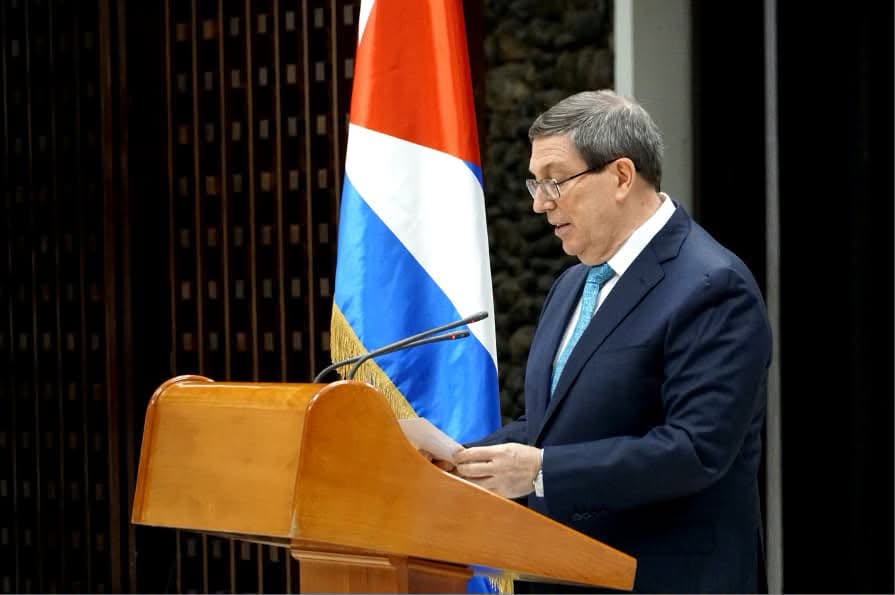
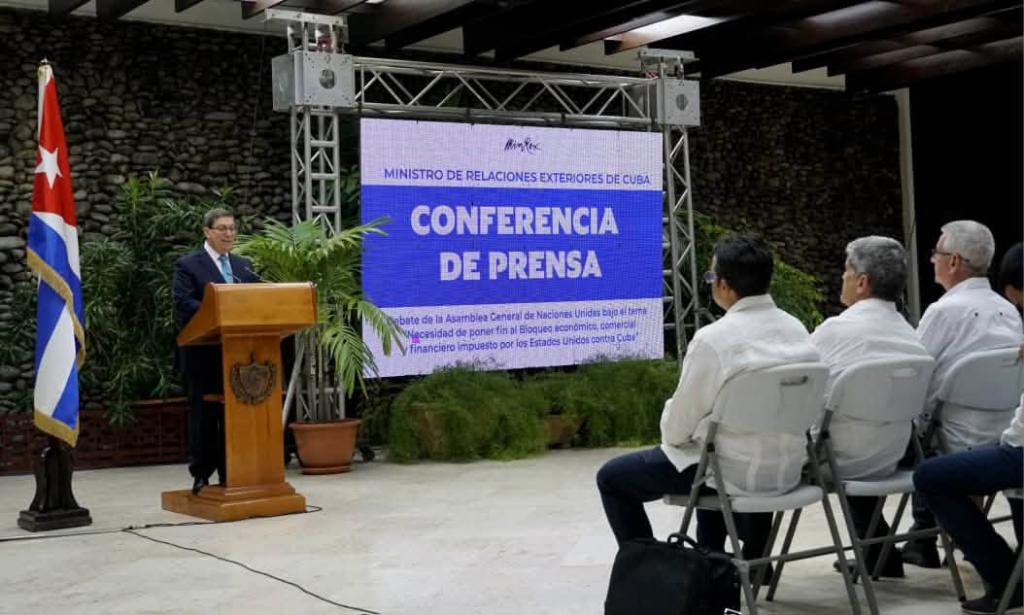
We have decided to request a session of the United Nations General Assembly under item 38 of its agenda, entitled “Necessity of ending the economic, commercial and financial embargo imposed by the United States of America against Cuba”. This session will take place on the morning of 7 July.
Together with the rest of the United Nations Member States, Cuba will denounce the aggressive actions of the United States Government against our country, which include the threat of direct military aggression, in breach of international law and international and regional peace and security. We will denounce the energy siege which, alongside other measures of extreme intensification of the blockade, constitutes an act of genocide. This is also classified as collective punishment and a massive, flagrant, and systematic violation of the human rights of Cuban men and women, as well as of international humanitarian law. These are acts that cause increasing harm, deprivation, and suffering to our people.
Cuba is not, nor can it be, a threat to the national security of the United States, which is a major military and nuclear power. Cuba is not a threat. The blockade is.
The blockade and the policy of aggression and hostility by the United States Government against Cuba constitute a threat to the existence and well-being of the Cuban people, and to the exercise of their human rights. It is a threat to regional peace, security, and stability. It is a threat to any sovereign State that could be subjected to measures of a similarly aggressive and extraterritorial nature in the future.
The General Assembly—the most democratic, universal, and representative organ of the United Nations—will be able to address this issue on the upcoming 7th with objectivity and, undoubtedly, in adherence to the purposes and principles of the Charter of the United Nations. In particular, this includes respect for the sovereign equality of States, their territorial integrity and political independence, the prohibition of the threat or use of force, respect for the self-determination of peoples, non-interference in internal affairs, and the peaceful settlement of disputes. We are certain that the overwhelming majority of the international community supports and will continue to support Cuba, which means supporting international law and the Charter of the United Nations.
This is an urgent situation because the multidimensional aggression of the United States government against Cuba is already underway and intensifying. It is not a future danger or an impending threat; it is a crime against humanity in full execution. Its humanitarian toll is escalating, and the suffering and deprivation it inflicts upon our people increase daily.
This systemic aggression is reinforced by the use of communication, digital, and monopoly-media power to attempt to isolate and discredit Cuba, and to try to justify the unjustifiable crime that imperialism is committing against our people. Recent publications in prestigious Cuban and international press outlets have demonstrated the connection, articulation, and deliberate use of US media by the State Department as part of the aggression against Cuba. This is done to establish slanderous and mendacious narratives, to lie and confuse US, international, and Cuban public opinion, and even to pressure political sectors within the United States or influence the White House itself. This has now been complemented, for approximately the last three to four weeks, by an intense diplomatic deployment in almost all capitals across the globe, as well as in the multilateral sphere.
This is unprecedented due to the brutal nature of the actions being carried out and the coercive and threatening manner applied against the governments and foreign ministries of other states. The Permanent Mission of the United States in New York, at the United Nations headquarters, in other international organisations, and its embassies across all latitudes are exerting unprecedented pressure to try to prevent this session on 7 July from taking place. The diplomatic apparatus of the State Department is attempting to block the United Nations General Assembly from considering a matter of global interest and immense urgency, utilizing pressure, blackmail, and threats.
They are attempting to intimidate United Nations Member States. They seek to censor their voice and their right to speak out on a matter directly related to international peace and security and the well-being of an entire people. At this moment, the United States Permanent Mission in New York is threatening to take procedural actions to prevent the General Assembly from meeting and deliberating on this matter.
They are trying to use coercive methods to prevent the most democratic organ of the United Nations from exercising the powers granted to it by the Charter. This conduct is in addition to the United States government's persistent attempt to hamstring the United Nations Security Council through the abuse of the veto privilege. It is an inconceivable effort to approach every capital to try to justify aggressive actions that are causing deaths in Cuba and would cause many more—causing a bloodbath, a humanitarian catastrophe—if the option chosen by the United States government, as it constantly threatens, were to unleash a military adventure against Cuba.
We know that this is the conduct and permanent instigation of the Secretary of State and other politicians, primarily linked to Florida, who are trying to force the President of the United States into making a decision of incalculable consequences that would severely damage his legacy. I will demonstrate this with three US documents currently circulating in an opaque, clandestine manner, which form the basis of the meetings and pressure they are exerting on diplomats and government officials across various latitudes. One is this one, which begins by saying: “It's time for change in Cuba”—it is time for change in Cuba—and has the hypocrisy to state that the suffering of the Cuban people must not continue.
It posits that Cuba is a direct threat to the national security of the United States due to its support for hostile actors, terrorism, and regional instability. However, this document, as you can see, is extensive; it is a document of several pages, and from this point until the end, it is aimed at threatening foreign individuals with sanctions. That is to say, it is a document containing threats of extraterritorial and punitive application of commercial or economic measures of any nature—unilateral coercive measures and the use of sanctions that are illegal from the perspective of International Law.
It is a document that complements Executive Order 14404, which, in an ambiguous and vague manner, authorises the Secretary of the Treasury to impose sanctions at whim, with the aim, among others, of generating an opacity that induces intimidation among States, companies, and individuals in the sector. This document contains and mentions entities, individuals, and financial institutions simply for having any type of link with Cuba, stating that their relations with US entities will be blocked. It contains extraordinary and threatening paragraphs, regardless of whether a State, entity, or person has commercial relations with Cuba or not.
It even states, and I translate:
"Even if there are no links between your country and the target or plan of the sanctions included in this announcement by the Secretary of the Treasury, the United States continues to urge you to review any links with Cuba that could expose you, your people, your business to risks of sanctions if sectors of the Cuban economy involved in this could be identified."
It also tells you imperatively:
"I ask you to review current financial and commercial relations with Cuba in light of these new sanctions. I warn your companies and your financial institutions of the risks of sanctions. I urge you to consider aligning with United States efforts to hold the Cuban government accountable for its threats to regional security and stability, and I urge you to coordinate with the United States on the implementation and enforcement of these measures."
It has the extraordinary scope of asserting that any financial institution of any nature must proceed with caution in any dealings with any sanctioned entity under this authority, under pain of becoming a target and being exposed to the risk of sanctions. And it requests of you—because it is a document that remains imperative and direct—that it "requests your coordination and support and that you work cooperatively with the United States government on these matters of mutual interest."
It insists once again that Cuba's actions constitute a direct threat to the national security of the United States and asserts that they require decisive action. It says: "I urge you to carefully consider the implications of continuing any type of economic relationship with Cuba and to take the appropriate steps to reduce your exposure to sanctions related to that country." A second paper is circulating; its first line reads: "the regime must reform, it has to change, do not vote for its propaganda."
It then lists a series of mendacious, slanderous chapters that are offensive to the dignity and sovereignty of any State, and to the standing of any diplomat addressed in such a manner. It refers to the upcoming vote on the General Assembly resolution, "Necessity of ending the economic, commercial and financial embargo imposed by the United States of America against Cuba", which traditionally takes place at the end of the year. According to the General Assembly calendar, this vote will take place on 27 October of this year, just as it has occurred on 33 previous occasions.
It is a resolution that has always received the overwhelming support of the majority of Member States, despite some attempts to amend it, contaminate it, procedurally damage the consideration of the matter, or even—particularly last year—exert brutal pressure to modify or force States to alter their speeches during the United Nations General Debate at the beginning of the sessions (attended by heads of state, dignitaries, etc.), or to change each country's vote regarding this resolution.
It claims, for example, that "Cuba alone is to blame for the economic problems." It asserts, saying, "the United States embargo is legal", refers to human rights issues, and ends once more with a threat, stating: "Cuba is a threat to peace and security."
There is a third document—the State Department works copiously, as if it had no more important matters to attend to—there is a third entirely slanderous document, which I am showing here, dedicated to attempting to present Cuba as a belligerent party in the war taking place in Ukraine; full of lies, without a single shred of evidence, without a single piece of data. I must flatly reject the military threat from the planet's largest military and nuclear power against a small island, a country of the South. I must reiterate that there are no foreign military bases in Cuba, and that the Secretary of State deliberately lies when he claims otherwise.
The only foreign base usurping our country’s territory is the United States base occupying territory in Guantanamo.
Havana was the place where the proclamation of Latin America and the Caribbean as a Zone of Peace was signed. Cuba has been, is, and will remain a country of peace.
We have cooperated and will continue to cooperate, despite their hostility, with the United States government on law enforcement matters, in combating drug trafficking, international organised crime, human trafficking, and particularly terrorism. This is despite the fact that Cuba is today a victim of terrorist acts and the instigation of terrorism and violence carried out from United States territory with absolute impunity, with funding and the involvement of notorious terrorists—evidence of which was delivered and is constantly updated for the United States government, particularly in 2023. We have revisited this matter following the foiled infiltration attempt by a heavily armed terrorist commando with weapons of war and high-powered explosives in the Corralillo area.
I reiterate that Cuba does not participate in any way in the war in Ukraine and that it prosecutes mercenary activity as established by the Constitution of the Republic. It is well known that criminal proceedings have been initiated against several dozen defendants, and that 12 of those criminal proceedings concluded with 31 individuals being severely penalised.
The United States government constantly uses impossible, totally unrealistic, and absolutely mendacious pretexts to try to justify its aggression, and above all, to try to prevent the American public from recognising the grave humanitarian harm that these policies cause in our country. They use a wide range of elements that are well known and which we have forcefully and systematically rejected.
Recently, approximately three to four days ago, the United States government tried to prevent an international agency of the United Nations system, the World Food Programme, from approving humanitarian food aid for the Cuban people. It tried to prevent this through dirty procedural manoeuvres, even affecting the interests of four other states unrelated to this issue, in order to create a package that would be procedurally viable to block the World Food Programme from deciding on food aid to Cuba.
And it is well known that the brutal, total energy siege applied against Cuba today and the extreme tightening of the blockade measures have a severe impact on nutrition, access to food, and food prices—essential foodstuffs for Cuban families.
This programme is valued at 116 million dollars. Despite procedural tricks, the United States government found itself completely isolated in a democratic vote at the World Food Programme, joined by only one other State.
This behaviour contrasts with the United States' offer of 100 million dollars in humanitarian aid to Cuba, about which the Secretary of State, while at the Holy See—when no such offer had even been made, let alone rejected in any way by Cuba—deliberately lied in that special venue. He stated and declared there that the offer had been made, which did not exist, and that it had been rejected by the Cuban government.
It is known that after the United States government subsequently approached Cuba, and religious organisations approached their Cuban counterparts, the Cuban government accepted that offer based purely on the framework within which international cooperation and humanitarian aid operate. It is nonetheless cynical that the executioner—the author of the energy siege and the extreme tightening of the blockade that causes billions of dollars in annual damages (I recall that last year the damages were conservatively estimated at 7,556 million dollars, almost 50% more than the previous year)—should act in this manner.
Accumulated damages are in the range of 170 billion dollars, without factoring in the humanitarian toll. Who could estimate the harm caused by the energy siege? It is difficult to calculate even the direct and indirect economic damage, but the suffering, the deprivation, the anxiety, the blackouts, the difficulties with food, and the obstacles to acquiring medicines cannot be quantified in numbers. The human cost is incalculable.
The fanfare surrounding those 100 million dollars has by no means materialised. Out of that aid from many months ago following the hurricane, valued at 3 million dollars, I can state that only very recently has 2.8 million dollars been executed. Later, there was an announcement of an offer of 9 million dollars in humanitarian aid, which was quickly reduced to 6 million, and I can state that up to this moment, out of that 6 million dollars in humanitarian aid, only 90,000 dollars has been executed after the passage of many months.
One hundred million dollars would, of course, help, while recognising that it is equivalent to only five days of the blockade, and that if it were used entirely for electricity generation, it would only sustain it in a very limited manner for approximately 15 days—roughly 10 dollars per Cuban. However, the inconsistency is such—and I challenge the Secretary of State to confirm or deny this—that they are informing churches in Cuba that this aid cannot be executed until the end of the year, that it will not be executed under any circumstances in the coming months, and that it will not include powdered milk or medicines. I ask why these conditions are being imposed, and I challenge the Secretary of State to confirm or deny this information.
The General Assembly will therefore consider the agenda item “Necessity of ending the economic, commercial and financial embargo against Cuba” on 7 July. We are convinced that the General Assembly will pronounce itself, as it has historically done, in favour of International Law and the Charter of the United Nations. It will undoubtedly demand that the United States government lift its genocidal measures, which are illegal under International Law and International Humanitarian Law. It will surely request the immediate and unconditional lifting of the fuel siege.
Cuba is a nation that loves peace and dialogue. We firmly believe in multilateralism and the central role of the United Nations Organisation. We will persist in preserving Latin America and the Caribbean as a Zone of Peace.
For Cuban men and women, a free, sovereign, dignified, and independent homeland is sacred. For this ideal, several generations of patriots have paid the supreme price and endured every sacrifice. It will be no different now.
For this ideal, faced with a scenario of aggression that we do not desire and hope will never occur, we will fight to the bitter end. Cuba is not a threat; the blockade is. Thank you very much.