
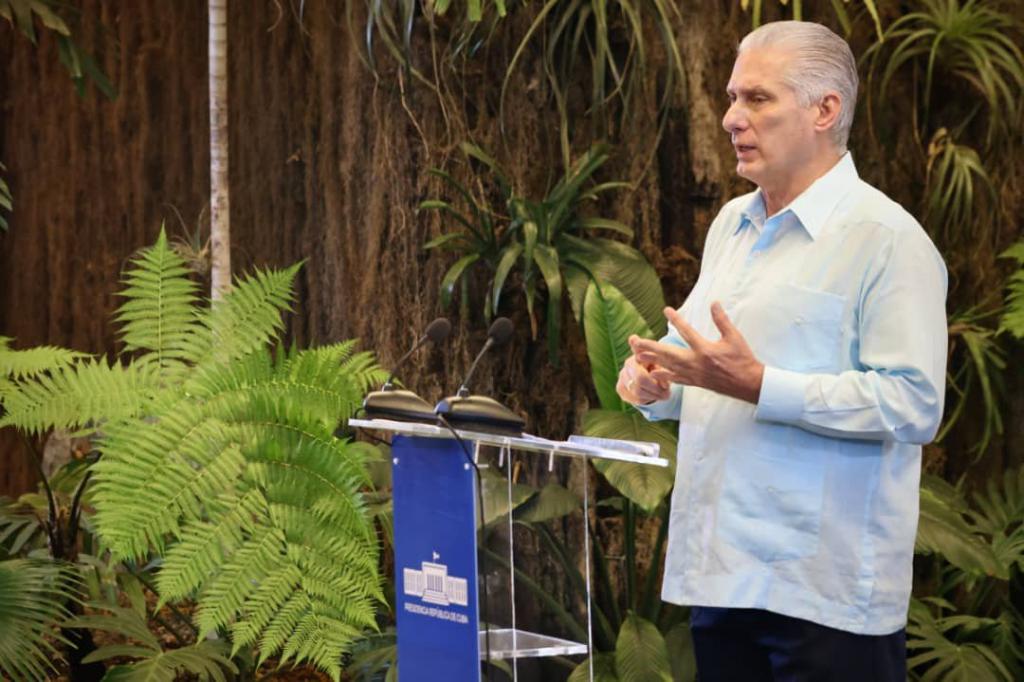
Paris, 14 March 2026.– During a press briefing held at the Palace of the Revolution on 13 March 2026, the President of the Republic of Cuba, Miguel Díaz-Canel Bermúdez, updated the national press on the complex energy and economic situation facing the country due to the tightening of the United States blockade and, in particular, following the signing of an executive order by U.S. President Donald Trump restricting fuel exports from third countries to the island.
From the Permanent Delegation of Cuba to UNESCO, key announcements and reflections by the Cuban President are shared in areas of particular relevance to UNESCO: education, science, culture, information and communication.
Education: continuity and creativity in the face of adversity
In response to difficulties arising from fuel shortages and power outages, the President explained that both the Ministry of Education and the Ministry of Higher Education have adopted measures to ensure the continuity of the academic year. Semi-presential modalities have been introduced, and community-based learning environments have been strengthened, with increased involvement of teachers and support from Municipal University Centres.
Díaz-Canel stressed that, despite current limitations, “for the Cuban Revolution, education and higher education remain priorities and will continue to be so.” He affirmed that once the current situation caused by the “energy blockade” is overcome, full in-person education will be restored, building on Cuba’s recognized educational experience in Latin America and the Caribbean.
Science and energy: innovation and transformation of the energy matrix
The President highlighted scientific and technological advances aimed at addressing the energy blockade, which has prevented fuel imports for more than three months.
Among the achievements mentioned:
- The development of new wells to increase domestic oil and gas production, exceeding planned targets in the first two months of the year.
- The accelerated installation of photovoltaic parks, currently generating between 49% and 51% of daytime electricity.
- The planned integration of over 100 additional megawatts from photovoltaic sources before the end of March.
- The implementation of battery energy storage projects (50 MW) to regulate the national grid, with the first 25 MW becoming operational in the coming days.
- The expansion of electric mobility, with over 2,665 electric vehicles and 21,600 electric scooters, along with the creation of solar-powered charging stations.
He also underlined fiscal and tariff incentives to stimulate investments in renewable energy, as well as the role of domestic industry in assembling related technologies.
Culture: creative resilience and cultural vitality
The President referred to journalistic accounts reflecting the persistence of vibrant cultural life despite current challenges. He emphasized the Cuban people’s “creative resilience,” which sustains unity and cultural dynamism.
Information and communication: transparency against media manipulation
President Díaz-Canel opened his remarks by recalling that 14 March marks Cuban Press Day, commemorating the founding of the newspaper Patria by José Martí, highlighting the link between culture, independence and communication.
He reiterated the Government’s commitment to systematic and transparent communication, announcing that this briefing would be followed by further interventions from senior officials to address fifteen priority issues. He also denounced media disinformation campaigns targeting Cuba’s management of international donations, underscoring the “unbreakable ethics” governing their distribution, with strict oversight mechanisms involving international organizations such as the World Food Programme and UNDP.
Dialogue with the United States and defence of sovereignty
On the international front, the President reported recent discussions between Cuban and U.S. officials, facilitated by international actors, aimed at seeking bilateral solutions based on equality, sovereignty, reciprocity and international law. He also confirmed cooperation with U.S. authorities in investigating an attempted terrorist infiltration, including an expected visit by FBI experts.
Humanitarian decision: release of 51 individuals
The President announced the sovereign decision of the Cuban Government to release 51 individuals serving prison sentences, all of whom have demonstrated good conduct and have served a significant portion of their sentences. He described this as consistent with the humanitarian principles of the Cuban justice system.
Source: Statement by President Miguel Díaz-Canel Bermúdez, Palace of the Revolution, 13 March 2026.