
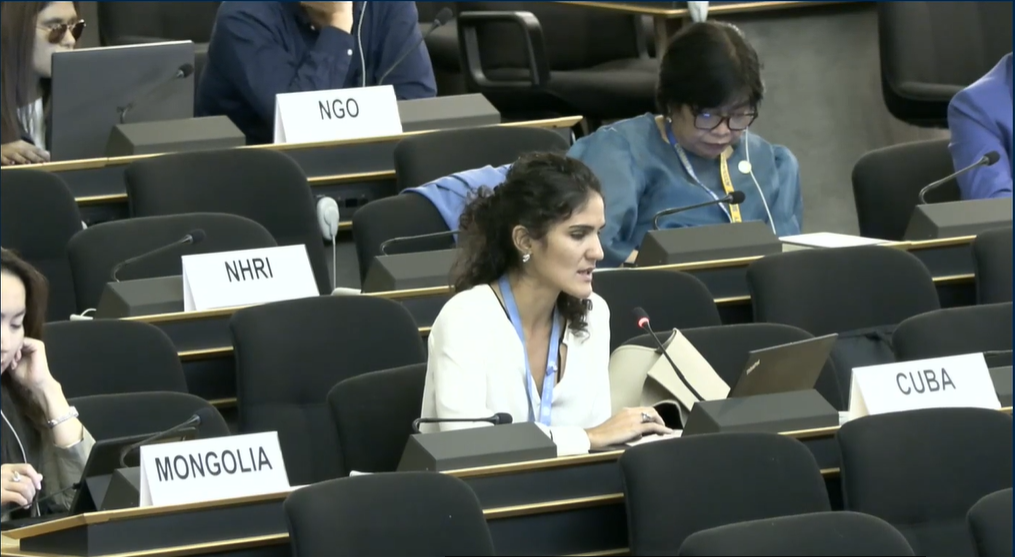
Mr. President,
Education is the fundamental driving force of any society.
It is no coincidence that our States agreed to recognize this fundamental human right as one of the Sustainable Development Goals of the 2030 Agenda. Its realization constitutes the only guarantee for promoting the economic, social and cultural development of any society, as well as for enabling human beings to reach their full potential.
Despite the many individual and collective benefits associated with this human right, the number of children and young people who do not attend school has increased for the seventh consecutive year and has now reached 273 million. Only two out of every three children complete secondary education.
In this context, Cuba supports the adoption, as rapidly as possible, of an Optional Protocol to the Convention on the Rights of the Child concerning free public education at the pre-primary and secondary levels. It is urgent to ensure that the benefits of education are universalized.
Our support for this legal instrument is fully consistent with the high priority that Cuba attaches to this issue. Our country allocates 20% of its state budget to ensuring a universal, free, inclusive and quality education system for all, even amid the numerous obstacles resulting from the tightening of the economic, commercial and financial blockade imposed by the United States.
On this basis, Cuba would like to make the following observations on the draft principles for the elaboration of an Optional Protocol, presented by the Presidency.
Regarding the scope of the future Optional Protocol:
1. We support the future instrument taking the provisions of resolution A/HRC/RES/56/5 as a reference, while not limiting its scope to them. The language of the instrument should be as ambitious as possible to guarantee that everyone has access to free education.
2. The future instrument must ensure full coherence with the legal obligations already established in the Convention on the Rights of the Child and its Optional Protocols, avoiding duplication of standards and ensuring complementarity with the existing international legal framework.
Regarding substantive elements, we recommend:
1. Including a provision on State responsibility for promoting universal, free, inclusive and quality education, including early childhood education, primary and secondary education.
2. Expanding the language on international cooperation for the implementation of the right to quality education, and including provisions on the need to provide technical assistance, as well as promoting capacity-building and access to financing on preferential terms for developing countries.
3. Providing for the elimination of unilateral coercive measures in the field of education. Such measures create serious difficulties for affected countries in guaranteeing access to education systems, the acquisition or production of school materials and supplies, access to new information and telecommunications technologies, access to the Internet and advanced learning programmes, among other adverse effects.
4. The future instrument should expressly enshrine the principles of equality and non-discrimination as cross-cutting guarantees for the full enjoyment of the right to education, ensuring equal opportunities and equal access to free, inclusive and quality public education for all persons, without distinction of any kind.
Regarding implementation and monitoring mechanisms:
1. Provide that States Parties to the Convention on the Rights of the Child include information on the obligations arising from the Optional Protocol in their periodic reports submitted pursuant to Article 44 of the Convention.
Thank you very much.