
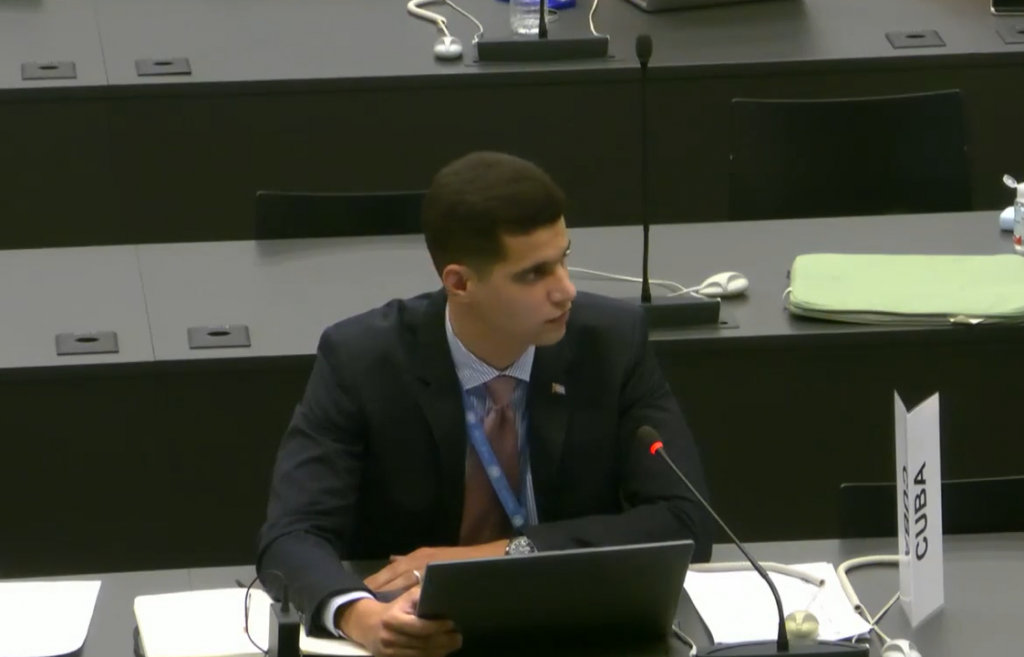
Mr. Chair,
The Cuban delegation thanks the Chair for the Food for Thought paper submitted to guide the work towards the elaboration of a legally binding international instrument for the protection of the human rights of older persons.
We wish to present the following preliminary observations and proposals.
Structure of the Future Treaty or Convention
In Cuba's view, the future instrument should include the following eight main sections:
Preamble
Object, Purpose and Scope
Definitions
Principles
Obligations of States
International Monitoring Mechanism
International Assistance and Cooperation
Final Provisions
We remain open to considering proposals from other delegations regarding the structure of the instrument, including the possibility of adding further sections in addition to the eight proposed by Cuba.
Preamble
With regard to the Preamble, we propose:
Including a reference stating that the rights contained in the future international instrument are universal, indivisible, interdependent and interrelated, and that they must be treated globally and in a fair and equitable manner, on the same footing and with the same emphasis. (Paragraph 5 of the Vienna Declaration and Programme of Action.)
Including a preambular paragraph recognizing the need for international cooperation, technical assistance and solidarity, including South-South cooperation, in order to support developing countries in the progressive implementation of the obligations arising from the future instrument.
Including an explicit reference to the negative and disproportionate impact of unilateral coercive measures on the enjoyment of the human rights of older persons, particularly with regard to access to medicines, medical technologies, geriatric equipment and long-term care services.
Definitions
To ensure legal clarity, the future instrument should define key concepts such as older person, age discrimination, autonomy, care, and others.
We consider it important that these definitions, including that of older person, be formulated in a way that provides legal certainty while allowing each State Party sufficient flexibility to adapt these concepts to its national context and domestic legislation.
In other words, Cuba advocates for flexible and context-sensitive definitions.
Such flexibility is fully consistent with the principle of State sovereignty and the need to respect the national and cultural diversity of States.
Principles
This section of the instrument should include, among others, the following General Principles:
Respect for the principles of the Charter of the United Nations.
Adherence to the principles of universality, indivisibility, interdependence and interrelatedness of all human rights.
Recognition that older persons are full holders of all human rights on an equal basis with all other persons.
Recognition of the central role of the State in promoting social protection policies for older persons.
Emphasis on the importance of international cooperation and technical assistance for the implementation of the future international instrument.
Obligations of States
Among the core provisions of the future instrument, the Cuban delegation proposes the inclusion of the following key prohibitions and obligations of States:
An explicit prohibition of all forms of age discrimination, together with the obligation to adopt appropriate legislative and administrative measures to prevent and eliminate such practices.
Guarantee the right of older persons to make decisions about their own lives.
Guarantee the right of older persons to participate fully and effectively in society.
Protect older persons against all forms of violence that affect them.
Guarantee the rights of older persons to health, education, food and social security, among other rights.
Recognize the primary responsibility of the State to ensure accessible and universal care systems for older persons. The participation of the family, the community and other actors should not be interpreted as replacing the responsibility of the State.
Ensure equitable access to care services for older persons in situations of economic vulnerability.
Refrain from imposing, and immediately cease, unilateral coercive measures against other States where such measures undermine the purpose and objectives of the future Treaty or Convention.
Implementation
As the international mechanism for monitoring implementation of the instrument, Cuba supports the establishment of a treaty body and a system of periodic reporting by States Parties, in line with the established practice of the United Nations human rights treaty bodies.
The financing of this treaty body should come from the United Nations regular budget through assessed contributions, rather than voluntary contributions, in order to ensure its independence, financial predictability and freedom from politicization.
Cuba supports the participation of older persons in the work of the future treaty body, in line with the practice of other United Nations human rights treaty bodies, including CEDAW, the Committee on the Rights of the Child (CRC), and CERD.
The intergovernmental nature of the review of the implementation of the future international instrument should be preserved.
International Assistance and Cooperation
Cuba considers it essential that the future instrument include a dedicated section on International Assistance and Cooperation.
These provisions should facilitate the sharing, at different levels and through various modalities, of experiences, knowledge and resources among States Parties, without prejudice to their respective obligations, in order to advance the purposes and objectives of the instrument.
The Cuban delegation will submit specific drafting proposals for this section on International Assistance and Cooperation.
We will also present, at the appropriate time, proposals concerning the final provisions of the instrument, including issues relating to entry into force, amendments and reservations, among others.
Thank you.