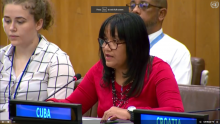
Mr. President,
The commitments that the Heads of State and Government, meeting at the World Summit for Social Development in Copenhagen in 1995, had agreed upon, remain fully valid; in particular the fundamental objectives of eradicating poverty, reducing inequality, promoting productive employment, decent work for all and an inclusive society.
Madam President:
I have the honour to thank Mrs. Phumzile Mlambo-Ngcuka, Under-Secretary-General and Executive Director of UN Women, and her team for the valuable information presented to the Board today, and in particular for the presentation of the annual report on the implementation of the 2018-2021 Strategic Plan. We also thank Ambassador Pennelope Beckles, Permanent Representative of Trinidad and Tobago to the United Nations.
Madam President,
Mr. Chairman,
Cuba reiterates its willingness to cooperate with all United Nations human rights bodies and institutions that are universally applicable and non-discriminatory in nature, based on the provisions set out in General Assembly resolution 68/268, which established guidelines aimed at strengthening and improving the functioning of the treaty body system; which does not imply the establishment of new mechanisms that exceed the provisions governing the standard itself.
Mr. Chairman,
Cuba upholds the principles of mutual respect, truth, justice, universality, impartiality and non-selectivity as the only way to promote and protect all human rights.
Higher priority and visibility should be granted to solving problems such as extreme poverty, illiteracy, lack of access to basic rights like health care, education and food, among others, which characterize the unjust international economic order.
We reaffirm our commitment to continue promoting international cooperation in the field of human rights.
Mr. Chairman,
Mr. President,
We thank Ms. Bachelet for her oral presentation and congratulate her on her appointment as High Commissioner. We further reiterate our support for the efforts to advance the cause of human rights on the basis of objectivity, non-selectivity and impartiality. She takes on this task facing great challenges, including the growing politicization in addressing the issue of human rights, particularly against countries of the South.
Mr. Chairman,
Significant progress has been made since the Beijing Conference: the number of girls in school has increased, as well as the number of paid working women and those who are elected to carry out public responsibilities and leadership roles. Women have acquired broader rights of access to employment, property and inheritance by marrying and divorcing on the same terms as men. These advances demonstrate that it is possible to reduce gender inequalities through public action.
Mr. Chairman,
Cuba recognizes the central role played by the United Nations Office on Drugs and Crime (UNODC) as the center of discussions on these issues within the framework of the United Nations. The Commission on Crime Prevention and Criminal Justice and the Commission on Narcotic Drugs must continue to carry out their work without prejudice in the performance of their functions or duplication by other forums that undermine their authority.