
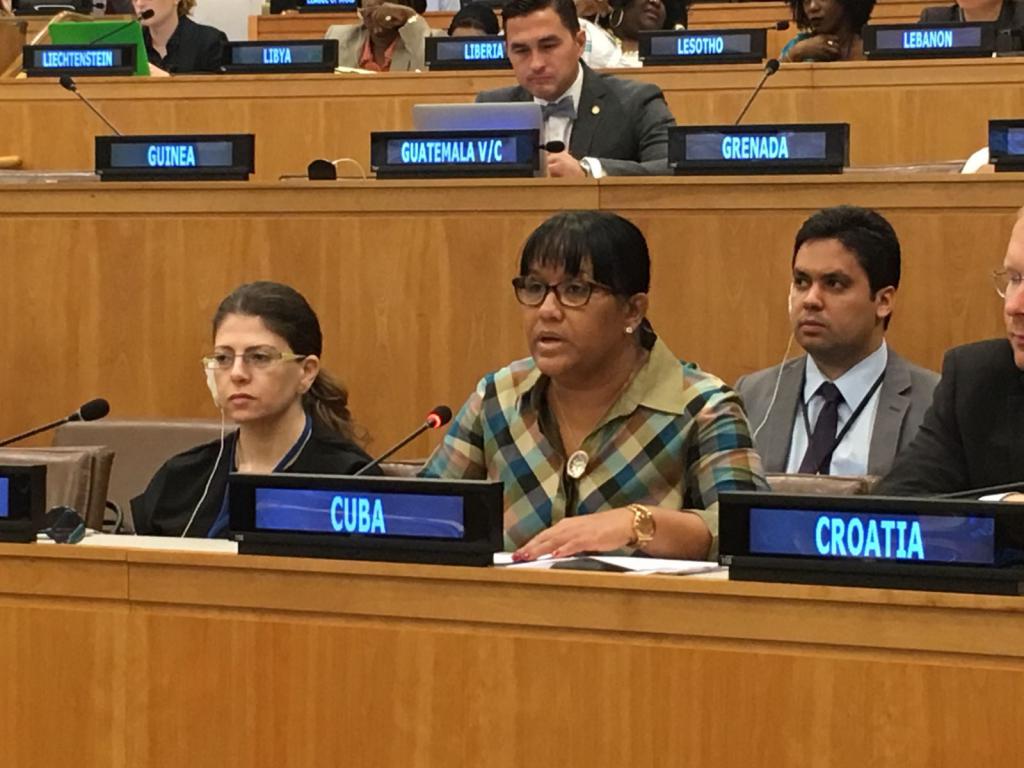
Mr. Chairman,
Cuba recognizes the central role played by the United Nations Office on Drugs and Crime (UNODC) as the center of discussions on these issues within the framework of the United Nations. The Commission on Crime Prevention and Criminal Justice and the Commission on Narcotic Drugs must continue to carry out their work without prejudice in the performance of their functions or duplication by other forums that undermine their authority.
We support the establishment of a Review Mechanism for the United Nations Convention against Transnational Organized Crime and its protocols, with characteristics similar to those established for the United Nations Convention against Corruption. Particular attention should be paid to ensuring its intergovernmental nature, in order not to generate rankings among countries, with a cooperative and non-punitive character and based on peer review procedures.
Cuba stresses the importance of the Congresses on Crime Prevention as a key intergovernmental framework in evaluating and creating non-binding guidelines, as well as facilitating the exchange of information and good practices among States and professionals in this area.
We reiterate that confronting crime does not in itself guarantee its eradication. It must go hand in hand with the fight against underdevelopment and the establishment of a more just, democratic and equitable international order to achieve fairer and more inclusive societies.
Mr. Chairman,
Under item 111 entitled "International Drug Control", we believe that drug abuse and dependence is a serious problem for people's health and a threat to security and economic and social progress. The cost of this scourge is enormous, as it reproduces cycles of poverty, violence, various criminal behaviors and social exclusion.
It will be very difficult to resolve production and trafficking from the impoverished South without eliminating demand in the developed North. The principle of common and shared responsibility is therefore more important today than ever.
The problem will not be solved by militarizing countries, legalizing drugs or assuming them as harmless substances.
We defend the international narcotics regime and intergovernmental bodies on drug control in accordance with the provisions of the three international conventions on the subject. We further stress the importance of the Commission on Narcotic Drugs as the principal United Nations body in addressing the world drug problem.
Mr. Chairman,
At a national level, Cuba has a zero-tolerance policy towards drug production, consumption and trafficking. We fulfill all international obligations to combat organized crime and provide international cooperation in this area, with a remarkable record in dealing with the most prevalent crimes, such as international terrorism, drug trafficking, money-laundering, piracy and trafficking in persons, among others.
Cuba is a State party to the 16 international counter-terrorism instruments and has a general law against terrorist acts. Cuban territory has never and will never be used for organizing, financing or undertaking terrorist actions against any country.
Mr. Chairman,
The practice of producing unilateral reports for qualification of other States is inadmissible and should be abolished.
Cuba reiterates its unwavering commitment to continue fighting transnational organized crime in all its manifestations, as well as the world drug problem and its related crimes.
Thank you