
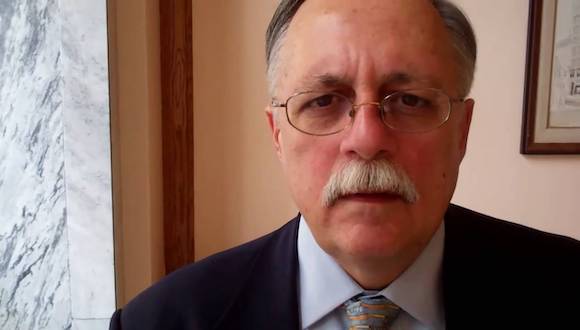
Among the most authoritative voices to explain the complex phenomenon of migration, this Cuban-American lawyer has rare qualities. He is proficient in the subject, having practiced it in US courts for many years. He understands well that the law is not a territory alien to political reason nor is it a fetish that dictates it. You can explain the Cuban immigration issue in comparative terms, for having practiced your trade with migrants from other countries. And do it in a clear and concise language, far from the rhetoric of his trade.
I thank you on behalf of Temas, whose Advisory Board he honors, for the time and promptness with which you have responded to these last-minute inquiries.
Rafael Hernández (RH): According to official sources from the United States, in fiscal year 2022 more than 260,000 Cubans have entered that country, almost all of them irregularly, without visas of any kind, through the Mexican border. What is the legal status granted to those Cubans at the time of entry? Are they classified as refugees? How has this procedure differed from that applied to other migrants from the south who have tried to cross the border in 2022?
José Pertierra (JP): Cubans who enter the United States illegally do so as undocumented. Not as refugees. The Department of Homeland Security (DHS) is required to detain them temporarily.
Before the implementation of the new regulations, on January 9, 2023, Cubans detained while crossing were not expelled expeditiously (like so many other recently arrived undocumented immigrants); they enjoyed the privilege of being released by DHS, on parole or under a promise to appear later in court.
The Cuban Adjustment Act (Public Law 89-732) allows any Cuban who has entered the United States with a visa or parole, to receive (at the discretion of Immigration) permanent residence, as long as they have been physically present in the country. country for more than a year and a day.
In 2017, to prevent Cubans who entered the country irregularly from receiving the benefits of the Cuban Adjustment Act, President Barack Obama ended the policy known as "dry foot/wet foot" and instructed government officials to DHS to not grant them parole. Anyone who had not entered with a visa or parole would not qualify (by definition) for the Cuban Adjustment Act.
To implement President Obama's directive, DHS renamed the legal mechanism for releasing newly arrived Cubans. Instead of granting him parole, he began to release them with something they called "Order for Release on Recognition" (ORR). That is to say, under the promise that the Cuban would appear in court when summoned.
But, in 2021, an Immigration judge in Miami ruled that, according to the Supreme Court of the United States, the only authority DHS has to release newly arrived undocumented immigrants is to grant them parole. In other words, the judge ruled that ORR is a parole by another name. Subsequently, many Immigration judges have followed that interpretation and have been granting Cubans who received ORR residency through the Cuban Adjustment Act, even though they have not received parole. So we see how, in practice, the “dry foot/wet foot” policy returned, despite President Obama's directive.
This is one of the reasons for the massive flow of undocumented Cubans who have illegally crossed the United States border with Mexico. They knew that just by stepping foot on US soil they would receive permanent residence in the United States, even without having to seek asylum or claim persecution in their home country.
Cubans continued to enjoy the privilege that US immigration laws have given them for decades. No other national enjoys the state of grace that Cubans have enjoyed upon arriving in the United States illegally.
RH: Regarding the final legal status of Cuban migrants, are the courts in charge of issuing that ruling? Can some of them be subject to deportation? How many are estimated to be deportable? What would prevent deportables from appealing the Cuban Adjustment Act to remain in the United States?
JP: The new regulation, published on January 9 in the Official Gazette (Federal Register), dramatically changes the rules of the game for Cubans who try to enter the United States illegally: they will be expelled to Mexico or Cuba. If they want to request asylum, they will have to do it online from abroad. The United States does not want to allow them to do so in its territory, if they have entered the country irregularly. The Biden government promises to employ more judges and Immigration officials to expedite the asylum process. And, in order to be able to deport more quickly the Cubans they catch at the border trying to enter illegally, they are going to hire more Border Patrol officers.
I anticipate that lawyers and organizations that defend immigrants will try to challenge this regulation in federal courts, alleging that the Asylum Law does not allow deportation of asylum seekers until they have litigated their cases. And, to try to counter that legal recourse, the Biden government announced that it is preparing another regulation that would disqualify for asylum anyone who, en route to the United States, has passed through a third country and has not applied for asylum there. In other words, they want to close the border to Cubans trying to cross illegally. Trump tried to implement something similar when he was president, and the federal courts blocked the regulation. It would be necessary to see how the Biden government will write the new regulation to avoid being blocked by the courts.
On the other hand, even the old rules of the game are likely to be affected by this change. The 9/01 rule cannot be applied to those who have already entered, but the courts could tighten the screws on the interpretation of the parole and thus disqualify them for residence.
Then, they would have to apply for asylum. They would have to prove to an immigration judge that they fear persecution in Cuba because of their political opinion or membership in a persecuted group. The fear should be reasonable. Cubans have a better chance of convincing a judge about asylum than Central Americans. Even so, if they manage to implement the rule that prevents asylum for those who have passed through a third country before arriving in the United States (and make it retroactive), then it would be difficult for Cubans who entered before the 9/01.
I don't think the priority for the Biden government is to massively deport Cubans who entered before that date. The priority is to stop the flow as of 9/01.
RH: When a Cuban is returned to Cuba by the Coast Guard, can he still aspire to request his entry through legal means? Under US law, could those who entered the border and are deported apply for an immigrant visa or parole or otherwise aspire to enter the country in the future?
JP: Cubans who have been deported from the United States would not qualify for the parole program that President Biden has announced. And to be able to enter through a family petition they would have to obtain a pardon. Something that is not easy.
RH: According to the new regulation in force as of January 9, 2023 for migrants from Nicaragua, Haiti, and Venezuela, does the granting of the parole category represent guaranteed access to permanent residence? Would the Adjustment Act give Cubans guaranteed access over other migrants?
JP: As the Cuban Adjustment Act is still in effect, Cubans who have entered on parole will have the right to apply for permanent residence after having been in the United States for more than a year. On the other hand, Venezuelans, Nicaraguans and Haitians who enter with parole, through the same program, do not have that benefit. Cubans continue to enjoy more privileges than others.
But remember one important thing that few know: the Cuban Adjustment Act is discretionary. In other words, Immigration is not obliged to approve the residence of those who request it.
JP: As the Cuban Adjustment Act is still in effect, Cubans who have entered on parole will have the right to apply for permanent residence after having been in the United States for more than a year. On the other hand, Venezuelans, Nicaraguans and Haitians who enter with parole, through the same program, do not have that benefit. Cubans continue to enjoy more privileges than others.
But remember one important thing that few know: the Cuban Adjustment Act is discretionary. In other words, Immigration is not obliged to approve the residence of those who request it.
If the Biden government decides that the Adjustment Act is not convenient for it, say, for reasons of national security or to more efficiently control the migratory flow of Cubans, the Executive has the legal power to close that path to residence. No need to go to Congress.
The electoral Achilles heel of the Democratic Party in the 2022 elections was the issue of immigration. I think that for the 2024 elections it will be the same. As I mentioned before, the Adjustment Law is not subject to a mandatory standard. It is discretionary. As long as it is not for arbitrary or capricious reasons, the president may dismiss its use. You don't need Congress to do it.
RH: If the United States has recognized that the sanctions against Venezuela and Cuba have had a weight in the increase in the migratory flow, would it be expected that they would be reduced? Could immigration normalization be the path to a process of understanding between the United States and these countries?
JP: Interestingly, the new rule explicitly recognizes that the United States sanctions against Cuba contributed to the massive flow of Cubans who entered illegally in 2022. It says verbatim: “DHS assesses that the high—and rising—number of Cuban nationals encountered at the SWB and interdicted at sea is driven by three key factors: First, Cuba is facing its worst economic crisis in decades due to the lingering impacts of the COVID-19 pandemic, high food prices, and economic sanctions.” (“DHS believes that the high—and growing—number of Cubans arriving at the southwest border and intercepted at sea is due to three factors: first, Cuba is experiencing its worst economic crisis in decades due to the lasting effects of the Covid-19, high food prices and economic sanctions").
The government hopes that the thousands of parole permits that they are going to grant to Cubans, combined with the closure of the border to those who intend to enter irregularly, will solve the problem.
But the magnet that attracts immigrants historically has always been the economy. To get out of poverty, people are willing to scale steel walls and legal hurdles. Washington knows this and that is why it is investing $3.2 billion dollars to strengthen the economic infrastructure of El Salvador, Honduras and Guatemala. Irregular immigration of nationals from those countries has declined. Just like the Mexicans.
However, illegal immigration of Cubans, Venezuelans and Nicaraguans has skyrocketed. It is no coincidence that they come from the countries that Washington has been trying to strangle economically.
If the Biden administration wants to reduce the illegal immigration of Cubans into the United States, it will have to do more than grant a limited amount of parole and try to seal the border. It has to stop suffocating Cuba and allow it to breathe.
I have no doubt that when the Cuban economic situation improves, the illegal immigration of Cubans will decrease enormously. We've seen it before.