
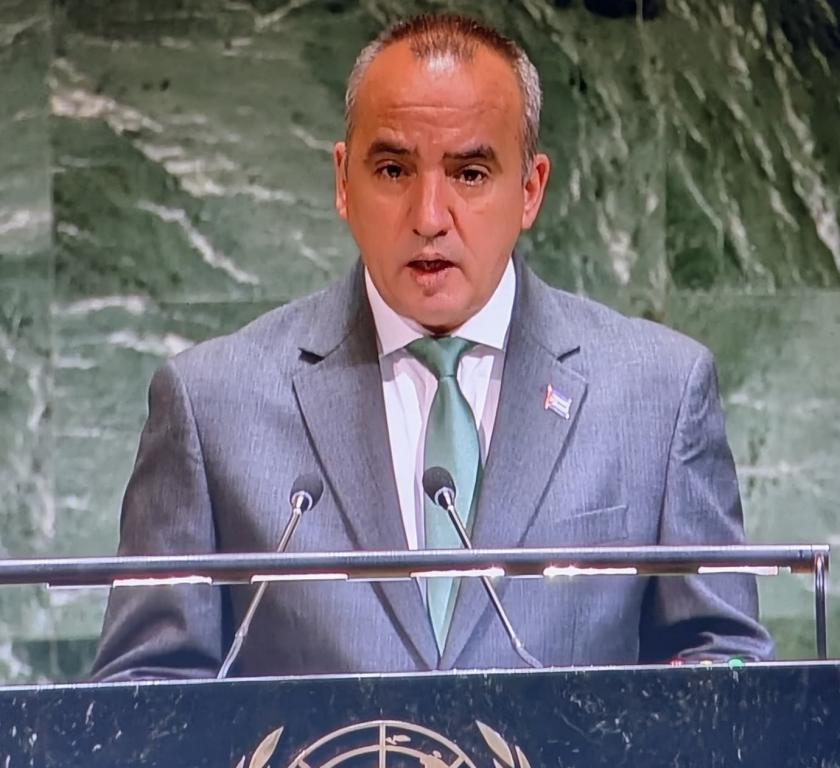
President:
Excellencies,
Cuba aligns itself with the statement made by Iraq on behalf of the G77 and China, and would like to add the following in its national capacity:
The World Summit on the Information Society, which we are celebrating today on its 20th anniversary, clearly established the connection between information and communication technologies and development.
Developing countries succeeded in having the digital divide recognized as a new expression of structural inequality. The summit brought this issue from the technical sphere to the multilateral political agenda.
Today, two decades later, it is beyond doubt that digital technologies are fundamental to the development of countries.
However, it has also been confirmed that these technologies have a considerably smaller positive impact in developing countries than in developed countries.
This inequality is not accidental. It is the result of an unjust and undemocratic international economic order and the implementation of unilateral coercive measures, which violate international law and the Charter of the United Nations and limit development in the affected countries.
In Cuba's case, the illegal economic, commercial, and financial blockade imposed by the United States government for over six decades is the main obstacle to technological, economic, and social development. This blockade prevents Cuba from acquiring technology, accessing financing, and participating fully in the global knowledge economy.
Therefore, we emphasize the urgent need to eliminate the structural barriers preventing emerging digital technologies from contributing to the fulfillment of the 2030 Agenda.
Achieving this would require more than the efforts of developing countries. These efforts must be supported by concrete actions that facilitate access to markets, fair and preferential financing, unconditional technology transfer, and genuine North-South cooperation.
Aligning the implementation of the World Summit on the Information Society, the 2030 Agenda for Sustainable Development, the Pact for the Future, and the Global Digital Compact offers an opportunity to move forward in this direction and strengthen international cooperation.
Nevertheless, the monitoring and evaluation framework must be rational and inclusive. It should strengthen intergovernmental spaces so that all governments, particularly those of developing countries, can fulfill their roles and responsibilities in the global digital governance. Active participation of the countries of the South in discussions on decisions that directly affect them is imperative.
President:
Excellencies:
The Declaration of Principles from the first stage of the World Summit on the Information Society established a shared vision of building “a people-centered, inclusive, and development-oriented Information Society”, where everyone has the opportunity to create, share, and use knowledge to improve their lives.
Unfortunately, this noble goal remains an aspiration for a great portion of humanity.
It is now up to us to make a reality of that common vision envisaged 20 years ago.
Let’s ensure that Information Society becomes an effective right for all peoples, not just an unfulfilled promise!
Thank you