
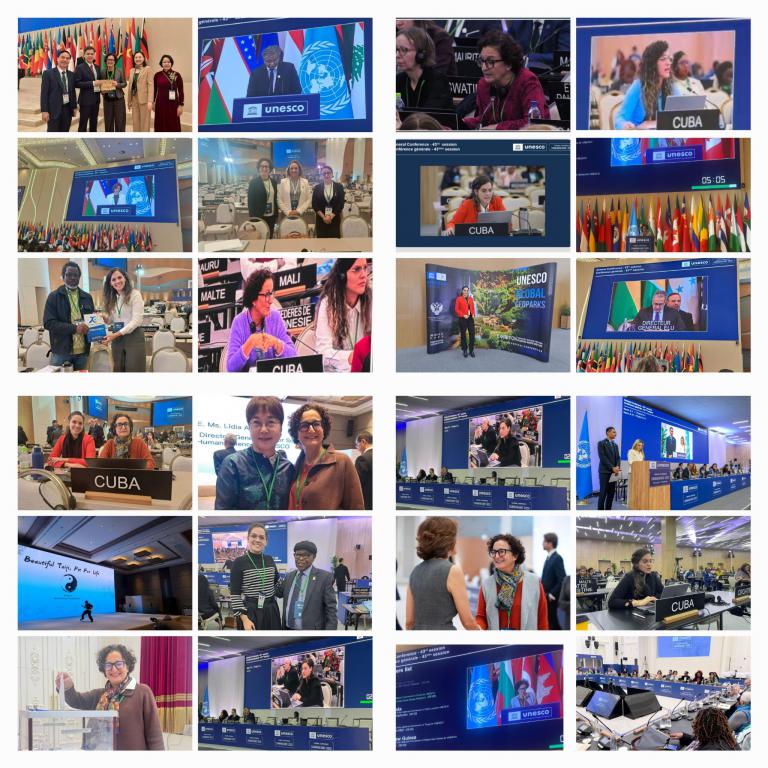
Samarkand, 16 November 2025. — The 43rd session of UNESCO’s General Conference successfully concluded on 16 November 2025 in the city of Samarkand, Uzbekistan, with significant results for the Organization and notable participation and contributions by the Cuban delegation.
This historic session took place from 30 October to 16 November 2025 and marked the first time in the last 40 years that the General Conference was held outside UNESCO Headquarters in Paris, bringing together delegates from more than 190 Member States and Observers, Heads of State, ministers and representatives of partner organizations to define cooperation priorities in education, science, culture, information and communication.
Among the most notable outcomes of the 43rd General Conference was the election of Dr Khaled El-Enany as the new Director-General of UNESCO, marking a leadership transition that reflects Member States’ confidence in promoting multilateral cooperation in times of global complexity. During the session, the Recommendation on the Ethics of Neurotechnologies was also unanimously adopted, constituting the first global normative initiative of its kind and consolidating UNESCO’s role as a reference point in the ethical governance of emerging technologies.
The Cuban delegation, headed by Dulce María Buergo Rodríguez, President of the Cuban National Commission for UNESCO, and including Laura Álvarez Delgado, Third Secretary of the Permanent Delegation of Cuba to UNESCO, actively participated in the General Policy Debate and in the various commissions, highlighting actions such as:
- The systematic denunciation of the impact of the intensified economic, commercial and financial blockade imposed by the Government of the United States in all areas of competence of the Organization, affecting the full enjoyment in Cuba of rights such as education, science, communication and culture, as well as international development cooperation.
- The defense of UNESCO’s role as a space for multilateral cooperation and solidarity, and as a promoter of inclusive policies responding to global challenges.
- Exchanges with the Director-General-elected through meetings with representatives of Small Island Developing States and new members of UNESCO’s Executive Board, of which Cuba is a member, where common priorities were shared to strengthen regional and global cooperation.
- Exchanges with authorities and representatives of other nations, including Viet Nam, Timor-Leste, South Africa, Jamaica, France, Angola, China, Russia and the host country Uzbekistan, among others.
- Securing Cuba’s membership in the governing body of the International Institute for Higher Education in Latin America and the Caribbean (IESALC) and in the Intergovernmental Council of the International Programme for the Development of Communication (IPDC).
The Cuban delegation also reaffirmed commitments during forums and side events, including meetings on cultural heritage, education, science and technical cooperation networks, as part of ongoing efforts to promote multilateral initiatives.
UNESCO’s General Conference, the Organization’s supreme governing body, meets every two years and is essential for defining the policies, budget and strategic priorities guiding UNESCO’s work for the following biennium, consolidating its role as a platform for cooperation among States to address global challenges through shared knowledge, culture and science.