
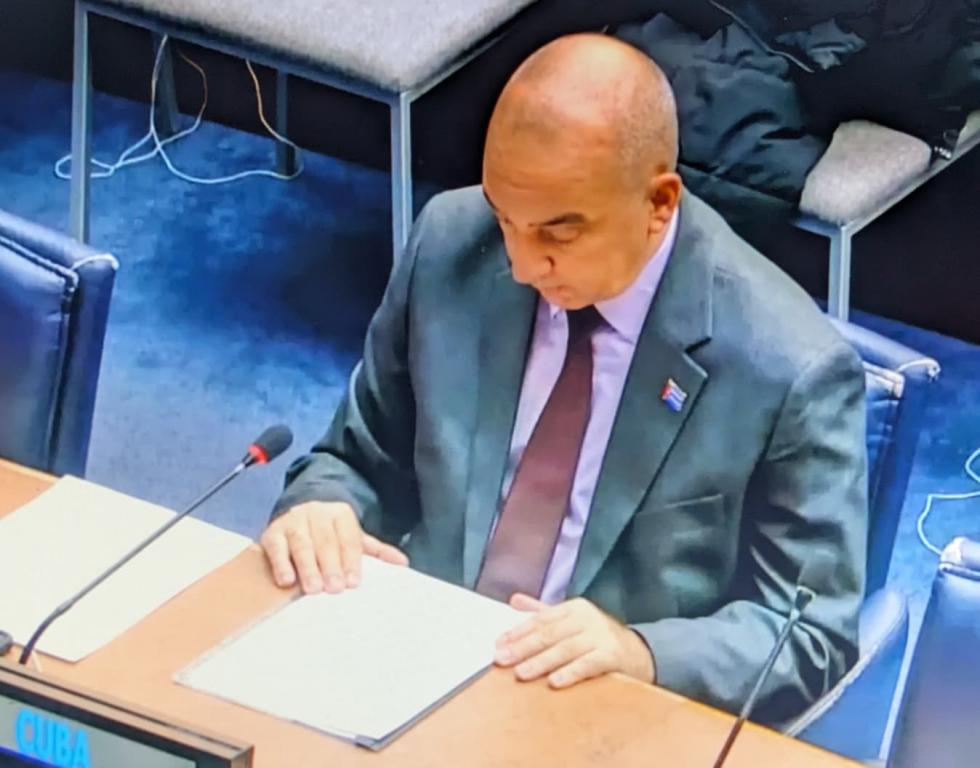
Ms President:
Allow me to begin by expressing my sincere gratitude for the support and trust placed in Cuba to assume the Vice-Chairmanship of this important Committee. We take on this responsibility with a profound sense of commitment.
In this regard, I wish to extend my congratulations on your election as Chairwoman, as well as to my colleagues from Indonesia, Sierra Leone, and Syria, who will also continue to serve on the Committee. You may count on our full cooperation and commitment to advancing the completion of the decolonization process.
On the sixty-fifth anniversary of the establishment of the Special Committee on Decolonization, the historic promise to definitively eradicate colonialism remains unfulfilled. As long as even a single people continues to be subjected to that scourge, the decolonization efforts of the United Nations, grounded in the principle of equal rights and the self-determination of peoples, cannot be considered complete.
Rejecting that humiliating form of domination, as well as repudiating new neocolonial and hegemonic practices, is our moral duty to humanity and a demonstration of our utmost respect for the values and principles on which this Organization is founded.
The end of colonialism in all its forms and manifestations requires political will, collective action, and the definitive elimination of blockades and unilateral coercive measures that seek to impose economic models, political systems, or forcible regime change.
After centuries of anti-colonial struggle, the renewed colonial aspirations embodied in the obsolete Monroe Doctrine are once again looming over our region with singular force, threatening peace and regional and international stability and disregarding the principles of the Proclamation of Latin America and the Caribbean as a Zone of Peace. The imposition of an imperialist doctrine of “peace through force” threatens the future of humankind with terror, arms build-up and global destabilization.
The Government of the United States, whose country intervened in Puerto Rico more than 127 years ago and has since maintained its colonial domination over that sister Caribbean nation, is today intensifying its aggression against Cuba. It seeks, in vain, to deny our sovereignty in order to impose its neocolonial interests through force, threat and coercion. Cuba will not yield to blackmail, nor will it waver in the defense of its independence, achieved in the heat of our historic struggle against colonialism.
In this context, we reiterate our full support for the holding of the next Regional Seminar on the Decolonization of the Caribbean in the sister nation of Nicaragua, from 25 to 27 May of this year. We are convinced that it will be a successful event of the highest relevance and pertinence in the current context, in which imperialist intentions to seize, by force, the natural resources of the peoples of the region have intensified. These acts of such brutality were once thought to have been relegated to history. The Seminar, to be hosted by a country engaged in a firm struggle for national liberation, will contribute to our collective efforts in favor of decolonization.
Ms. President:
The decolonization process, which enabled the self-determination and independence of several peoples and territories under colonial domination, is considered as one of the most significant changes of the twentieth century. Let us prevent the remains of this scourge from spreading with new forms of domination and neocolonial subjugation.
Cuba will continue to defend the rights of peoples to self-determination and to build a future of well-being, socioeconomic progress, independence, sovereignty and dignity.
The hopes of the peoples of the colonial countries and territories are vested in the United Nations. To remain indifferent to their situation would be an irreparable mistake.
Thank you very much.