
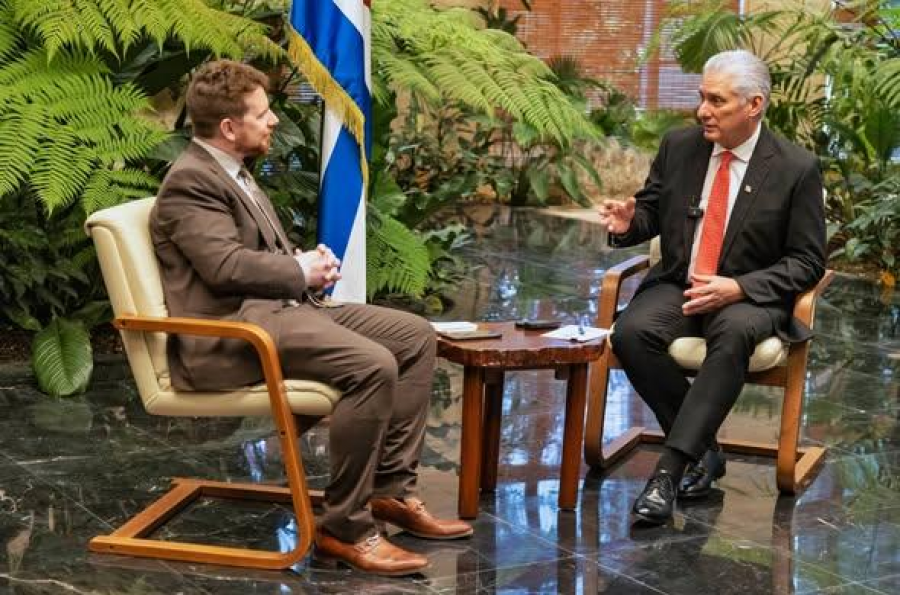
Excerpts from the interview with President Miguel Díaz-Canel Bermúdez and Tom O’Connor, senior foreign policy editor and deputy editor of national security and foreign policy at Newsweek
April 7, 2026
Newsweek: You have confirmed that the United States and Cuba are in talks and have proposed areas of cooperation such as science, migration, and the fight against drug trafficking. President Trump seems to be seeking regime change. Do you think it is possible to reach an agreement and that diplomacy could prevail?
Díaz-Canel: I believe dialogue is possible, and I believe we can reach some agreements, but it is difficult. Why can we say these two things?
We can engage in dialogue because, throughout all the years of the Revolution, there has always been a willingness on Cuba’s part to maintain a civilized, neighborly relationship with the United States, regardless of our ideological differences.
There are many common areas where we can work together, and not only could we do so, but we could reach agreements that are beneficial to both peoples and both nations.
That said, we have always maintained that it must be a respectful dialogue, on equal terms, with respect for our sovereignty, our political system, and our self-determination, and based on reciprocity and observance of international law.
I also say that dialogue is possible because, at different times with other U.S. administrations, we have been able to engage in dialogue and address issues of common interest. In some cases, we have been more successful than in others. But these two reasons explain why that possibility exists.
On the other hand, what factors hinder this dialogue? First, in the United States, within U.S. society, there are sectors that firmly oppose any kind of dialogue with Cuba.
Furthermore, this is an asymmetrical relationship between Cuba and the United States, where the United States, as the superpower, has always played the role of aggressor, and the small island of Cuba has always been the nation and country under attack.
We have frequently held talks and reached agreements, and Cuba has always fulfilled its commitments. However, on several occasions, the U.S. government has failed to honor its own.
But, on the other hand, for 67 years there has been, on the part of the United States, a policy of hostility, aggression, and threats—a policy of blockade, of intensified blockade, and now, even more intensified, with the cruel energy blockade.
It is evident that our country is suffering multidimensional aggression from the United States, with a devastating effect on people’s lives.
On the other hand, there are the current actions of the U.S. government: proposing supposed talks with other nations only to attack them later. All of this, without a doubt, breeds mistrust among our people.
But I do believe that we can engage in dialogue and negotiations and reach agreements. We can reach agreements on issues such as migration, security, the environment, science and innovation, trade, education, culture, and sports. We can also attract investment from U.S. companies in Cuba and develop trade between our two countries.
We can also implement mutually beneficial project programs in various sectors of our economy. If dialogue is consolidated and agreements are reached in this area, I am certain they will be mutually beneficial for both nations and both peoples.
This would allow us to take firm steps toward creating spaces for understanding that move us away from confrontation. Because what I believe is that the Cuban and American peoples deserve to be able to work in a climate of peace, friendship, and cooperation, rather than being embroiled in a war.
Newsweek: You mentioned that this U.S. administration has a history of taking military action in the midst of negotiations. We have seen this in the cases of Iran and Venezuela, and President Trump has said in some of his statements that Cuba could be next. If diplomacy fails or does not achieve the desired results, are you concerned about a possible U.S. military operation against Cuba? Is there a strategy to defend against it?
Díaz-Canel: Cuba is not a country of war. It is a country of peace that promotes solidarity and cooperation. But Cuba does not fear war. We have a defense doctrine called “the war of the entire people,” which is not an aggressive doctrine, but a defensive one, involving the entire population.
Cuba does not pose a threat to the United States, much less an “extraordinary and unusual” threat, as has been claimed to justify the executive order. And I am not saying this simply in response to your question, but because Cuba has demonstrated this throughout its history in the context of the United States and the world.
(EmbacubaFiyi - Granma)