
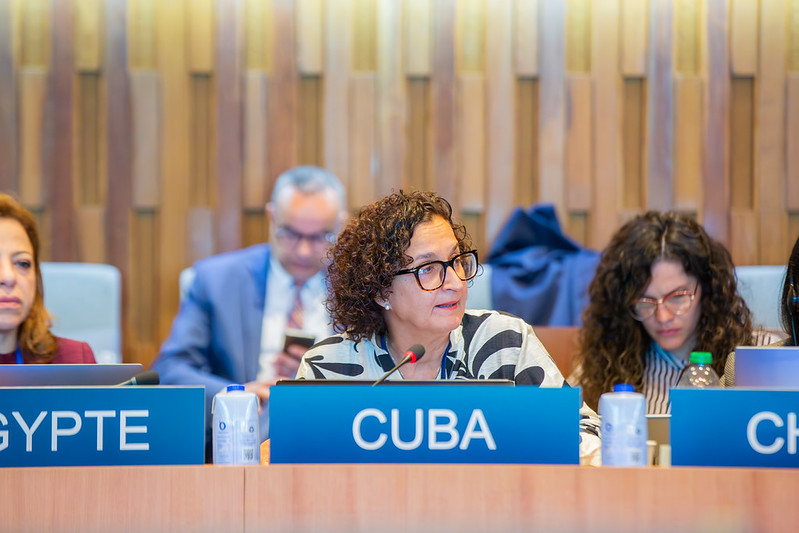
Paris, 23 April 2026.– The 224th session of the Executive Board of UNESCO, held from 8 to 23 April 2026 at the Organization’s Headquarters, provided a platform for Cuba to reaffirm its commitment to peace, multilateralism, and international cooperation, while denouncing the tightening of hostile policies by the United States against the Island.
During her statement before the Executive Board, the President of the Cuban National Commission for UNESCO and Representative of Cuba to this body, Dulce María Buergo Rodríguez, warned about the current international context, marked by growing tensions, interventionist practices, and doctrines that promote “peace through force,” to the detriment of international law and State sovereignty.
Cuba underscored the inescapable responsibility of the international community to promote a truly just, democratic, and equitable order, based on respect for the sovereign equality of States, the right of peoples to self-determination, and genuine cooperation. In this regard, it highlighted the fundamental role of UNESCO as a platform for multilateral dialogue and the promotion of peace, stressing that without peace, the Organization’s programmes and mandates cannot advance.
In its statement, the Cuban delegation denounced that the country has endured for more than six decades the longest sustained economic aggression in contemporary history. This is compounded by Cuba’s arbitrary inclusion on the list of States allegedly sponsoring terrorism, as well as new coercive measures, including a recent executive order aimed at tightening the blockade on fuel supplies, with the objective of causing economic and human damage to undermine national sovereignty.
Cuba reiterated that it will never renounce its sovereign right to build its own development model, nor its commitment to contributing to a more just, supportive, and peaceful world.
The delegation also expressed its gratitude to countries and partners that have shown solidarity with Cuba, as well as for the continued support of UNESCO, both from Headquarters and its Office in Havana, in advancing the Organization’s agenda in the country and the region.
Despite the complex context, Cuba reaffirmed its willingness to continue promoting international cooperation initiatives, including South-South, North-South, and triangular cooperation modalities, highlighting their importance in strengthening intersectoral approaches and addressing global challenges more effectively, in line with Cuba’s experience in areas such as health.
In this context, Cuba expressed its support for the UNESCO 80 Roadmap, promoted by the Director-General, aimed at strengthening coordination, avoiding duplication, and generating synergies within the Organization and across the United Nations multilateral system.
The Cuban delegation strongly condemned the genocide against the Palestinian people and reiterated the urgent need to achieve a just, comprehensive, and lasting solution to the conflict in the Middle East, based on the creation of two States that would guarantee the full exercise of the Palestinian people’s right to self-determination. It also expressed concern over the growing instability in the region, particularly regarding attacks against Iran and Lebanon.
Finally, recalling the historic leader of the Cuban Revolution, Commander-in-Chief Fidel Castro Ruz, in the year marking the centenary of his birth, Cuba reiterated its urgent call for peace, unity, and international cooperation in an increasingly complex global context, underscoring the continued relevance of these principles on the occasion of UNESCO’s 80th anniversary.